Jennifer Sudkamp, Neil Roach, Shaun Beebe, Jessica Metcalf, and Paul McGraw · Ergonomics · Published online July 31, 2025; print issue September 2026
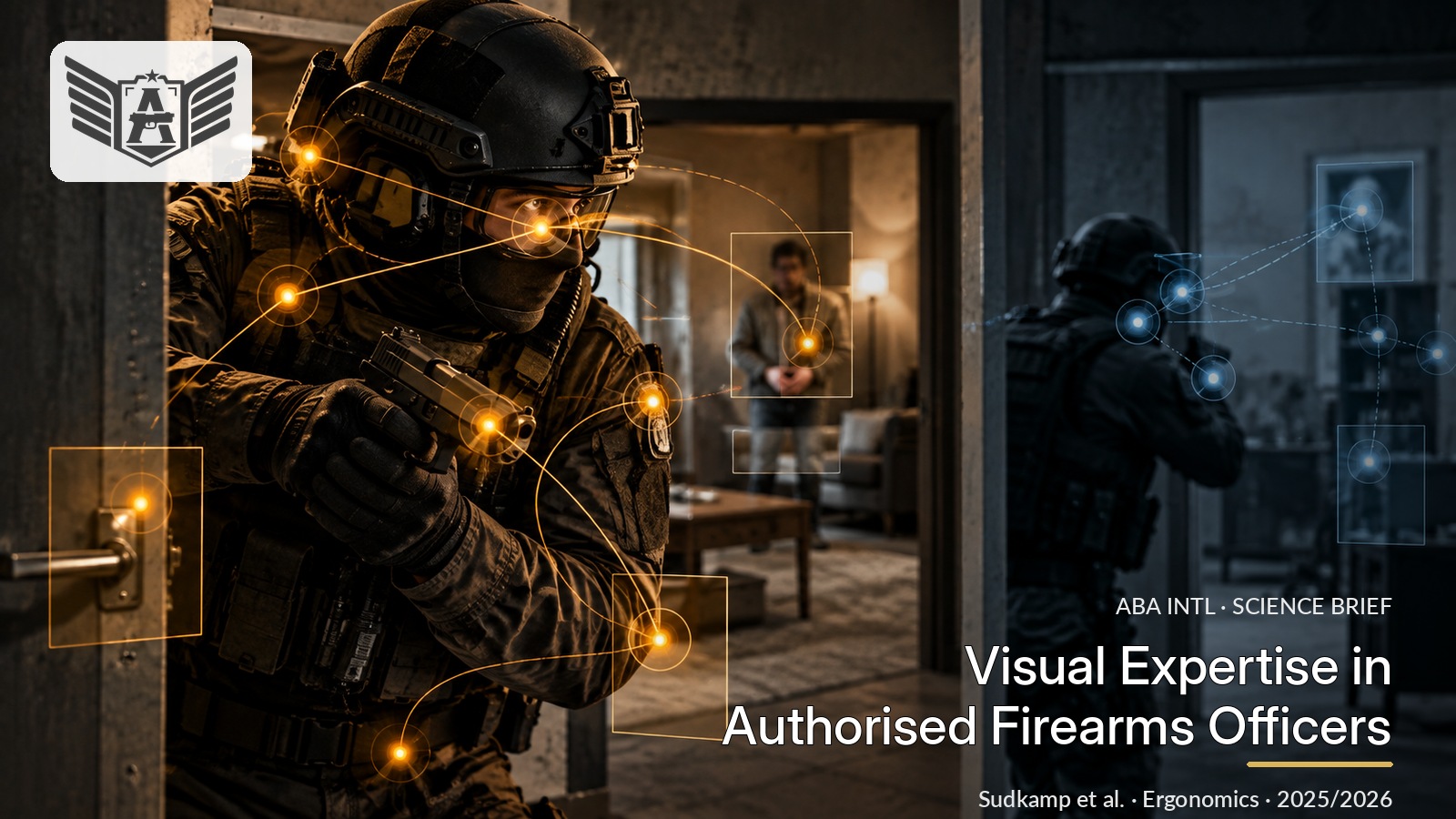
Mobile eye tracking in British Authorised Firearms Officers reveals measurable differences in visual sampling between experienced and novice officers.
Jennifer Sudkamp, Neil Roach, Shaun Beebe, Jessica Metcalf, and Paul McGraw examined visual expertise among British Authorised Firearms Officers in “Expertise modulates visual sampling strategies in authorised firearms police officers.” The article was first published online by Ergonomics on July 31, 2025 and subsequently appeared in the September 2026 print issue, Volume 69, Issue 9, pages 1769–1785. The distinction matters because the article is correctly cited as a 2025 online publication even though its paginated print issue carries a 2026 date.
The investigators recruited 22 British police officers. Ten were experienced Authorised Firearms Officers with at least eight years in the role and an average of 19.6 years of firearms-officer experience; these officers were also qualified tactical-training instructors. Twelve officers were classified as novices because they had recently entered the Authorised Firearms Officer training program and had received only introductory firearms handling at the time of testing. Participants completed interactive video-based tactical scenarios while wearing mobile eye-tracking equipment. The scenarios included ambiguous conflict situations in which officers had to search, interpret behavior, communicate, and determine appropriate operational responses.
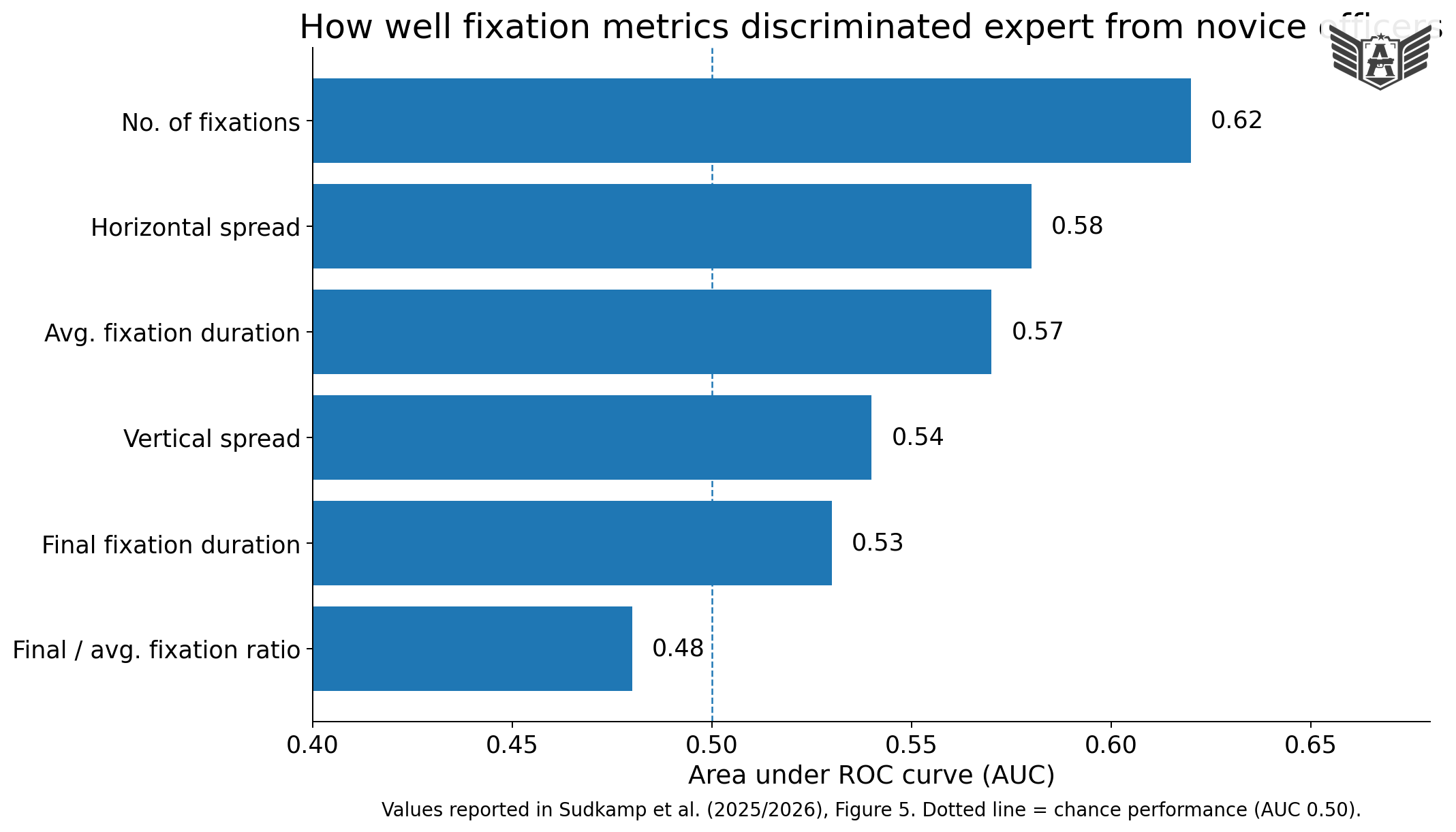
The expert and novice groups differed not only in where they looked but also in how they sampled the environment. Across scenes, experts tended to make more fixations of shorter average duration and to distribute those fixations across a wider horizontal area. Table 2 reported an average fixation duration of 709.3 ms for experts and 944.68 ms for novices, with experts averaging 17.40 fixations compared with 14.45 among novices. Receiver-operating-characteristic analysis showed that the number of fixations was the single most discriminative metric, with an AUC of 0.62, followed by horizontal spread at 0.58 and average fixation duration at 0.57. These are moderate rather than decisive classification values, but they demonstrate that visual-sampling behavior contained measurable information about expertise.
Another important result concerned gaze consistency. Experts’ gaze locations were more similar to those of other experts, particularly when a suspect was temporarily hidden or obscured. This suggests that expert visual behavior reflected expectations about where relevant information might reappear rather than dependence only on immediately visible stimuli. Immediately before operational responses, experienced officers also tended to increase fixation duration, consistent with more deliberate visual preparation. The authors additionally tested saliency models and found that a model combining low-level salience with attention to suspects’ waistlines best accounted for officers’ actual gaze locations.
The study should not be treated as establishing a universal “correct gaze pattern.” The sample was small, the expert group was older than the novice group, the scenarios were simulator-based, and participants came from a specific British firearms-policing context. Nevertheless, the research provides measurable candidates for studying the development of visual expertise: fixation count, fixation duration, spatial distribution, gaze similarity, and visual behavior immediately before action. Its most important implication is that expertise may be visible before the motor response begins, at the level of information acquisition and expectation. Measuring only final accuracy or response time can therefore miss a substantial part of the performance process.
Original article visual: The article is CC BY 4.0. Open the publisher page and select Figure 5 or Figure 6 for the original visual.
Context and Scientific Interpretation
The purpose of this ABA Intl Science Brief is scientific communication rather than the creation of a new clinical, legal, or operational standard. Results should be interpreted within the population, measurement protocol, and statistical design used by the original investigators. Where ABA Intl has redrawn numerical results, the values are taken directly from the published article and the visualization is identified as an ABA Intl graphic rather than as an original publisher figure.
Reference
Sudkamp, J., Roach, N., Beebe, S., Metcalf, J., & McGraw, P. (2025). Expertise modulates visual sampling strategies in authorised firearms police officers. Ergonomics. https://doi.org/10.1080/00140139.2025.2540417
A source-based visual summary of the study is provided below. The figure caption identifies whether it reproduces reported values, study structure, or qualitative themes.
TRAIN. MEASURE. EQUIP.
Continue learning through ABA research and training. When equipment is the next variable, go directly to the ABA Store.
GET THE EQUIPMENT →Continue from research to practice
Knowledge is useful when it changes what you do next.
Use this evidence to identify the next capability you need to build and the ABA route designed for it.
Find your ABA training path