Rangxi Jin et al. · Scientific Reports 16, 23617 · Published July 29, 2026
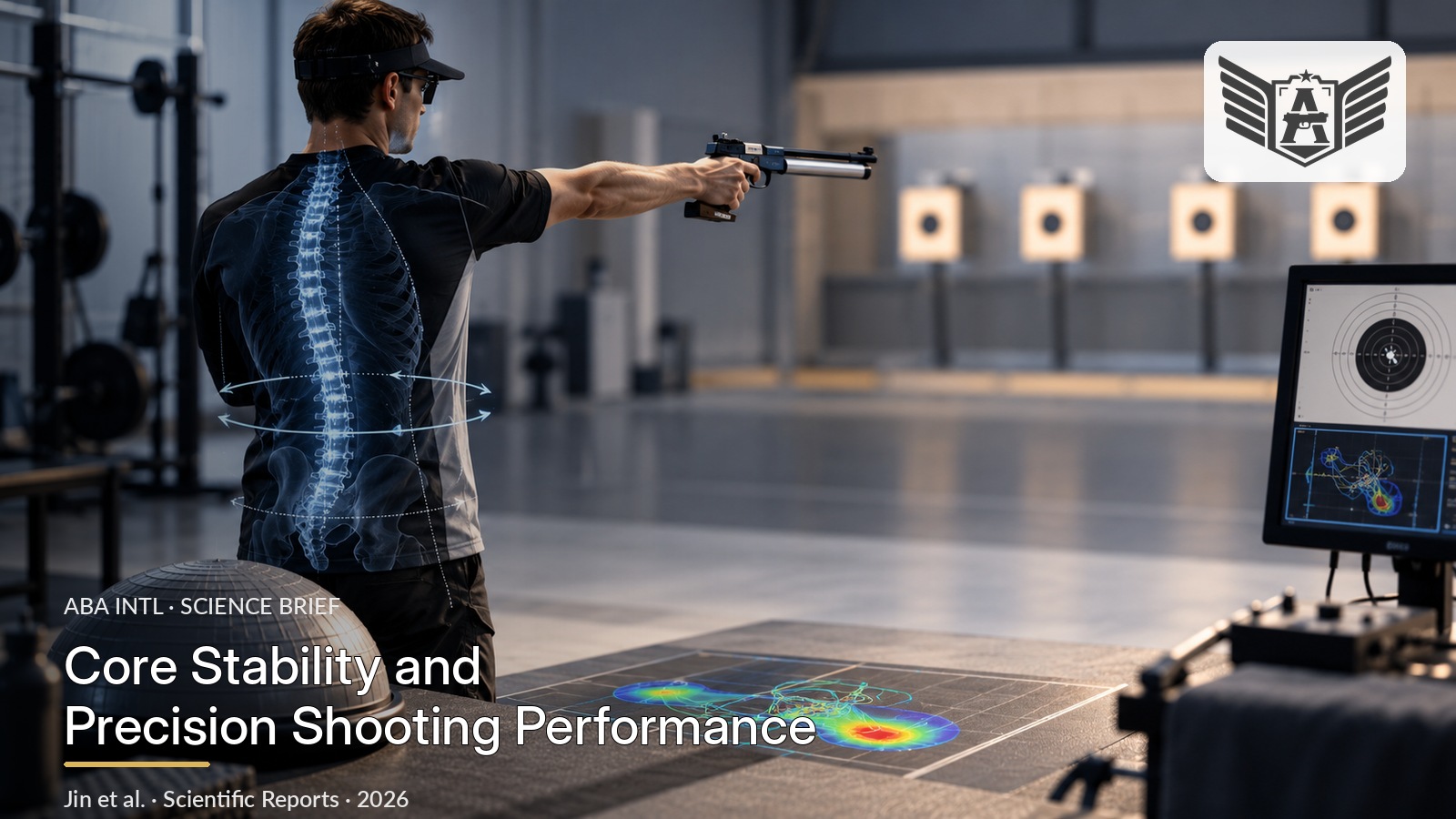
A 2026 pilot randomized trial compared stable and unstable trunk-core training in national-level 10 m air-pistol athletes.
On July 29, 2026, Scientific Reports published “Unstable trunk core strength training improves shooting performance and holding stability in elite 10 m air pistol athletes: a pilot randomized controlled trial,” by Rangxi Jin, Zhen Niu, Chao Chen, Mitchell James Finlay, Francisco Cuenca-Fernández, Yijie Ma, Yuming Zhong, and Xianfu Song. Unlike the police-focused studies discussed elsewhere in this series, this investigation involved national-level competitive air-pistol athletes. That distinction is essential because the movement, perceptual, environmental, and decision demands of 10-meter precision competition differ substantially from operational pistol use.
Twenty national-level 10-meter air-pistol shooters were randomly allocated to one of two eight-week conditioning programs. Ten completed unstable trunk core strength training using implements such as Swiss balls, BOSU balls, and balance discs, while ten performed comparable trunk exercises on stable surfaces. Before and after the intervention, investigators measured postural behavior using center-of-pressure variables and shooting-specific performance using a SCATT electronic training system. Measures included shooting score, stability within the 10- and 10.5-ring zones, muzzle behavior during the final second before firing, aiming time, and aim-to-trigger deviation.

The unstable-training group showed larger numerical improvements across several outcomes, including shooting score, 10.5-ring stability, center-of-pressure measures, muzzle behavior, and aim-to-trigger deviation. The largest between-group difference occurred in 10.5-ring stability: the stable-surface group improved by 6.48%, whereas the unstable-surface group improved by 31.55%. The Time × Group interaction for this measure remained significant after false-discovery-rate correction. Muzzle oscillation velocity also retained significance after correction, with the stable group reducing velocity by 4.05% and the unstable group by 8.74%. Several other initially significant outcomes did not survive correction and were appropriately treated by the authors as exploratory.
This statistical distinction is important because the paper could otherwise be summarized too broadly as evidence that unstable core training improves every dimension of shooting performance. It does not. The trial was intentionally small and described as a pilot study, and multiple-comparison correction reduced the number of robust between-group findings. The strongest result concerns high-precision holding stability rather than a generalized improvement across every shooting variable.
The study is nevertheless informative from a motor-control perspective. Precision pistol shooting requires a stable relationship among the body, the weapon, the aiming system, and the target. Trunk stability may influence the regulation of small postural movements and the transfer of motion across the kinetic chain. Training on unstable surfaces imposes greater proprioceptive and neuromuscular demands, creating a plausible mechanism for transfer to fine postural control. However, competitive air pistol remains a highly controlled precision task. Operational or defensive shooting can involve locomotion, time pressure, visual search, uncertainty, recoil management, multiple targets, and complex decisions. The present results therefore support a narrow conclusion: in this small sample of elite air-pistol athletes, unstable trunk training produced larger improvements in selected precision-stability measures than comparable stable-surface training.
Context and Scientific Interpretation
The purpose of this ABA Intl Science Brief is scientific communication rather than the creation of a new clinical, legal, or operational standard. Results should be interpreted within the population, measurement protocol, and statistical design used by the original investigators. Where ABA Intl has redrawn numerical results, the values are taken directly from the published article and the visualization is identified as an ABA Intl graphic rather than as an original publisher figure.
Reference
Jin, R., Niu, Z., Chen, C., et al. (2026). Unstable trunk core strength training improves shooting performance and holding stability in elite 10 m air pistol athletes: a pilot randomized controlled trial. Scientific Reports, 16, 23617. https://doi.org/10.1038/s41598-026-64539-z

TRAIN. MEASURE. EQUIP.
Continue learning through ABA research and training. When equipment is the next variable, go directly to the ABA Store.
GET THE EQUIPMENT →Continue from research to practice
Knowledge is useful when it changes what you do next.
Establish a baseline, locate the limiting factor and measure whether training produced a real change.
Ask about ABA | Performance