Aerobic fitness is sometimes presented as a general badge of
readiness and sometimes dismissed because a firearm task can be
completed in seconds. Both positions miss its operational role. Aerobic
capacity supports repeated movement, heat management, recovery between
bouts, and the ability to begin a fine-motor or decision task after
locomotion. It does not directly measure judgment, marksmanship, or
technical competence. The useful question is how cardiorespiratory
capacity changes the performer’s recovery curve across representative
sequences.
Oxygen uptake reflects an integrated system. The heart must deliver
blood, the lungs must exchange gases, the vasculature must distribute
flow, and skeletal muscle must extract and use oxygen. Petek, Gustus,
and Wasfy (2021) describe cardiopulmonary exercise testing as a way to
assess this integrated cardiac, pulmonary, vascular, and musculoskeletal
response. A single peak value is therefore the output of multiple
interacting components, not an isolated property of the lungs.
VO₂peak or VO₂max is commonly expressed in absolute liters per minute
and relative milliliters per kilogram per minute. Relative values
facilitate comparison across body sizes but can disadvantage heavier
individuals even when absolute work capacity is useful. Absolute values
can hide the metabolic cost of moving body mass and equipment.
Interpretation should match the task rather than selecting whichever
expression flatters the performer.
Peak oxygen uptake is not the only relevant measure. Ventilatory
thresholds help describe the intensity at which ventilation and
metabolism begin changing disproportionately, while heart-rate recovery
provides information about postexercise autonomic adjustment. Oxygen
pulse, ventilatory efficiency, breathing reserve, and exercise
electrocardiography can reveal different limitations. A performance
program should avoid reducing CPET to a leaderboard.
Athletes differ from general-population reference groups. Petek et
al. (2021) note that trained individuals can show higher cardiac output,
faster heart-rate recovery, higher peak oxygen uptake, lower breathing
reserve, and a higher prevalence of exercise-induced arterial hypoxemia.
A value flagged as unusual by a general equation may be normal for an
athlete, while a “normal” predicted peak can provide false reassurance
when the individual previously had substantially greater capacity.
The same caution applies to tactical populations. Body armor, load
carriage, intermittent sprints, awkward movement, and heat create
demands not represented by a standard cycle or treadmill ramp. CPET
characterizes capacity and can support clinical evaluation, but the
transfer test remains occupational. An instructor should not infer that
a high VO₂peak guarantees effective movement with equipment or valid
decisions afterward.
Aerobic capacity matters most across repeated bouts. A single short
effort can rely heavily on anaerobic energy systems, but recovery
between efforts depends substantially on oxidative metabolism. A fitter
performer may restore phosphocreatine, reduce ventilation, and regain
attentional stability more rapidly, allowing the next action to begin
from a better state. The benefit is a series-level capability, not
necessarily a faster first five seconds.
Anaerobic threshold language requires care. The ventilatory or
lactate thresholds are method-dependent transition regions, not a switch
from aerobic to anaerobic metabolism. Energy systems operate together
across intensities. The supplied didactic review on anaerobic threshold
emphasizes how terminology and measurement can create confusion when
complex bioenergetics are converted into one breakpoint (Gomes et al.,
2009). Programs should state how a threshold was identified before using
it for zones.
Field tests can be valuable when laboratory testing is unavailable,
but prediction error must be acknowledged. Shuttle runs, timed
distances, step tests, and submaximal protocols estimate different
aspects of performance. Environmental conditions, motivation, pacing,
body mass, and familiarity affect results. Repeated use of the same
standardized test is often more useful for monitoring change than
comparing an individual with a generic norm.
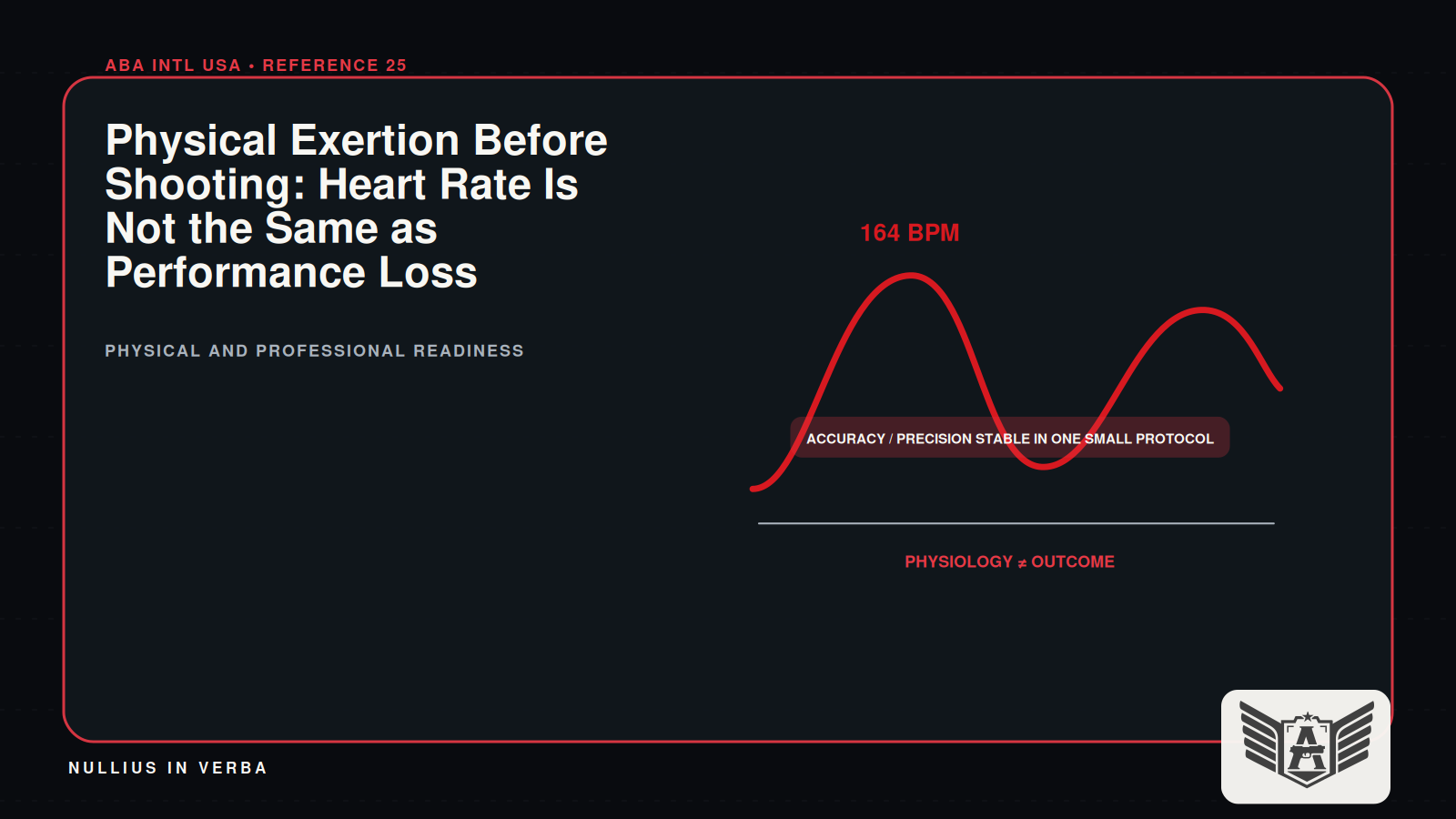
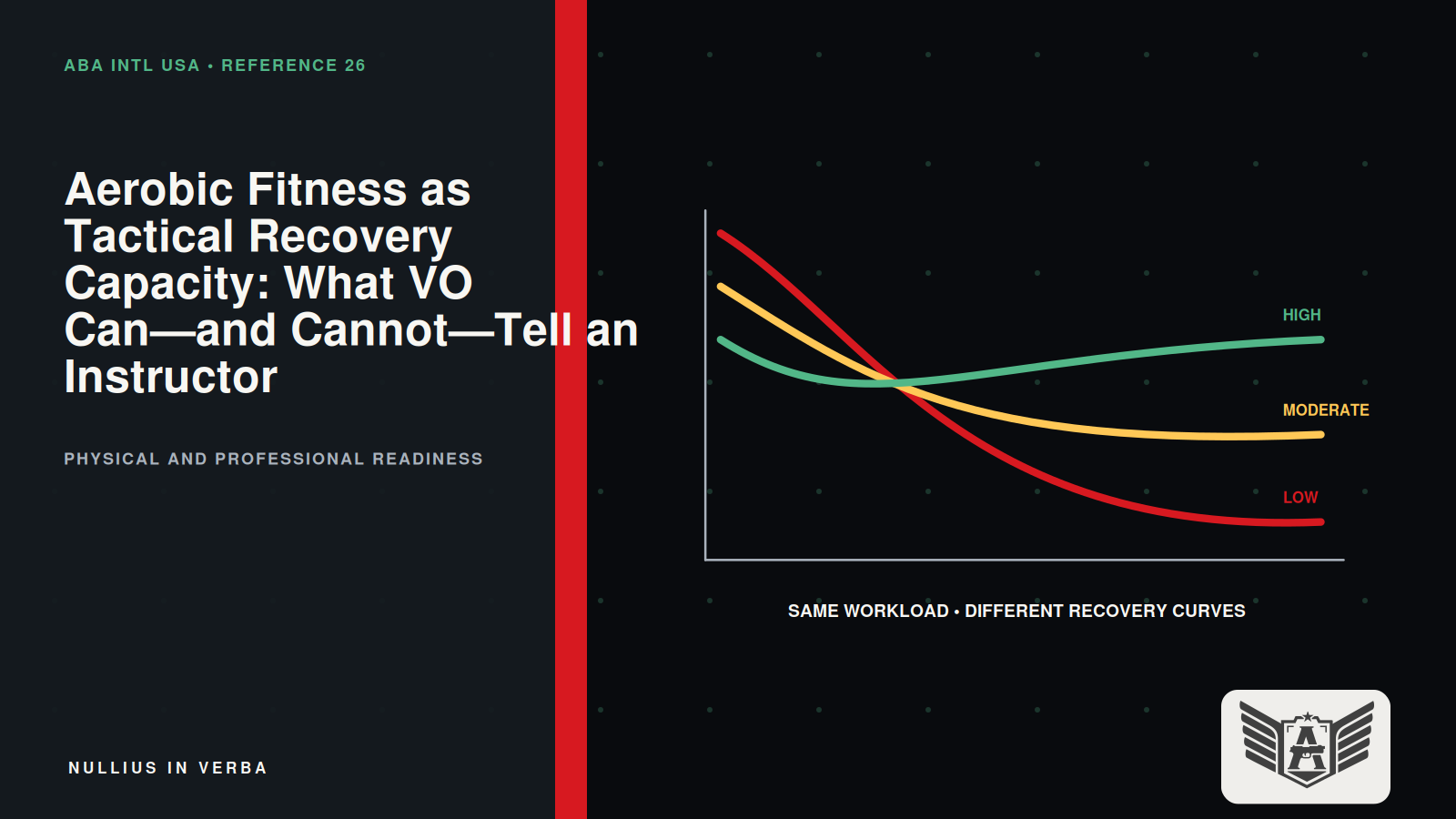
Recovery metrics connect fitness to firearms performance. After a
defined work bout, the program can record time until ventilation permits
clear communication, heart-rate recovery at fixed intervals, perceived
exertion, decision validity, and the return of stable technical
performance. The resulting curve shows when capability returns, not
merely how high heart rate rose. Different performers may reach the same
peak and recover very differently.
Programming should combine aerobic base, higher-intensity intervals,
strength, movement skill, and task-specific practice. Excessive
endurance volume can compete with strength or recovery, while
insufficient aerobic work can make every demanding session more
fatiguing. The appropriate balance depends on role, schedule, injury
history, and current limitation. A doctrine of “more conditioning” is no
more precise than a doctrine of more ammunition.
Clinical boundaries are essential. Unexplained exertional chest pain,
syncope, abnormal dyspnea, palpitations, or an unexpected decline in
capacity requires qualified medical evaluation. Petek et al. (2021)
emphasize that CPET can help evaluate symptoms and established
cardiovascular disease in athletes. A firearms instructor should not
interpret a medical exercise test beyond scope or train through red
flags in the name of resilience.
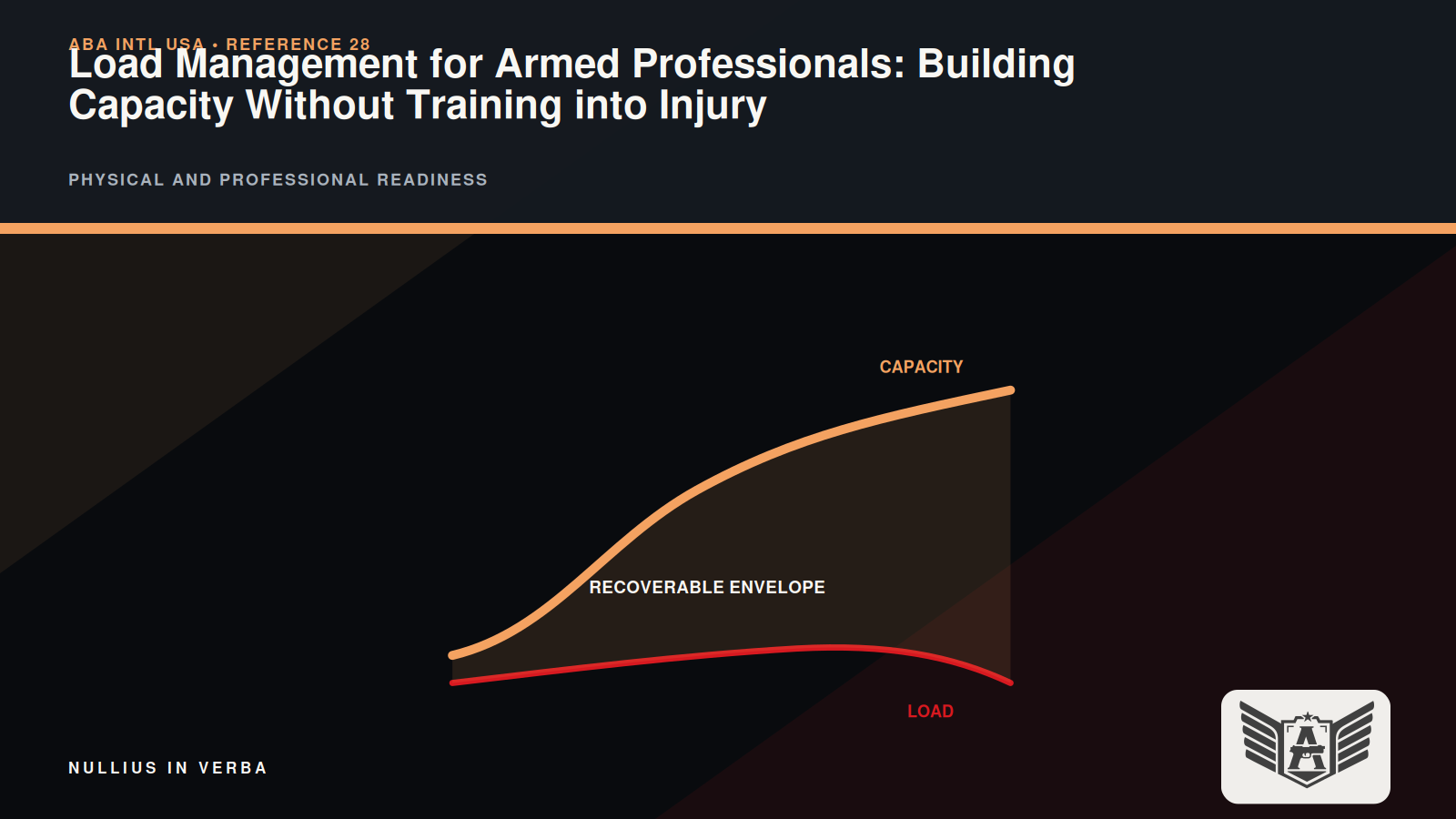
The Textbook of Sports Medicine and the Olympic handbook on injury
prevention both situate conditioning within long-term adaptation and
risk management rather than isolated tests (Kjær et al., 2003; Bahr
& Engebretsen, 2009). Fitness improves when load, recovery, and
tissue capacity are balanced. A tactical program that repeatedly
exhausts participants without progressive structure may reduce readiness
through injury even as it appears demanding.
TMM links physiology to the occupational outcome. Technique defines
the work and the postwork task. Metrics include work completed,
physiological response, recovery, and valid performance. Method
prescribes intensity, sequence, equipment, and rest while tracking
change across weeks (Bearare & Silveira, 2026). VO₂ becomes useful
when it helps explain or change that system, not when it becomes an
identity.
Aerobic fitness is best understood as recovery capacity with broad
health value. It expands how much work can be repeated, how rapidly
control can return, and how resilient training volume can become. It
cannot decide whether an object is a threat or repair an invalid
technique. ABA doctrine gives it an important but bounded role: build
the engine, then verify what the full system can do.
References
Bahr, R., & Engebretsen, L. (Eds.). (2009). Sports injury
prevention. Wiley-Blackwell.
Bearare, S. C., & Silveira, L. (2026). Technique-Method-Metric
Triad in firearms training under extreme stress. RECIMA21 – Revista
Científica Multidisciplinar, 7(7), e778536.
https://doi.org/10.47820/recima21.v7i7.8536
Gomes, R. V., Moreira, A., Lodo, L., & Capitani, C. D. (2009).
Limiar anaeróbio e bioenergética: Uma abordagem didática. Revista
Mackenzie de Educação Física e Esporte, 8(2), 57–65.
Kjær, M., Krogsgaard, M., Magnusson, P., Engebretsen, L., Roos, H.,
Takala, T., & Woo, S. L.-Y. (Eds.). (2003). Textbook of sports
medicine: Basic science and clinical aspects of sports injury and
physical activity. Blackwell Science.
Petek, B. J., Gustus, S. K., & Wasfy, M. M. (2021).
Cardiopulmonary exercise testing in athletes: Expect the unexpected.
Current Treatment Options in Cardiovascular Medicine, 23, 49.
https://doi.org/10.1007/s11936-021-00928-z

Continue from research to practice
Knowledge is useful when it changes what you do next.
Establish a baseline, locate the limiting factor and measure whether training produced a real change.
Ask about ABA | Performance