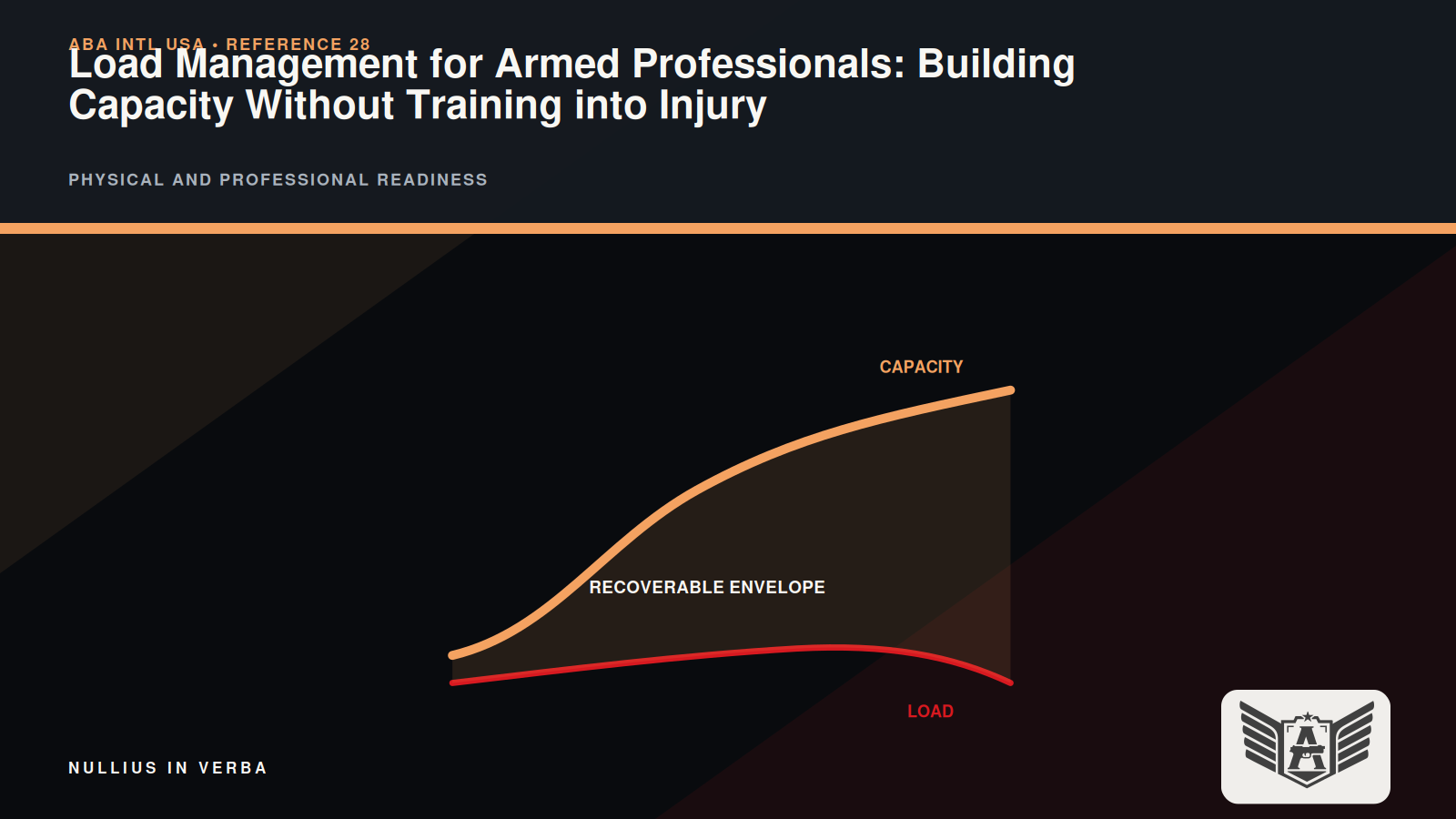
An armed professional can accumulate load from strength training,
running, defensive tactics, range volume, dry practice, shift work,
armor, equipment carriage, and insufficient sleep in the same week.
Programs often record only the formal workout and treat the rest as
background. Tissue and nervous systems do not respect administrative
categories. Adaptation depends on the total demand relative to current
capacity and recovery.
Training load is not inherently harmful. Progressive overload is the
mechanism through which strength, endurance, and technical tolerance
develop. The problem is a mismatch: demand rises faster than the
performer can adapt, or recovery falls while nominal volume remains
constant. Load management is therefore not an effort to minimize work.
It is the process of applying enough work to create adaptation without
producing avoidable injury or chronic degradation.
External load describes work performed: distance, mass, repetitions,
duration, rounds, or drill exposures. Internal load describes the
individual response: heart rate, perceived exertion, soreness, fatigue,
pain, and performance change. Two people can complete the same external
session and receive different internal doses. A single program volume
should never be assumed to be an equal stimulus.
Firearms practice has specific repetitive demands. Sustained
gripping, repeated presentations, prolonged static posture, recoil
exposure, and visual concentration can create local fatigue that is
invisible in a general fitness log. Dry practice adds volume even when
ammunition count is zero. If the instructor records only live rounds,
the actual upper-limb and attentional load can be underestimated
substantially.
Equipment adds chronic mechanical demand. Duty belts, armor, helmets,
packs, and protective systems alter gait, posture, heat load, and
movement strategy. A conditioning session without equipment and an
operational shift with equipment are not equivalent, but both belong in
the weekly exposure map. Equipment changes should be phased because a
familiar workload performed in a new carriage system is a new
biomechanical stimulus.
Rapid spikes deserve attention because tissue adaptation is slower
than motivation. A short preparation course can double running,
live-fire, and contact volume while reducing sleep through long days.
The performer may tolerate the first week and develop symptoms later as
cumulative recovery debt grows. Progression should be planned across
weeks and adjusted when external obligations increase.
The acute-to-chronic workload ratio has been promoted as a simple
injury predictor, but its precision and causal interpretation have been
debated. Gabbett (2016) emphasized the paradox that well-developed
chronic capacity can protect athletes while excessive acute spikes
increase risk. Programs should retain the practical insight—prepare
gradually for required load—without treating one ratio or “sweet spot”
as a diagnostic law for every individual.
Pain is information but not a complete injury classification.
Location, onset, behavior during and after activity, neurological
symptoms, swelling, night pain, and change in function matter. Normal
training discomfort can coexist with adaptation, while persistent or
escalating symptoms can signal a problem that requires clinical
assessment. Instructors should not diagnose from the firing line, and
learners should not be punished for reporting symptoms early.
Performance trends can reveal overload before injury. Increased
spread, falling valid rate, slower recovery, reduced grip endurance,
altered movement, irritability, and unusually high perceived effort at
the same workload can indicate reduced readiness. One bad day is not
proof, but a repeated multi-metric pattern justifies adjustment. The
purpose of monitoring is to change decisions, not to collect data that
no one reviews.
Recovery includes sleep, nutrition, hydration, spacing of similar
stressors, and reduced-load periods. Passive rest alone is not a
program. A week that places heavy gripping, high-volume live fire,
upper-body strength, and contact training on consecutive days
concentrates load on the same tissues even if each department considers
its session reasonable. Cross-department scheduling is an
injury-prevention intervention.
Individual history changes capacity. Previous injury, age, training
age, medication, job assignment, body composition, and current life
stress influence response. Equal standards can coexist with
individualized progression: the destination remains role-based, while
the path and time needed to reach it can differ. Forcing identical
weekly increases may create unequal risk rather than equal
preparation.
Bahr and Engebretsen (2009) frame sports-injury prevention as a
sequence of describing the problem, identifying mechanisms and risk
factors, introducing preventive measures, and evaluating their effects.
That sequence transfers well to armed-professional programs. Anecdotes
identify candidate problems, but incidence, exposure, and repeated
measurement are required before a prevention claim becomes credible.
Kjær et al. (2003) emphasize that sports medicine integrates tissue
biology, clinical reasoning, and training adaptation. The lesson for
firearms programs is that injury prevention cannot be separated from
performance design. A technically ideal position that repeatedly exceeds
a performer’s joint capacity is not yet an operational solution;
technique, equipment, and conditioning must be adapted together.
TMM supplies the control loop. Technique defines the movements and
contact demands. Metrics include external volume, internal response,
pain behavior, performance quality, and recovery. Method sequences
exposures and changes dose when the evidence crosses predefined
thresholds (Bearare & Silveira, 2026). A deload is not a failure of
commitment when it preserves the next training block.
Readiness is the ability to repeat high-quality work across time, not
to survive one heroic week. Load management turns discipline into
continuity: train hard enough to adapt, monitor enough to detect
mismatch, and recover enough to return capable. ABA doctrine rejects
both fragility and bravado. The standard is durable performance
supported by a system that learns before tissue failure becomes the
instructor.
References
Bahr, R., & Engebretsen, L. (Eds.). (2009). Sports injury
prevention. Wiley-Blackwell.
Bearare, S. C., & Silveira, L. (2026). Technique-Method-Metric
Triad in firearms training under extreme stress. RECIMA21 – Revista
Científica Multidisciplinar, 7(7), e778536.
https://doi.org/10.47820/recima21.v7i7.8536
Gabbett, T. J. (2016). The training-injury prevention paradox: Should
athletes be training smarter and harder? British Journal of Sports
Medicine, 50(5), 273–280.
https://doi.org/10.1136/bjsports-2015-095788
Kjær, M., Krogsgaard, M., Magnusson, P., Engebretsen, L., Roos, H.,
Takala, T., & Woo, S. L.-Y. (Eds.). (2003). Textbook of sports
medicine: Basic science and clinical aspects of sports injury and
physical activity. Blackwell Science.

Continue from research to practice
Knowledge is useful when it changes what you do next.
Use this evidence to identify the next capability you need to build and the ABA route designed for it.
Find your ABA training path