Some lower-leg pain appears with remarkable regularity: after a
similar distance or duration, pressure and cramping build, function
deteriorates, and symptoms ease when activity stops. Because rest
relieves the problem and the athlete may look normal between sessions,
the pattern can be dismissed as poor conditioning or low tolerance.
Chronic exertional compartment syndrome is one important differential
diagnosis that requires clinical evaluation rather than motivational
pressure.
Jorge et al. (2024) define chronic compartment syndrome as increased
pressure within a nonexpandable fibro-osseous space associated with
continuous and intense physical activity. The review identifies it as a
significant cause of exertional lower-limb pain and notes that it has
also been reported less often in the forearm, hand, thigh, foot, and
lumbar paravertebral compartments. Tactical professionals can encounter
relevant exposure through running, marching, load carriage, and
repetitive gripping.
During exercise, muscle blood flow and volume increase. In a
compartment bounded by relatively noncompliant fascia and bone, pressure
can rise enough to impair perfusion and neural function. The exact
pathophysiology remains debated, and no single mechanism explains every
case. The practical implication is that symptoms can be
exercise-dependent even when resting examination is unremarkable.
Typical complaints include tightness, cramping, aching or burning
pain, and sometimes numbness, tingling, weakness, or altered foot
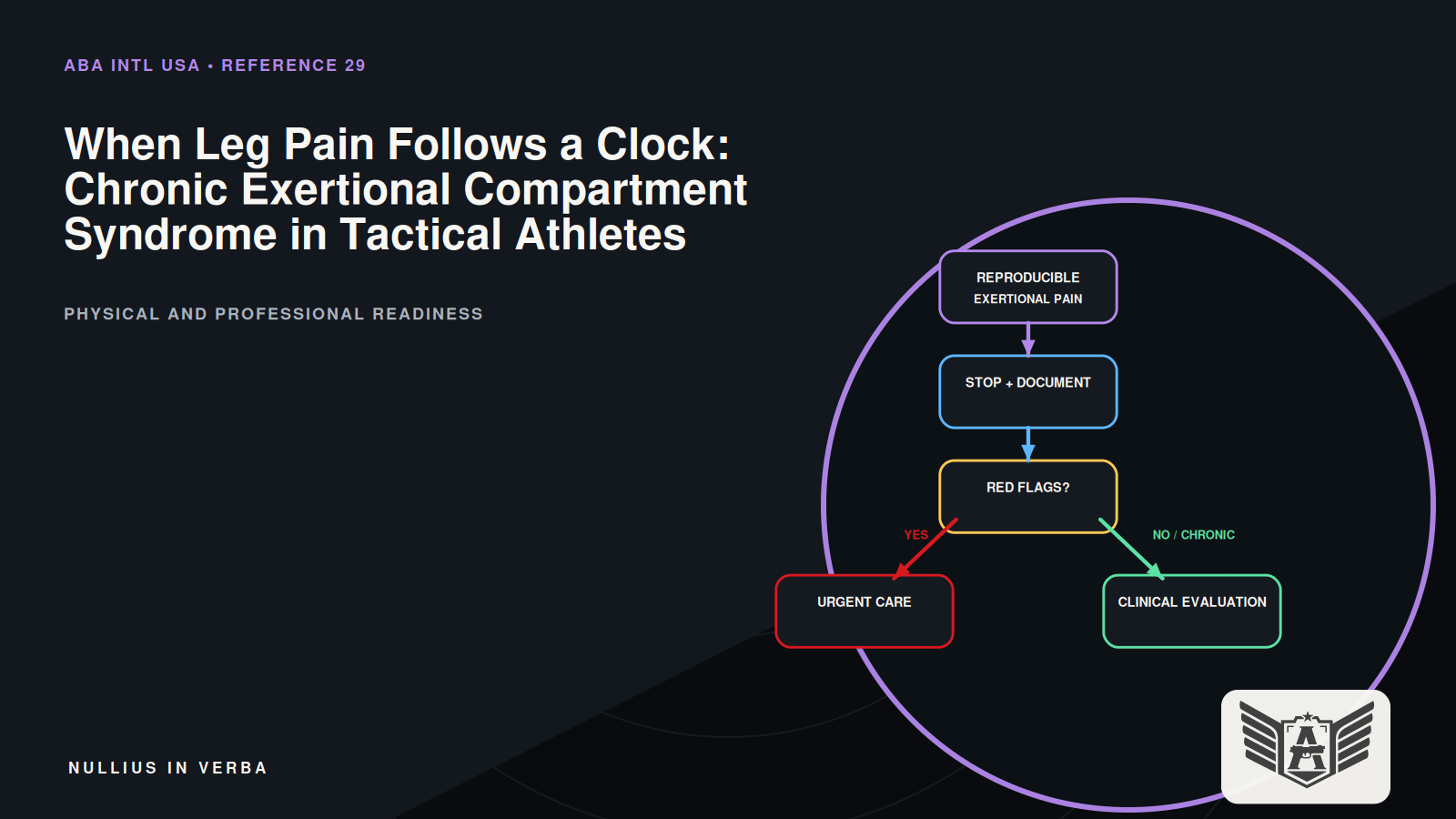
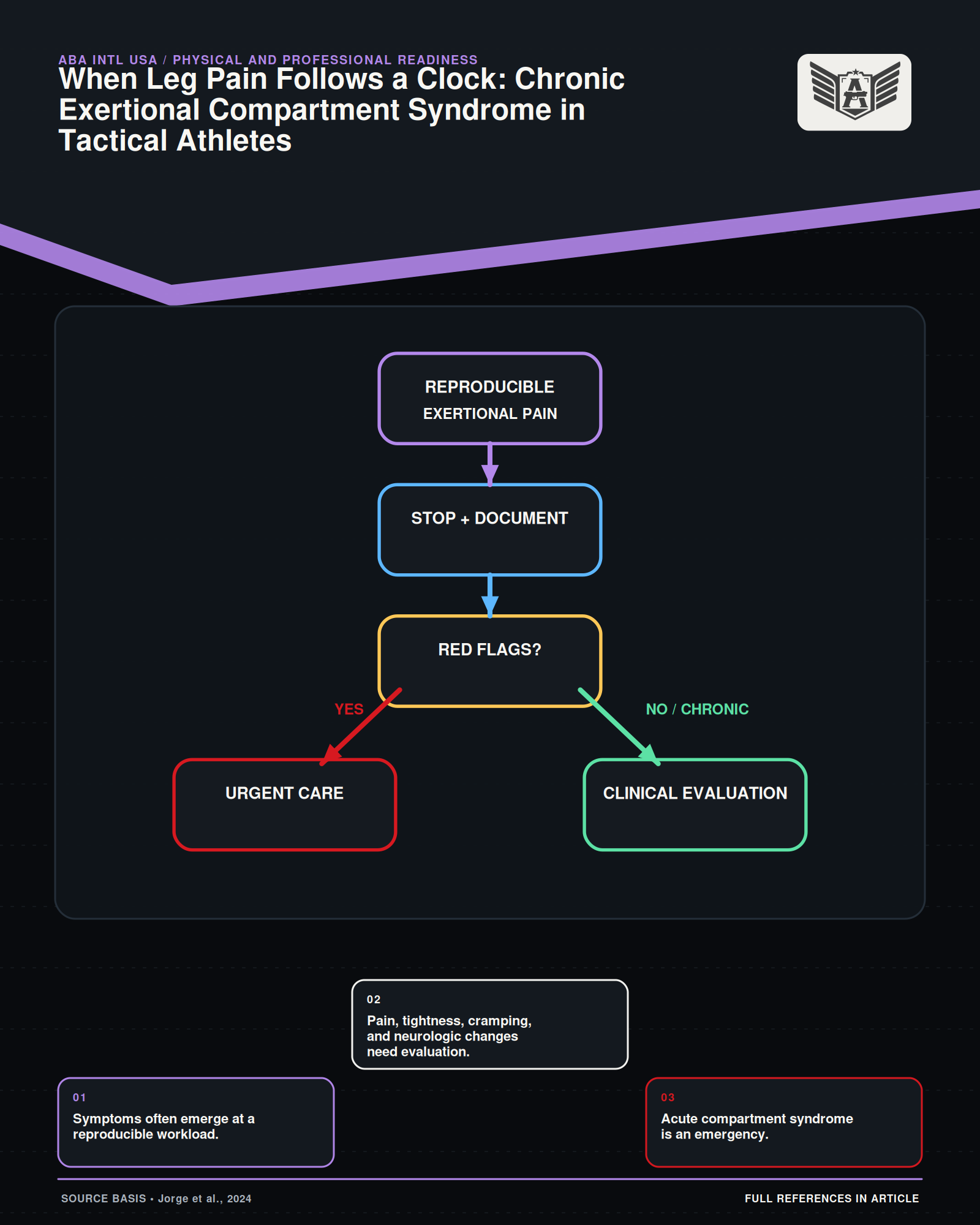
control. Symptoms often begin at a reproducible workload and improve
with rest or reduced activity. The pattern matters more than one
adjective for pain. A log that records onset time, distance, intensity,
location, neurologic features, and recovery can materially improve the
clinical history.
Chronic exertional compartment syndrome should not be confused with
acute compartment syndrome. Acute syndrome is commonly associated with
trauma or another sudden event, severe and escalating pain, tense
swelling, neurological changes, and threatened tissue perfusion; it is a
medical emergency. Chronic exertional symptoms are usually reversible
with rest and are not typically an immediate emergency. New severe or
persistent symptoms, however, require urgent assessment rather than
self-classification.
Differential diagnosis is broad. Bone stress injury, medial tibial
stress syndrome, tendinopathy, nerve entrapment, vascular causes, lumbar
referral, and technique- or equipment-related overload can produce
overlapping complaints. A runner can also have more than one condition.
Internet checklists and instructor palpation cannot replace a qualified
sports-medicine evaluation.
Diagnosis is primarily clinical and is supported by testing selected
by the treating professional. Jorge et al. (2024) note that postexercise
intracompartmental-pressure measurement has long been used despite
controversy and limitations. Exercise magnetic resonance imaging and
other less invasive approaches are under investigation. No test should
be interpreted outside the symptom pattern and protocol used to provoke
it.
The training session itself can help clinical reasoning if it is
documented safely. The athlete can report the exact exercise that
triggers symptoms, whether a threshold is consistent, which movements or
surfaces change onset, and how long recovery takes. Deliberately pushing
through neurological symptoms to “make the test obvious” is
inappropriate unless conducted under a clinician’s protocol.
Initial management often includes load reduction and modification
while evaluation proceeds. That may mean replacing running with a
lower-impact conditioning mode, reducing march load, changing terrain,
or spacing exposures. Modification preserves general capacity without
repeatedly provoking the suspected compartment. It is not proof that the
diagnosis is correct and should not delay referral when symptoms
persist.
Conservative interventions have been explored, including gait
retraining and activity modification, but Jorge et al. (2024) conclude
that robust evidence remains limited, particularly for athletes. A
program should be transparent about that uncertainty. Promising does not
mean proven, and response in one individual does not establish a
universal treatment.
Fasciotomy has historically been the principal surgical treatment,
with open, minimally invasive, and endoscopic approaches described.
Outcomes and risks depend on compartment, patient selection, technique,
and follow-up. Surgery is a decision between the patient and qualified
clinicians after diagnostic evaluation; it is not an instructor
recommendation or a shortcut for preserving a training calendar.
Return to training should be criterion based. Pain behavior,
neurologic symptoms, wound status where relevant, strength, movement,
graded workload tolerance, and the treating team’s guidance matter more
than a fixed date. The athlete should demonstrate repeated tolerance
below and then through the former trigger range before full load is
restored. Sudden return to the old volume recreates the original
demand-capacity mismatch.
Prevention claims must remain modest because the etiology is not
fully resolved. Gradual progression, appropriate footwear and equipment,
variation in surface and load, strength, recovery, and early symptom
reporting are reasonable general controls for exertional injury. None
guarantees that compartment syndrome will not develop. Monitoring is
more defensible than promising prevention.
TMM supports but does not medicalize instruction. Technique records
movement and equipment conditions, Metrics record workload and symptom
behavior, and Method modifies exposure while clinical evaluation
determines diagnosis (Bearare & Silveira, 2026). The framework’s
role is to preserve a clear history and a safe training response, not to
expand the instructor’s scope into medicine.
Pain that follows a clock is not evidence of weakness; it is evidence
of a reproducible relation between load and the body. A reference
organization rewards early reporting, protects access to qualified care,
and maintains fitness through appropriate alternatives. Toughness is the
capacity to train for the long term. Ignoring a recurring neurologic or
pressure pattern is not toughness—it is the refusal to measure.
References
Bahr, R., & Engebretsen, L. (Eds.). (2009). Sports injury
prevention. Wiley-Blackwell.
Bearare, S. C., & Silveira, L. (2026). Technique-Method-Metric
Triad in firearms training under extreme stress. RECIMA21 – Revista
Científica Multidisciplinar, 7(7), e778536.
https://doi.org/10.47820/recima21.v7i7.8536
Jorge, P. B., Toledo, M. B., Mari, F. C., de Toledo, R. R. F., de
Lima, M. V., & Sprey, J. W. C. (2024). Chronic compartment syndrome
in athletes. Revista Brasileira de Ortopedia. Advance online
publication. https://doi.org/10.1055/s-0044-1787766
Continue from research to practice
Knowledge is useful when it changes what you do next.
Use this evidence to identify the next capability you need to build and the ABA route designed for it.
Find your ABA training path