High heart rate is often treated as a direct measurement of degraded
firearms performance. An instructor induces exertion, reads a pulse
value, and assumes the shooter is now experiencing the motor and
cognitive effects of lethal stress. This inference combines different
phenomena. Heart rate can rise from exercise, heat, anticipation,
caffeine, or psychological threat, and each state changes the body
differently. The relevant question is how a defined exertion protocol
changes a defined performance profile.
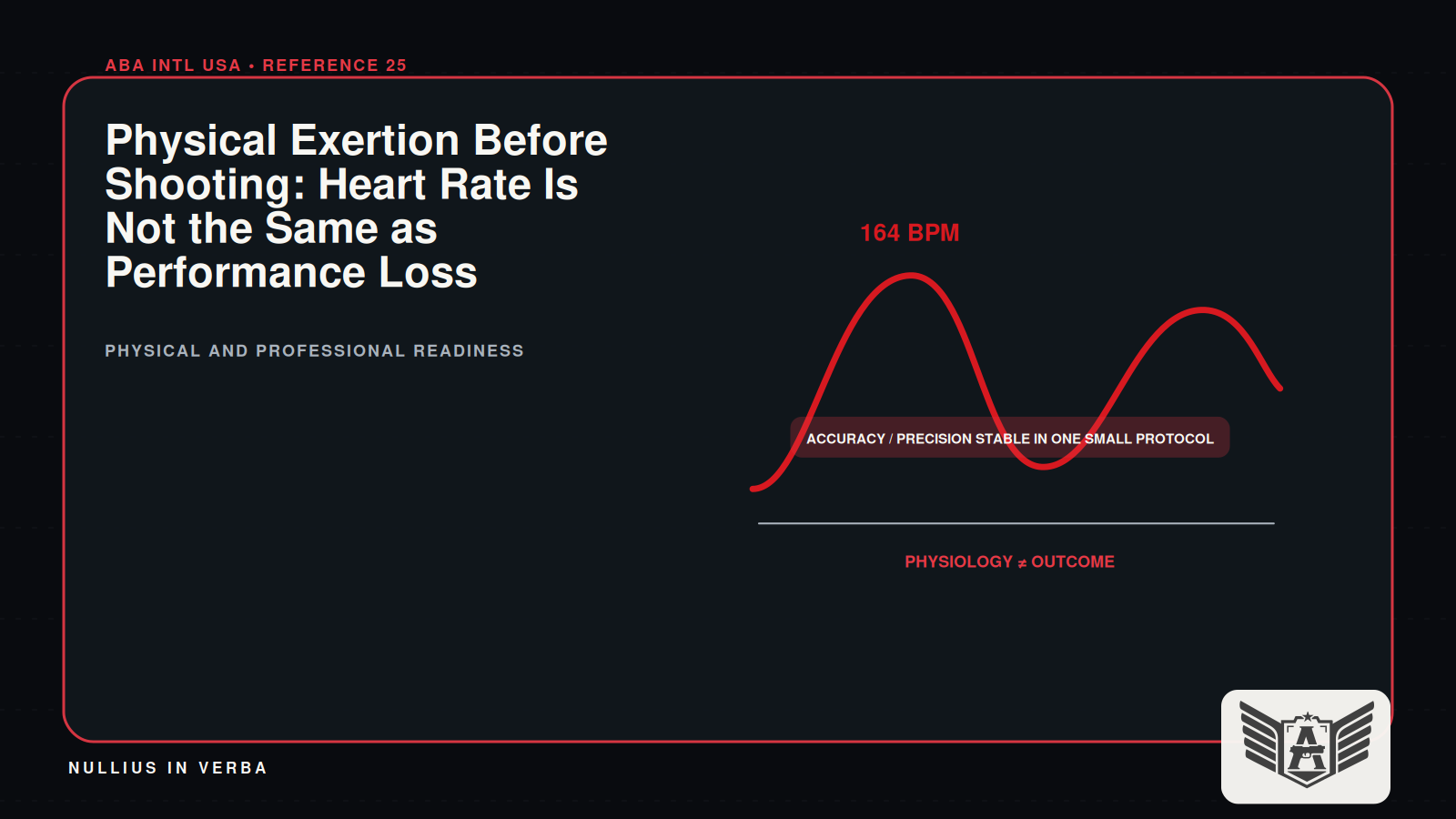
Brown et al. (2013) studied eight police officers before and after a
cycle-ergometer exercise bout taken to voluntary exhaustion.
Participants completed rapid-fire pistol trials, and postexercise heart
rate averaged 164 beats per minute. The investigators reported no
significant deterioration in their measures of accuracy or precision
after exercise. The finding is useful precisely because it resists a
simple heart-rate doctrine: a high cardiovascular value did not
automatically produce worse marksmanship under the protocol.
The study is small and narrow. Eight officers cannot represent all
populations, the target task emphasized rapid-fire accuracy rather than
complex identification, and a cycle ergometer does not reproduce a foot
pursuit with load, obstacles, communication, and emotional threat. The
authors’ result should not be generalized into a claim that fatigue
never affects shooting. It establishes that the measured pistol task
remained stable after one specific exercise exposure in an experienced
sample.
Exercise-induced arousal and threat-induced arousal share some
outputs but differ in appraisal and neuroendocrine context. Pedaling to
exhaustion can elevate heart rate and ventilation without creating fear,
moral consequence, or uncertainty about another person. Conversely,
severe anxiety can alter attention and movement without requiring
maximal metabolic effort. A training program that labels exercise as
“stress” should specify which stress component is represented and which
is absent.
Local muscular fatigue can matter even when heart rate does not.
Repeated gripping, loaded carries, pushing, pulling, or sustained arm
positions can change force control in the muscles that stabilize the
task. Lower-body cycling may create substantial cardiovascular demand
while sparing some upper-body structures. The exercise mode must
therefore match the occupational sequence that the instructor wants to
study.
Recovery timing changes the measured effect. Heart rate falls rapidly
after exercise in a fit individual, while local fatigue, heat strain, or
cognitive discomfort may persist. Testing immediately, 30 seconds later,
or three minutes later samples different physiological states. Reports
should state the delay from exertion to first trial and track
performance across recovery rather than treat postexercise as a single
condition.
Marksmanship metrics can conceal decision costs. A participant can
preserve group size on an announced target while becoming less capable
of recognizing alternatives or withholding action. Physical exertion
also occupies attention through breathing, discomfort, and interoceptive
signals. A representative test should include action and no-action
decisions if the capability is expected to operate under
uncertainty.
Speed–accuracy tradeoffs must be visible. A shooter may preserve
accuracy by taking longer or preserve time by accepting greater spread.
Reporting only one dimension produces the appearance of stability.
Average time, spatial error, precision, valid rate, false actions, and
trial-to-trial variability should be recorded together. A change in
strategy is a result even when the final score remains constant.
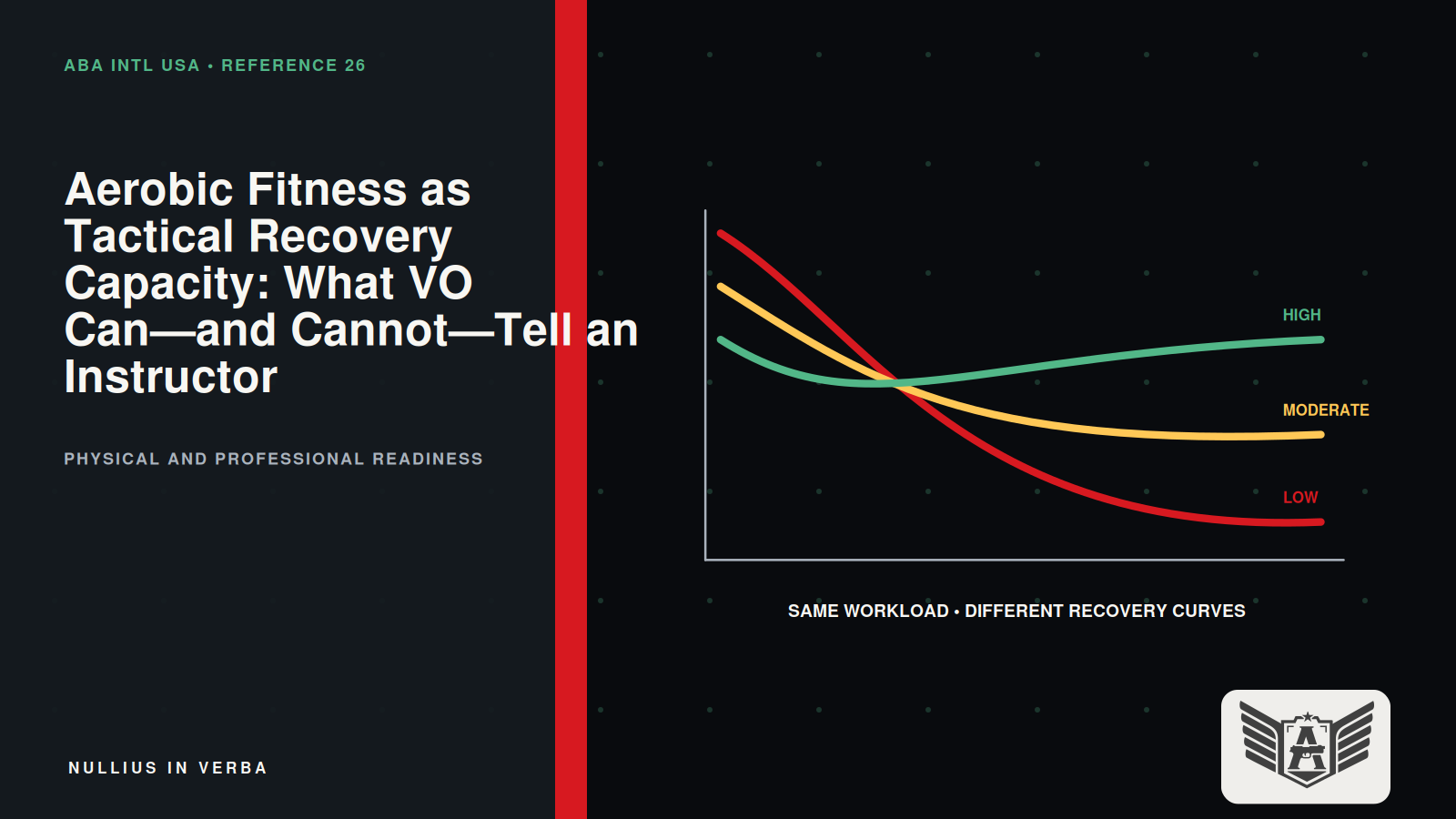
Fitness changes the dose. The same fixed run or circuit represents a
different relative intensity for different performers. Heart rate
expressed relative to individually measured or defensibly estimated
capacity is more interpretable than one universal threshold, but even
percentage of maximum does not capture local fatigue or heat. Perceived
exertion and work completed add context to the physiological
measure.
The exercise protocol should be reproducible. Work duration,
intensity, load, movement sequence, environmental conditions, and
recovery interval must be documented. Competitive “smoke sessions”
produce dramatic fatigue but are difficult to compare across days and
performers. Without a stable dose, the instructor cannot know whether
improved performance reflects adaptation or simply an easier
exposure.
Progression begins with component stability. The learner should first
demonstrate safe, valid performance when rested, then after controlled
aerobic work, then after task-specific physical work, and finally under
combined physical and decision demand. One constraint is added at a time
until interactions become the learning objective. This progression
protects interpretability while still reaching representative
complexity.
Brown et al.’s (2013) finding also raises a positive possibility:
well-learned pistol mechanics may be robust to some acute cardiovascular
stress. Robustness should be tested, not presumed. A technique that
survives elevated ventilation but fails after grip fatigue has a
specific envelope. The instructor can expand that envelope through
physical preparation, technical refinement, and recovery practice rather
than searching for a single “stress-proof” method.
O Cérebro Sob Fogo distinguishes the integrated effects of
extreme stress from the isolated signs often used to imitate it
(Silveira & Bearare, 2026). Heart rate is one signal in that system,
not a diagnosis. ABA doctrine therefore avoids heart-rate zones marketed
as universal cognitive states. The performer’s appraisal, task, training
history, and measured behavior remain necessary.
TMM organizes the test. Technique defines the action under a
specified starting state. Metrics include physiological load, local
fatigue indicators, decision validity, time, accuracy, precision, and
recovery. Method states the exertion dose and the interval before
performance (Bearare & Silveira, 2026). Replication across sessions
determines whether the observed effect is stable enough to guide
programming.
Physical exertion belongs in serious firearms preparation because
operational actions rarely begin from laboratory rest. It belongs there
as a controlled variable, not as theater. A high pulse proves that the
cardiovascular system is working. Only a complete performance profile
can show whether the shooter’s perception, decision, and execution
remain fit for purpose.
References
Bearare, S. C., & Silveira, L. (2026). Technique-Method-Metric
Triad in firearms training under extreme stress. RECIMA21 – Revista
Científica Multidisciplinar, 7(7), e778536.
https://doi.org/10.47820/recima21.v7i7.8536
Brown, M. J., Tandy, R. D., Wulf, G., & Young, J. C. (2013). The
effect of acute exercise on pistol shooting performance of police
officers. Motor Control, 17(3), 273–282.
https://doi.org/10.1123/mcj.17.3.273
Silveira, L., & Bearare, S. C. (2026). O cérebro sob fogo: O
que o estresse extremo faz com a mente e o corpo do atirador.
Editora Ludus.

Continue from research to practice
Knowledge is useful when it changes what you do next.
Connect technical execution with perception, judgment and decision-making in the Cognitive Operator pathway.
Explore Cognitive Operator