
Hydration advice is often reduced to carrying a large bottle or using
a universal intake target. Operational performance is more complex.
Fluid loss interacts with heat, exercise intensity, clothing, body size,
acclimatization, diet, and access to breaks. The relevant concern is not
that a small water deficit inevitably ruins marksmanship. It is that
vigilance, working memory, mood, thermoregulation, and perceived effort
can change before the performer recognizes a meaningful decline.
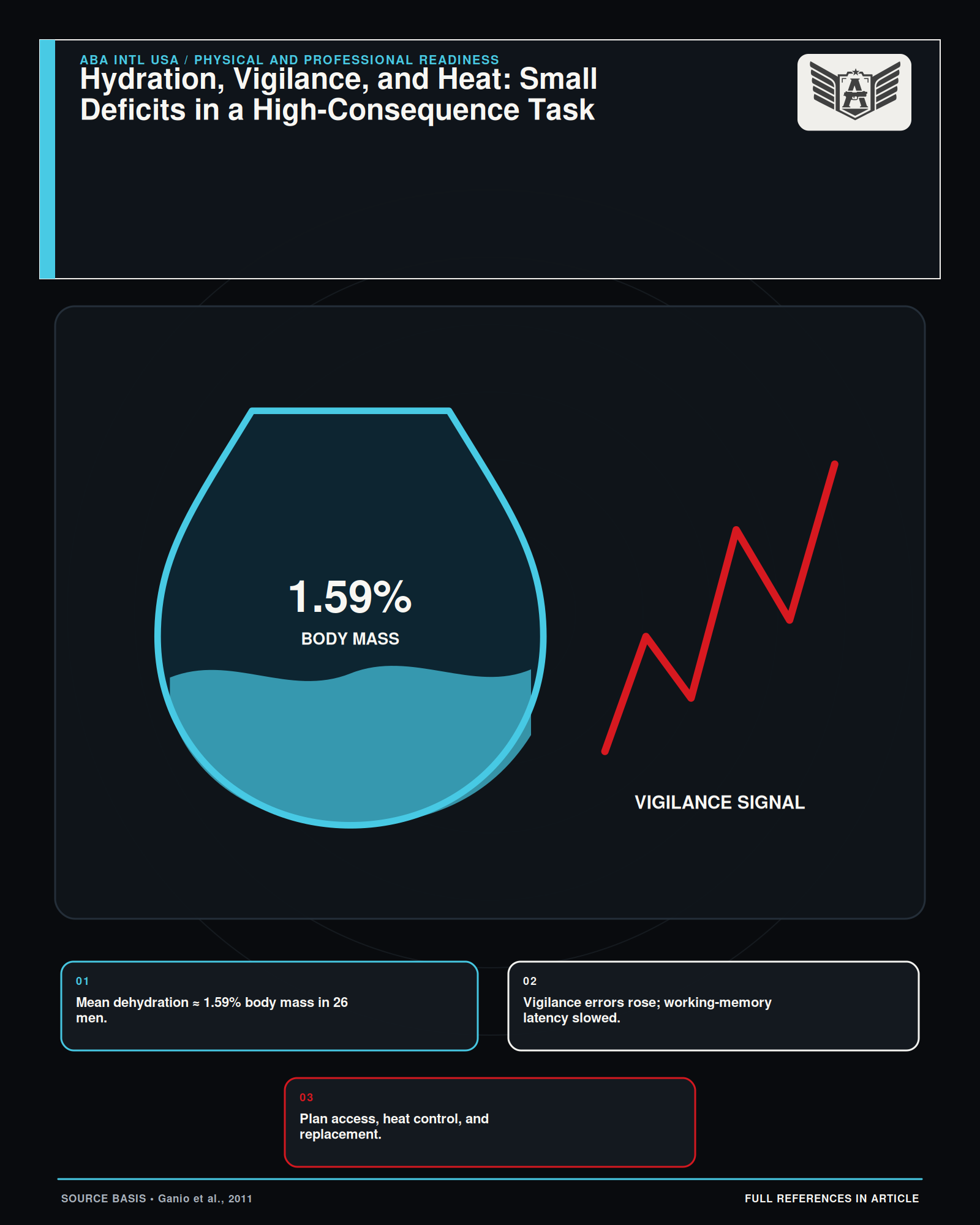
Ganio et al. (2011) studied 26 healthy young men across controlled
hydration conditions without inducing hyperthermia. Mean body-mass loss
in the dehydration trials was approximately 1.59%. Dehydration increased
errors on a visual-vigilance task and slowed response latency on visual
working memory, while fatigue and tension or anxiety increased. Many
other cognitive measures did not significantly change, which argues
against describing mild dehydration as a global cognitive collapse.
The distinction among affected and unaffected outcomes matters. A
performer can preserve simple reaction time or reasoning while becoming
more variable during sustained monitoring. High-consequence work often
depends on detecting a rare signal over time, remembering a developing
sequence, and maintaining a calibrated decision criterion. Small average
effects in those domains can matter when shifts are long and errors are
asymmetric.
The study isolated dehydration from severe heat, but operational
environments frequently combine them. Heat increases skin blood flow and
sweating, protective clothing impedes heat loss, and physical work
raises metabolic heat production. Dehydration can reduce the body’s
margin for thermoregulation while discomfort competes for attention. The
combined state cannot be inferred from a water-loss percentage
alone.
Body-mass change is a practical field estimate when measured under
consistent conditions. A one-kilogram loss over a session approximates
one liter of net fluid deficit, although food, urine, equipment, and
measurement timing affect interpretation. Pre- and post-session body
mass can help estimate individual sweat loss; it should not become a
public ranking or a trigger for indiscriminate overdrinking.
Thirst is useful but not perfectly calibrated to every operational
demand. It can lag rapid sweat loss, while stress and workload can
suppress attention to internal cues. Conversely, drinking aggressively
beyond need can create gastrointestinal distress and, in extreme
circumstances, dangerous hyponatremia. The goal is planned replacement
based on individual loss and conditions, not maximal water
consumption.
Electrolyte requirements depend on duration, sweat rate, sweat
sodium, diet, and environment. Short, moderate sessions may require only
water and normal meals. Long or hot work with substantial sweating may
benefit from sodium-containing fluids or food. Product marketing often
presents one formulation as universally necessary; sports-nutrition
evidence supports individualized strategy instead (Maughan, 2014).
Caffeine complicates the picture. Familiar moderate use does not
automatically dehydrate a habituated consumer, and it can improve
alertness temporarily. It can also disturb later sleep, increase anxiety
or gastrointestinal symptoms, and encourage professionals to mask
fatigue rather than restore recovery. Intake should be logged as part of
the performance context instead of treated as either poison or
solution.
Urine color can support self-monitoring but is influenced by
supplements, foods, medications, and the timing of the last void. A
single dark sample is not a medical diagnosis, and a clear sample does
not prove optimal electrolyte balance. Better field practice combines
thirst, recent intake, urine trend, body-mass change, environmental
exposure, and symptoms.
Hydration plans must account for access. A policy that tells
personnel to drink while schedules deny breaks, bathrooms, or refill
points is not an intervention. Supervisors should map where fluid is
available, how equipment permits carriage, and when short recovery
periods can occur. The same systems approach used for ammunition and
communications should apply to human thermal requirements.
Training should record wet-bulb globe temperature or another
defensible environmental measure when heat risk is material. Air
temperature alone omits humidity, radiant heat, and airflow.
Work-to-rest ratios, clothing adjustments, shaded recovery,
acclimatization, and emergency response criteria can then be tied to
observed conditions rather than a general impression that the day feels
hot.
Symptoms such as confusion, loss of coordination, collapse, severe
headache, vomiting, or altered behavior require immediate safety action
and appropriate medical evaluation. They should not be used as
opportunities to test toughness. Exertional heat illness can progress
quickly, and treatment scope belongs to qualified medical protocols. A
reference training system defines stop criteria before the first
participant becomes symptomatic.
Hydration can be integrated with shooting without claiming direct
causation from one session. The program can compare vigilance, valid
decision rate, performance spread, perceived exertion, and recovery
across documented environmental and fluid-balance conditions. Repeated
within-person patterns are more useful than attributing one miss to
dehydration after the fact. The observation should generate a
hypothesis, not an excuse.
TMM clarifies the control loop. Technique includes fluid access,
pacing, and recovery behaviors. Metrics include body-mass change,
environment, intake, symptoms, vigilance errors, and task validity.
Method prescribes replacement opportunities, heat controls, and
reassessment while maintaining safe limits (Bearare & Silveira,
2026). Hydration becomes part of readiness rather than an unmeasured
lifestyle lecture.
Small deficits deserve attention because the task has high
consequences, not because every decrement is catastrophic. The evidence
supports a conservative position: mild dehydration can selectively alter
vigilance, memory latency, mood, and fatigue; heat and workload can
amplify the challenge; and individual response varies. ABA doctrine
therefore plans, measures, and corrects fluid balance before impairment
has to announce itself through failure.
References
Bearare, S. C., & Silveira, L. (2026). Technique-Method-Metric
Triad in firearms training under extreme stress. RECIMA21 – Revista
Científica Multidisciplinar, 7(7), e778536.
https://doi.org/10.47820/recima21.v7i7.8536
Ganio, M. S., Armstrong, L. E., Casa, D. J., McDermott, B. P., Lee,
E. C., Yamamoto, L. M., Marzano, S., Lopez, R. M., Jimenez, L., Le
Bellego, L., Chevillotte, E., & Lieberman, H. R. (2011). Mild
dehydration impairs cognitive performance and mood of men. British
Journal of Nutrition, 106(10), 1535–1543.
https://doi.org/10.1017/S0007114511002005
Maughan, R. J. (Ed.). (2014). Sports nutrition.
Wiley-Blackwell.
TRAIN. MEASURE. EQUIP.
Continue learning through ABA research and training. When equipment is the next variable, go directly to the ABA Store.
GET THE EQUIPMENT →Continue from research to practice
Knowledge is useful when it changes what you do next.
Use this evidence to identify the next capability you need to build and the ABA route designed for it.
Find your ABA training path