Operational experience deserves respect because it exposes people to
constraints that controlled training may miss. It reveals friction,
equipment interaction, organizational failure, uncertainty, fatigue, and
the gap between written procedure and lived work. It does not, however,
suspend the rules of inference. Surviving an event does not prove that
every action taken was optimal, and performing a technique in the field
does not prove that the technique caused the favorable outcome.
Experience is an irreplaceable generator of questions. It becomes
unreliable when elevated from observation to proof without an
intervening method.
The phrase Nullius in Verba—take no one’s word for it—does
not mean that testimony has no value. It means that authority cannot
complete an argument. In armed professions, status can become a
substitute for evidence because some experiences are rare, dramatic, and
difficult to reproduce. The more consequential the claim, the more
tempting it is to protect it with biography. A scientific posture does
the opposite: it identifies what was observed, separates observation
from interpretation, and asks what additional evidence would be required
to support a general recommendation.
Human memory is reconstructive rather than a neutral recording.
Stress, attention, later information, group discussion, and narrative
rehearsal influence what is retained and how it is organized. A coherent
after-action story can therefore be psychologically compelling while
containing uncertainty about timing, sequence, perception, and
causality. This does not imply dishonesty. It means that honest
recollection should be treated as one data source among others—video,
contemporaneous records, physical evidence, multiple accounts, and
controlled testing—rather than granted immunity from examination.
Survivorship bias is especially important in tactical culture.
Methods used by people who returned are visible; methods used by those
who did not are less likely to be taught by them. A successful outcome
may reflect skill, luck, opponent error, team support, equipment, or
circumstances unavailable to the observer. The lesson “this worked for
me” is a legitimate case report. The lesson “therefore this will work
for you” requires evidence about mechanisms, boundary conditions, and
alternatives.
Memoirs such as Neil Reynolds’s account of private security work in
Iraq offer valuable texture about uncertainty, contracting,
organizational adaptation, and the human cost of operations (Reynolds,
2007). Their evidentiary function is descriptive. They can identify
recurring problems and illuminate decisions in context, but they are not
controlled comparisons of training methods. Treating narrative
literature according to its actual strength preserves its value; forcing
it to carry causal claims it cannot support weakens both the account and
the doctrine built from it.
Academic analysis of private military and security contractors shows
why professional context cannot be reduced to individual tactics.
Regulation, contracting structures, legitimacy, organizational identity,
industry norms, and accountability shape performance and conduct (Schaub
& Kelty, 2016). A technique may be mechanically effective while
being incompatible with policy, law, mission, or ethical responsibility.
Operational competence is therefore a system property, not a collection
of dramatic personal skills.
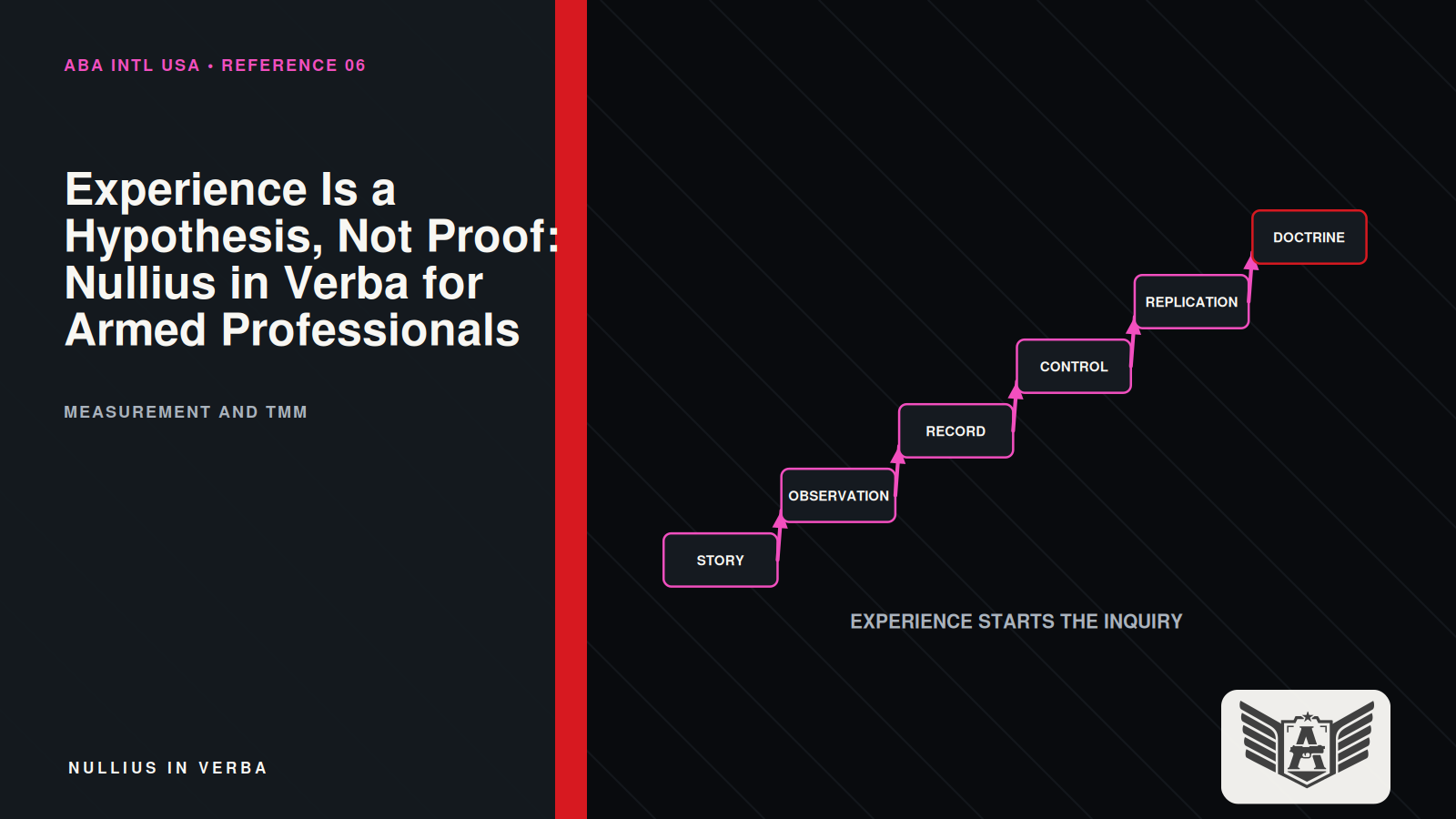
Field observations should enter training as explicit hypotheses. An
instructor might observe that a garment type delays access, that
officers abandon a visual behavior under pressure, or that a vehicle
configuration interferes with movement. The next step is to define the
observation in measurable terms and design a comparison. Different
garment conditions can be counterbalanced; controlled and pressured
trials can be compared; vehicle egress can be timed while safety
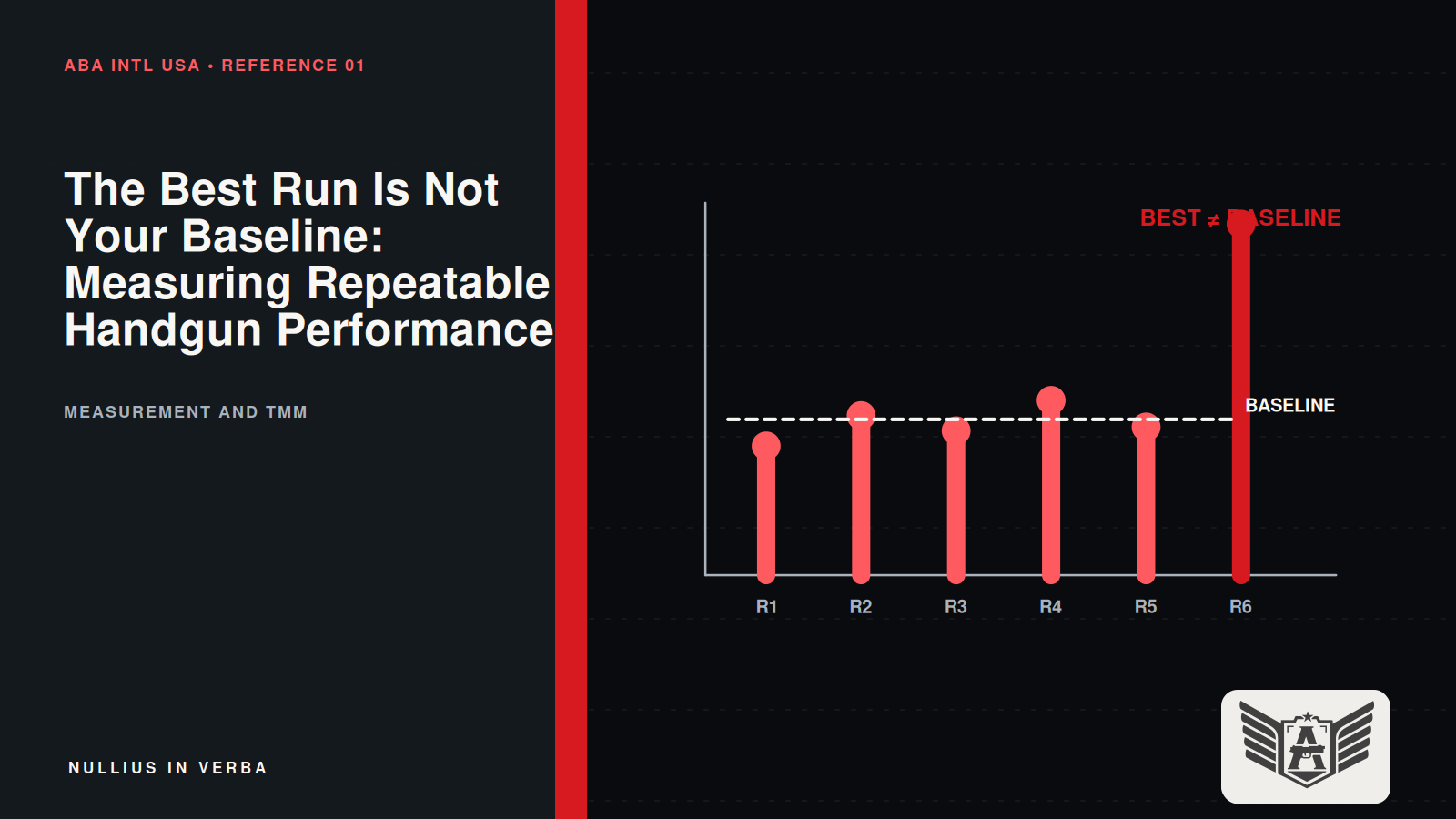
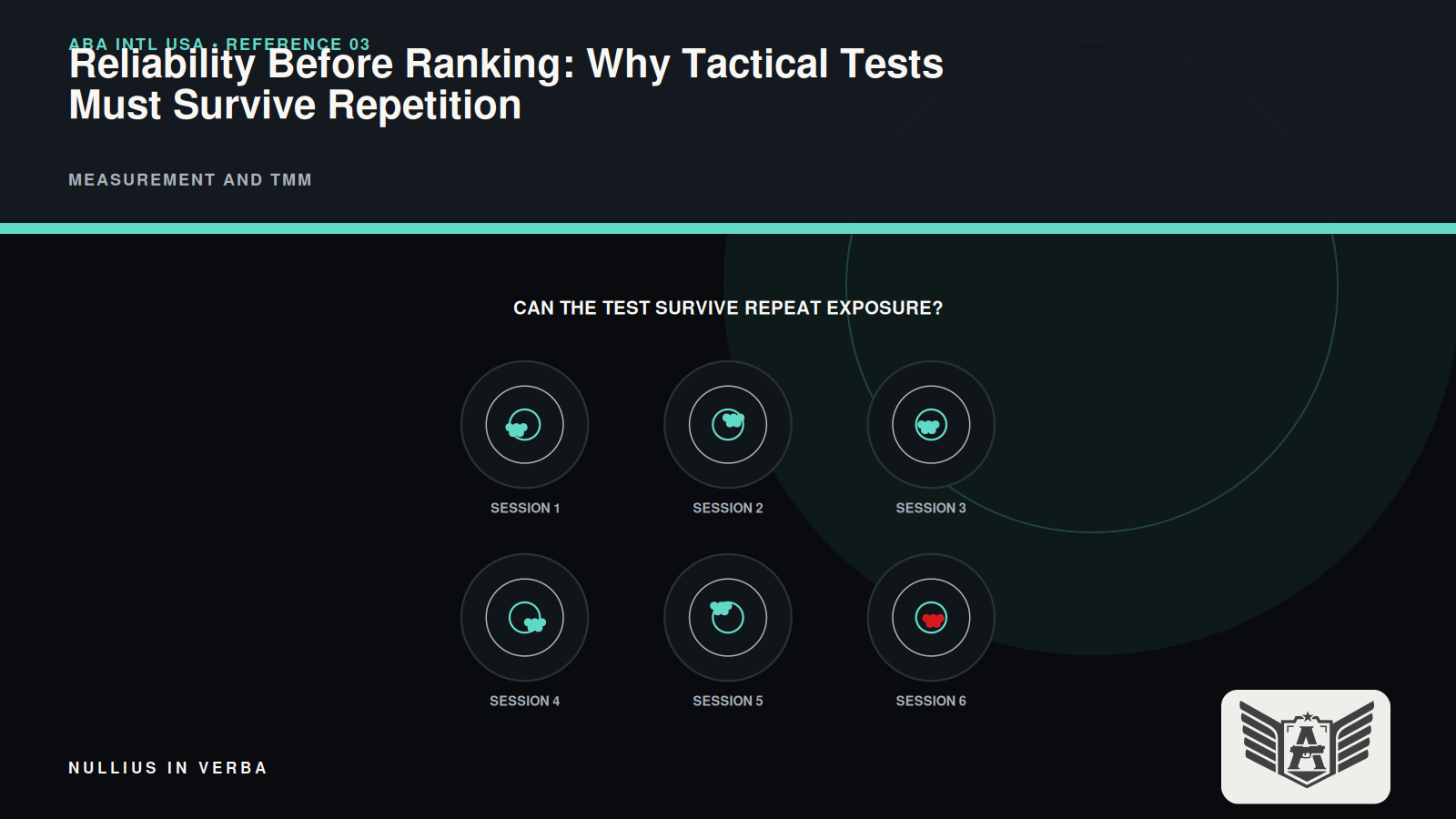
outcomes are recorded. Experience identifies the variable. Measurement
tests whether the pattern is repeatable and large enough to matter.
The TMM Triad formalizes that transition. Technique describes the
candidate solution observed or proposed. Metrics define what change
would support the claim. Method organizes practice or experimentation so
that the suspected constraint is manipulated and retested (Bearare &
Silveira, 2026). The field does not disappear from this process. It
informs task design and ecological limits. What disappears is the
assumption that confidence or seniority can replace a protocol.
The same discipline applies to scientific literature. One study is
not universal proof merely because it contains statistics. Small
samples, artificial tasks, narrow populations, measurement choices, and
publication bias limit inference. Nieuwenhuys and Oudejans’s (2010)
pilot study of seven police officers is valuable because it demonstrates
measurable changes in shooting behavior under anxiety; its small sample
also demands restraint. Evidence-led doctrine is not “paper worship.” It
is the integration of study quality, operational relevance, converging
results, and transparent uncertainty.
Expertise still matters because experts can recognize variables
novices do not know exist. They can design representative tasks, detect
meaningful error patterns, and interpret practical consequences.
Ericsson et al. (1993) showed that expert performance develops through
extensive, targeted practice rather than appearing as undifferentiated
talent. Expertise earns greater weight for certain judgments, but it
also creates a responsibility to expose those judgments to testing. The
mature expert uses authority to build better questions, not to prevent
questions.
Doctrine should state its confidence level. Some principles are
strongly supported across domains, such as the need to couple speed with
accuracy and to distinguish acquisition performance from retention.
Other claims are provisional, supported by field observation and limited
studies. Still others are local procedures justified by policy or
equipment rather than universal human-performance laws. Labeling these
categories helps instructors teach honestly and prevents students from
confusing organizational convention with biological necessity.
After-action review is most useful when it protects disconfirming
evidence. The review should preserve what was expected, what occurred,
what remains unknown, and which conclusions are speculative. It should
include near misses, procedural deviations, and outcomes that contradict
the favored method. A culture that punishes uncertainty will receive
confident fiction. A culture that rewards accurate limits will
accumulate data capable of improving training.
Marketing creates a special risk because extreme claims sell.
“Battle-proven,” “operator-tested,” and “born in combat” can describe
provenance while implying validation. A method used in a conflict may
never have been compared with alternatives, measured for failure rate,
or examined outside one team. Provenance is relevant; it is not a
result. ABA Intl’s use of Nullius in Verba rejects the false
choice between experience and science. Experience without measurement is
vulnerable to myth, while research without representative tasks is
vulnerable to irrelevance.
Students should learn to ask respectful but precise questions. What
was the task? How many observations support the claim? What counted as
success? What failures occurred? What alternatives were considered? Did
the result transfer? Under what equipment, legal, and organizational
constraints? What evidence would change the recommendation? An
instructor who can answer those questions demonstrates stronger
authority than one who demands belief.
Organizations can institutionalize this posture by collecting
standardized training and operational data, protecting privacy, and
separating learning reviews from performative blame. Recurrent problems
can be translated into testable curriculum changes. Qualification
results can be linked to later representative assessments. Equipment
changes can be piloted before universal adoption. The purpose is not to
turn every agency into a laboratory; it is to prevent preventable
experience from disappearing into anecdotes.
The practical conclusion is balanced. Do not discard the veteran’s
account, the instructor’s eye, or the operator’s intuition. Use them to
identify variables that deserve attention. Then define the claim,
measure the relevant outcome, compare plausible explanations, and limit
the conclusion to the evidence. Field experience is where many of the
best questions begin. It becomes doctrine only after it survives a
process designed to reveal when the experienced person—including the
instructor—is wrong.
Nullius in Verba is therefore not a slogan of distrust. It
is a professional ethic of accountability. It protects students from
charisma, instructors from self-deception, and organizations from
inherited error. The armed professional should be willing to say, “This
is what I observed; this is what the evidence supports; this is what
remains uncertain; and this is how we will test it.” That statement does
not diminish experience. It gives experience a path toward reliable
knowledge.
References
Bearare, S. C., & Silveira, L. (2026). Technique-Method-Metric
Triad in firearms training under extreme stress. RECIMA21 – Revista
Científica Multidisciplinar, 7(7), e778536.
https://doi.org/10.47820/recima21.v7i7.8536
Ericsson, K. A., Krampe, R. T., & Tesch-Römer, C. (1993). The
role of deliberate practice in the acquisition of expert performance.
Psychological Review, 100(3), 363–406.
https://doi.org/10.1037/0033-295X.100.3.363
Nieuwenhuys, A., & Oudejans, R. R. D. (2010). Effects of anxiety
on handgun shooting behavior of police officers: A pilot study.
Anxiety, Stress, & Coping, 23(2), 225–233.
https://doi.org/10.1080/10615800902977494
Reynolds, N. (2007). Kill zone: Surviving as a private military
contractor in Iraq. Delta Publishers.
Schaub, G., Jr., & Kelty, R. (Eds.). (2016). Private military
and security contractors: Controlling the corporate warrior. Rowman
& Littlefield.
Silveira, L. M. da. (2023). Introduction to combat shooting:
Scientific foundations, training, and application for instructors and
trainees. Editora CRV. https://doi.org/10.24824/978652514835.9

Continue from research to practice
Knowledge is useful when it changes what you do next.
Use this evidence to identify the next capability you need to build and the ABA route designed for it.
Find your ABA training path