A fast repetition is seductive because it is concrete, memorable, and
easy to publish. It can also be almost useless as a description of
skill. The fastest draw in a session reports that one performance
occurred under one combination of preparation, timing, movement,
attention, equipment behavior, and scoring tolerance. It does not tell
us how often the performer can reproduce the result, how much
performance varies around it, whether the shot met a defined accuracy
standard, or whether the same result will survive another session. A
personal record is therefore an event; a baseline is an estimate of a
performer. That distinction is the starting point for any serious
attempt to measure armed performance.
The problem is not unique to firearms. Human-performance measurement
has long distinguished an observed score from the underlying capability
that the score is intended to represent. Every observation contains the
ability of interest plus influences such as biological variability,
device resolution, evaluator judgment, task familiarity, and situational
noise. Morrow et al. (2011/2014) emphasize that useful testing depends
on reliability, objectivity, relevance, and validity. A number may be
recorded with great precision and still fail to describe the construct
that matters. A shot timer displaying hundredths of a second does not
automatically make a one-repetition test scientifically informative.
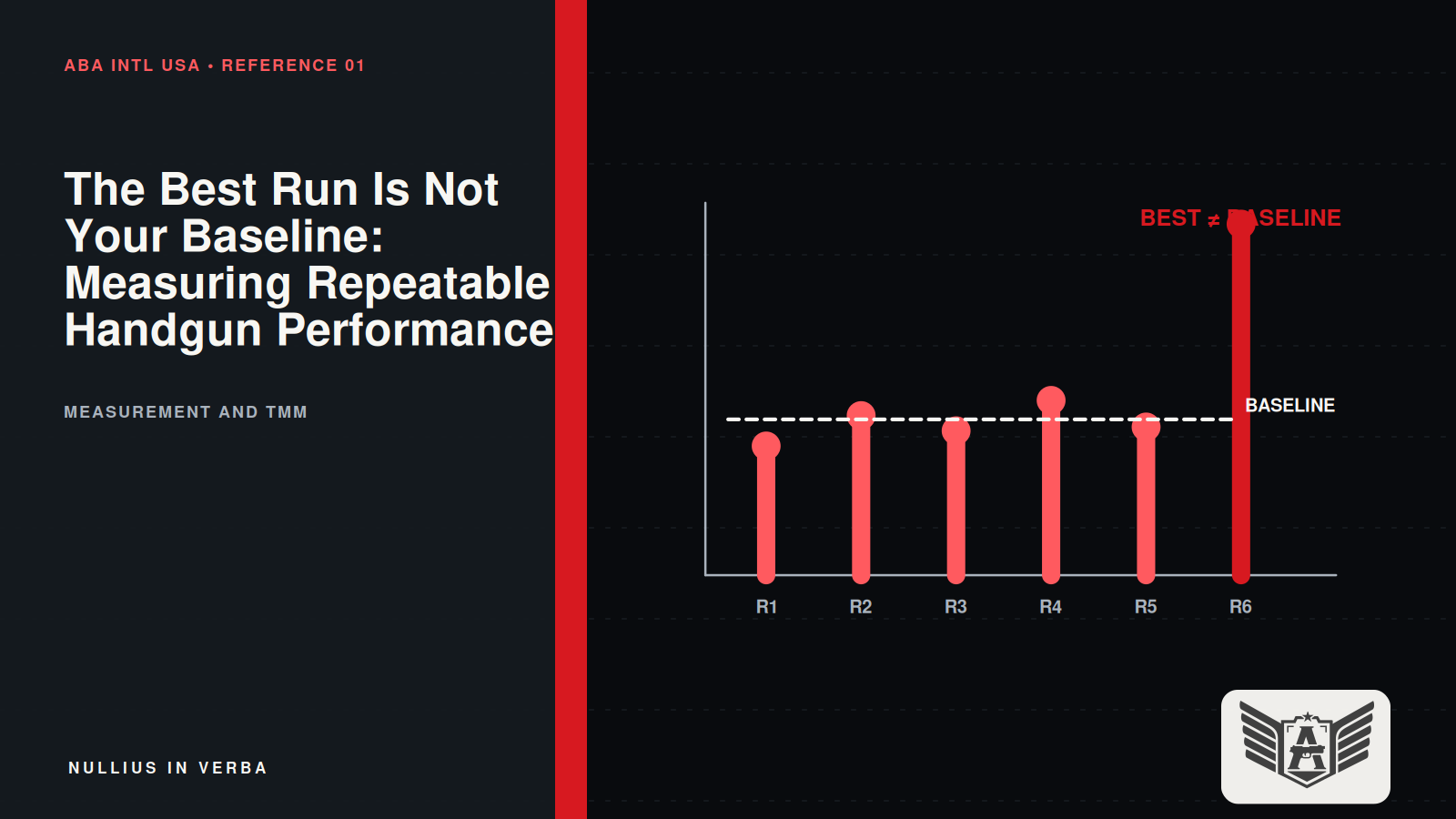
The best repetition is an extreme value selected after the fact. By
definition, it occupies the favorable tail of the performer’s
distribution. Selecting that value while ignoring the rest creates a
form of survivorship bias: the observer preserves the attempt that
supports the preferred conclusion and discards the evidence of the
system’s normal behavior. If ten attempts range from 1.30 to 1.95
seconds, reporting only 1.30 does not summarize the session. It conceals
the 0.65-second performance envelope, the central tendency, and any
relationship between faster attempts and unacceptable hits. The more
attempts a person takes, the greater the opportunity to produce an
unusually favorable extreme even if the underlying ability has not
changed.
This is why a baseline requires a predefined protocol. The task,
start position, concealment condition, target, distance, scoring zone,
timer method, allowed equipment, and definition of a valid attempt must
be established before the first scored repetition. The performer should
also know how many trials will count and how invalid attempts will be
recorded. A protocol that changes after a miss is not a measurement
procedure; it is negotiation with the result. ABA Intl’s TMM approach
places the metric between technique and method precisely because the
metric must constrain interpretation rather than decorate it (Bearare
& Silveira, 2026).
A minimal useful draw baseline can be built from five scored attempts
when logistical limits make a longer series impractical, provided its
limitations are stated. Five trials will not reveal the full probability
distribution, but they can expose more than a single best time if they
are preserved as a set. The report should retain every attempt, identify
validity against the same target criterion, calculate a measure of
central tendency, report the observed spread, and state the valid rate.
When the goal is individual diagnosis rather than population research,
this compact protocol offers a disciplined starting point for a
test-correct-retest cycle.
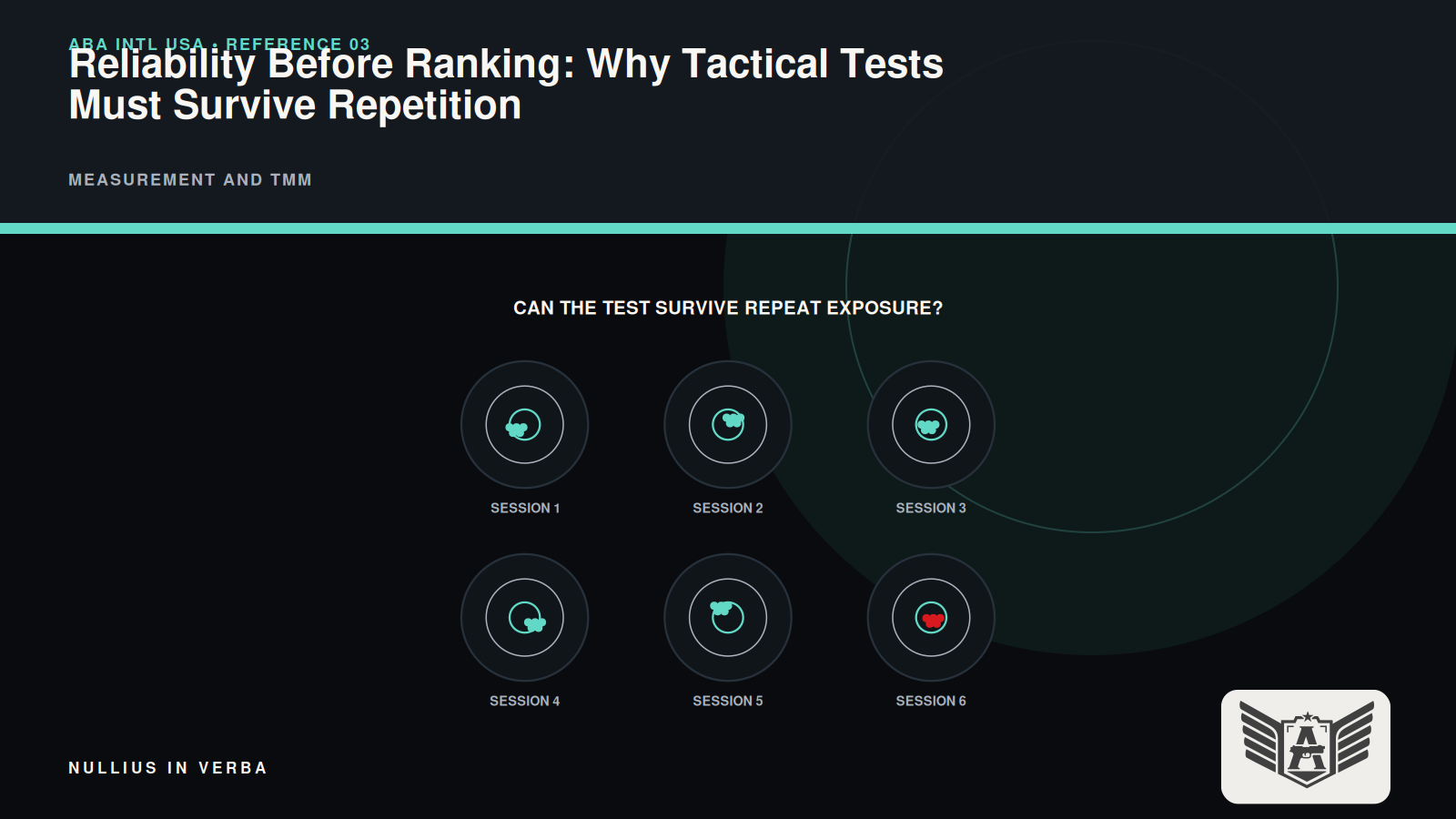
Central tendency matters because repeatable performance lives near
the center of the observations, not at the fastest edge. The arithmetic
mean is transparent and sensitive to every attempt, including unusually
slow trials. The median is more resistant to a single extreme and can
therefore provide useful context when a series contains one pronounced
disruption. Neither statistic should be treated as the “true” skill
level in isolation. When mean and median differ materially in a small
series, that disagreement is information: it suggests asymmetry, an
outlier, or a process that is not yet stable enough to summarize
comfortably with one number.
Spread matters because two shooters can have the same average and
radically different operational profiles. One may produce five tightly
clustered valid attempts around 1.55 seconds; another may alternate
between 1.25 and 1.90 seconds and arrive at a similar mean. The first
profile is predictable, while the second contains both a higher apparent
ceiling and a larger failure envelope. Range is easy to understand but
highly dependent on extreme values. Standard deviation becomes more
informative as the sample grows. For a compact field baseline, reporting
the raw trials and the range prevents the summary statistic from hiding
what happened.
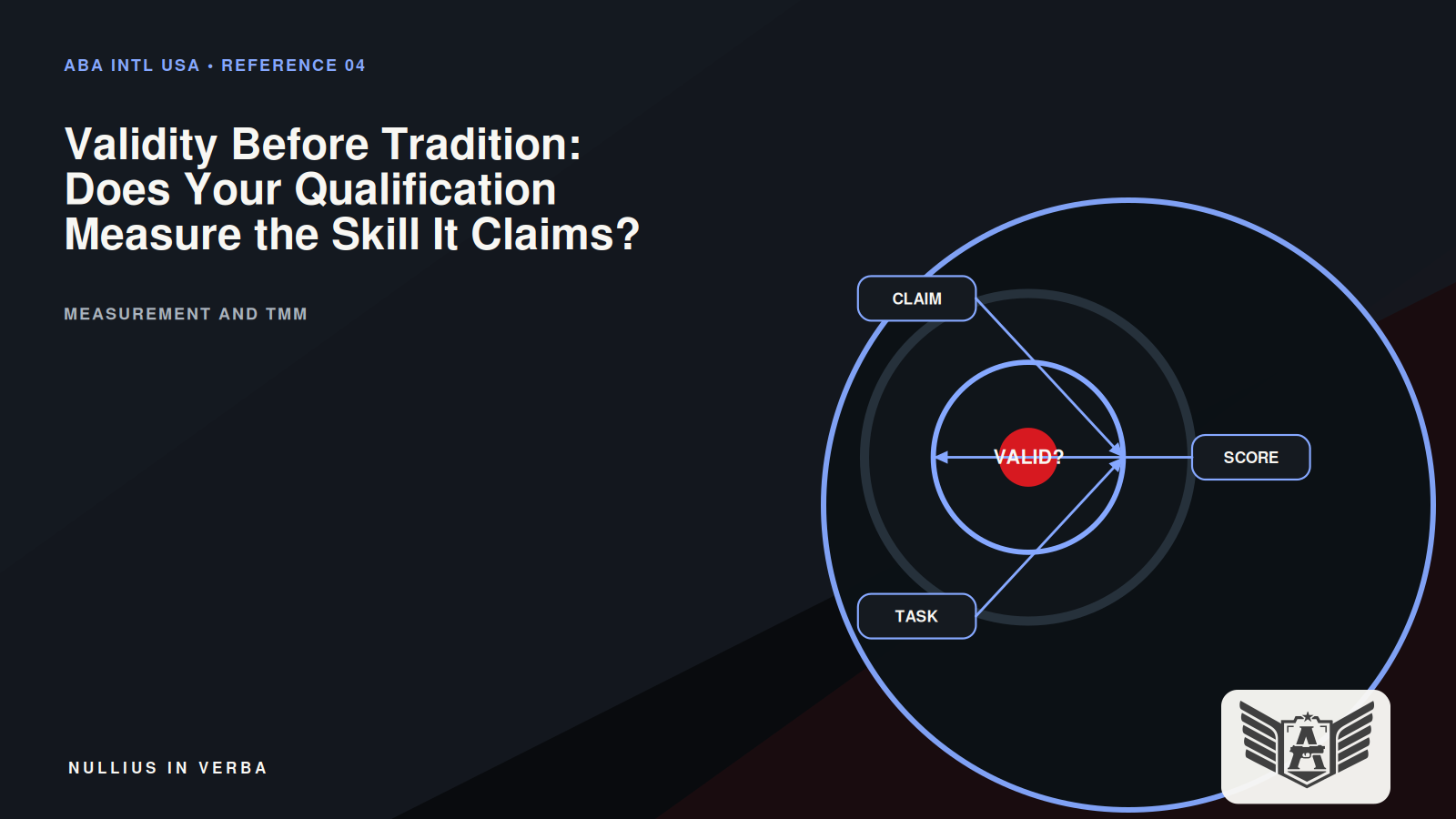
Validity matters because speed without a defined result is not draw
performance; it is movement time. Fitts’s foundational work showed that
movement speed and task difficulty are linked rather than independent
(Fitts, 1954). A faster movement toward a larger or more tolerant target
is not directly comparable with a slower movement toward a smaller or
more demanding one. In firearms assessment, the time must therefore
remain coupled to a target criterion. An attempt that ends outside the
predetermined scoring zone should not disappear. It should remain in the
dataset as an invalid attempt, because the invalid result is part of the
performer’s current speed-accuracy solution.
The valid rate is the simplest protection against a false speed
narrative. If four of five attempts meet the accuracy criterion, the
valid rate is 80 percent. The fastest attempt may still be reported, but
it should be labeled as valid or invalid, and it should never replace
the series. This prevents a performer from improving the visible time
merely by accepting a larger probability of failure. It also makes
comparisons more honest: a 1.45-second average with a 60 percent valid
rate is not self-evidently superior to a 1.60-second average with a 100
percent valid rate. The training objective determines how those profiles
should be interpreted.
Measurement also requires restraint about precision. A timer may
display 1.47 seconds, yet the complete procedure may not support the
inference that the performer is meaningfully better than at 1.50.
Start-signal anticipation, microphone detection, evaluator conventions,
target scoring, and within-person variability can all exceed the
displayed difference. Bland and Altman (1986) demonstrated why agreement
and repeatability cannot be inferred from correlation alone; the broader
lesson is that numerical resolution is not the same as measurement
certainty. Hundredths should be recorded, but small changes should not
be worshiped without repeated evidence.
Baseline conditions must be standardized enough to support comparison
while remaining relevant to the intended skill. The same belt, holster,
garment, firearm, target, distance, and start condition should be used
when the goal is to evaluate change over time. If one session begins
from an unconcealed hands-at-sides position and another from a different
garment with the hands occupied, the comparison combines training change
with task change. Both tasks may be worth measuring, but they are
different tests. A disciplined record does not force unlike conditions
into one trend line.
At the same time, standardization should not be mistaken for
transfer. A stable baseline answers a narrow question: how does this
performer behave under this protocol? It does not prove equal
performance under surprise, movement, low light, decision requirements,
startle, or altered equipment. Introduction to Combat Shooting
argues for connecting biomechanical execution to the demands of
application rather than treating isolated technique as the whole
competence (Silveira, 2023). The controlled baseline is valuable because
it isolates variables; its value disappears when the instructor pretends
that isolation reproduces the entire operational environment.
The best use of a baseline is diagnostic. Technique identifies the
movement solution being observed. Metrics reveal the pattern of
outcomes. Method selects the next training intervention. A wide spread
with acceptable accuracy may point toward inconsistent access or
presentation timing; a tight spread with a low valid rate may indicate a
stable but poorly calibrated speed-accuracy solution; a stable and valid
series that does not transfer under decision pressure may indicate that
the limitation is not mechanical at all. TMM prevents the instructor
from prescribing drills before identifying which part of the system is
constraining performance.
Retesting completes the logic. After a defined training block, the
performer repeats the same protocol under comparable conditions.
Improvement is not established by one faster attempt but by a defensible
change in the distribution: a lower central time, a narrower spread, a
higher valid rate, or some combination aligned with the stated
objective. If the average improves while spread and validity
deteriorate, the method may have purchased speed by destabilizing the
skill. If spread narrows before the mean changes, the performer may be
building the consistency that later permits speed to increase
safely.
Coaches should also distinguish a baseline from a qualification
threshold. A baseline is descriptive and individual: it estimates
current behavior. A standard is evaluative: it defines what level is
acceptable for a role or task. Mixing the two encourages ego protection.
A weak baseline is not a moral verdict; it is useful information.
Conversely, passing a generous standard does not mean the performer has
reached the limit of meaningful development. The baseline tells us where
the person is; the standard tells us whether a specified requirement was
met.
The cultural obstacle is often greater than the statistical one.
Firearms communities reward exceptional numbers, dramatic clips, and the
appearance of certainty. Serious training requires the opposite habit:
preserving misses, slow trials, unstable transitions, and failed retests
because those observations contain the information needed for
correction. Nullius in Verba is not hostility toward expertise.
It is a demand that expertise expose itself to measurement. An
instructor should be able to explain what was tested, how it was scored,
what uncertainty remains, and what evidence would change the
conclusion.
Your fastest draw can remain a personal record. It can be motivating
and worth celebrating. It simply should not be promoted into a
description of capability that it cannot support. Establish the task,
record the entire series, couple time to validity, inspect the center
and the spread, and retest after a defined method. That procedure is
less glamorous than posting the best number, but it produces something
far more valuable: a performance model that can be criticized, improved,
and reproduced.
References
Bearare, S. C., & Silveira, L. (2026). Technique-Method-Metric
Triad in firearms training under extreme stress. RECIMA21 – Revista
Científica Multidisciplinar, 7(7), e778536.
https://doi.org/10.47820/recima21.v7i7.8536
Bland, J. M., & Altman, D. G. (1986). Statistical methods for
assessing agreement between two methods of clinical measurement. The
Lancet, 1(8476), 307–310.
https://doi.org/10.1016/S0140-6736(86)90837-8
Fitts, P. M. (1954). The information capacity of the human motor
system in controlling the amplitude of movement. Journal of
Experimental Psychology, 47(6), 381–391.
https://doi.org/10.1037/h0055392
Morrow, J. R., Jr., Jackson, A. W., Disch, J. G., & Mood, D. P.
(2011). Measurement and evaluation in human performance (4th
ed.). Human Kinetics. [Portuguese edition: Artmed, 2014.]
Silveira, L. M. da. (2023). Introduction to combat shooting:
Scientific foundations, training, and application for instructors and
trainees. Editora CRV. https://doi.org/10.24824/978652514835.9

TRAIN. MEASURE. EQUIP.
Continue learning through ABA research and training. When equipment is the next variable, go directly to the ABA Store.
GET THE EQUIPMENT →Continue from research to practice
Knowledge is useful when it changes what you do next.
Connect technical execution with perception, judgment and decision-making in the Cognitive Operator pathway.
Explore Cognitive Operator