
If an individual does not understand what is happening in their environment, the outcome of a confrontation is often decided before any physical action takes place. In high-risk environments, particularly those involving armed conflict or defensive use of force, the decisive factor is rarely technical execution alone. Rather, it is the ability to correctly perceive, interpret, and anticipate unfolding events. This capability is formally defined in the scientific literature as situational awareness (SA).
Within the context of modern combat training, there remains a persistent overemphasis on technical proficiency—weapon handling, marksmanship, speed, and mechanical efficiency. While these elements are undeniably important, they are insufficient in isolation. Operators frequently train to improve execution under controlled conditions, yet fail to develop the cognitive processes required to navigate dynamic, uncertain, and ambiguous environments. The result is a dangerous asymmetry: highly trained individuals who are technically capable, but cognitively unprepared.
To illustrate this, consider a common operational scenario. An individual is positioned in a public or semi-public environment. Ambient conditions appear normal: movement is routine, behavioral patterns are consistent, and no immediate threat is apparent. Suddenly, a disruption occurs—a sudden movement, a raised voice, a shift in crowd behavior. At this moment, the critical question is not how quickly the individual can draw a weapon or engage a target. The defining question is far more fundamental: what is actually happening?
This distinction is not trivial. Human beings do not react to reality itself, but rather to their interpretation of it. In high-stress environments, this interpretation is often incomplete, biased, or delayed. Consequently, incorrect decisions are made not because of a lack of technical skill, but because the underlying perception of the situation is flawed.
Common approaches to addressing this problem tend to focus on increasing training volume or intensity. Practitioners may engage in more repetitions, acquire more advanced equipment, or emphasize faster execution. However, these strategies implicitly assume that the primary limitation lies in motor performance. This assumption is inconsistent with the findings of decades of research in human factors and cognitive systems.
A foundational contribution to this field is the work of Mica R. Endsley, particularly her 1995 paper titled “Toward a Theory of Situation Awareness in Dynamic Systems,” published in the journal Human Factors. Endsley sought to address a critical question: why do highly trained operators—such as pilots, military personnel, and system controllers—commit significant errors in complex, time-sensitive environments, despite possessing high levels of technical proficiency?
Her answer reframed the problem. The issue was not primarily one of skill execution, but of situational awareness. Endsley defined SA as a three-level construct:
- Perception of environmental elements
The detection of relevant stimuli within the environment—objects, individuals, movements, and changes. - Comprehension of their meaning
The integration of these elements into a coherent understanding of the situation—distinguishing between normal and abnormal behavior, identifying potential threats, and contextualizing observed patterns. - Projection of future status
The ability to anticipate how the situation is likely to evolve in the immediate future—predicting actions, trajectories, and outcomes.

Critically, failures in operational environments are most commonly associated not with a breakdown in perception alone, but with deficiencies in comprehension and projection. In other words, operators may see what is happening, but fail to correctly interpret its significance or anticipate its consequences.
This finding has direct implications for combat training. If an individual’s training does not explicitly develop all three levels of situational awareness, performance will degrade significantly under real-world conditions. This degradation is compounded by stress, time pressure, and cognitive overload, all of which impair information processing and decision-making.
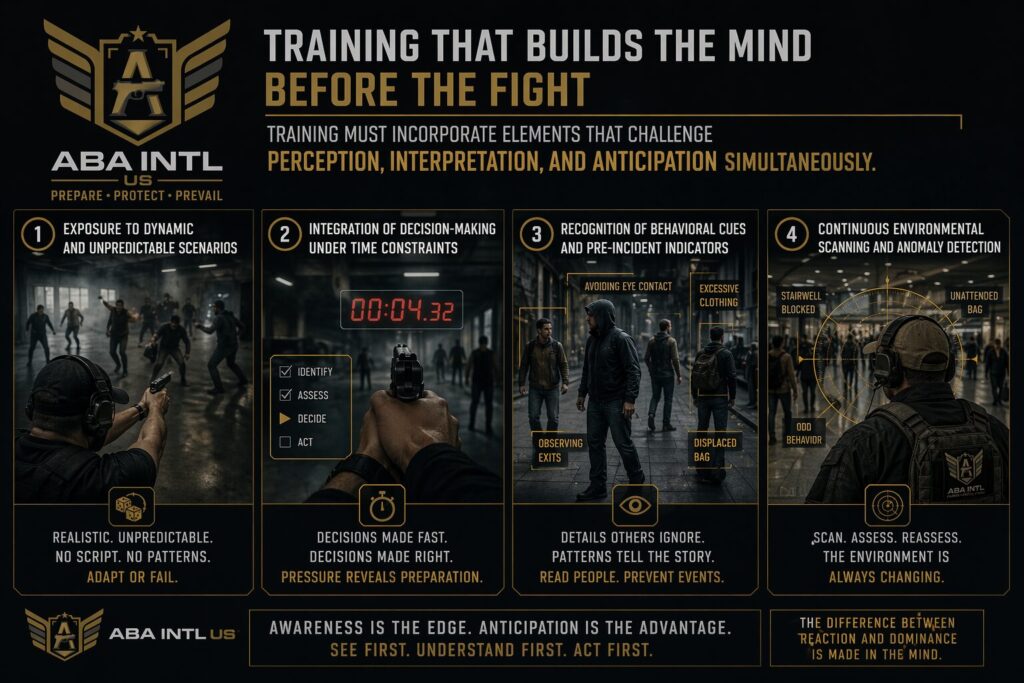
From an applied perspective, situational awareness transforms how training should be structured. Rather than focusing exclusively on isolated technical drills, training must incorporate elements that challenge perception, interpretation, and anticipation simultaneously. This includes:
- Exposure to dynamic and unpredictable scenarios
- Integration of decision-making under time constraints
- Recognition of behavioral cues and pre-incident indicators
- Continuous environmental scanning and anomaly detection
These elements shift training from a purely mechanical domain to a cognitive-operational one. The objective is no longer to execute a predefined action, but to solve a problem in real time, based on incomplete and evolving information.
In the field of security and armed defense, this distinction is critical. An operator who relies solely on reactive behavior will always be at a temporal disadvantage. Reaction, by definition, occurs after the initiating event. In contrast, an operator with well-developed situational awareness operates proactively—detecting early indicators, interpreting them accurately, and acting before the situation fully materializes.
This is particularly relevant in environments characterized by ambiguity. For example, two individuals may observe the same stimulus—such as a person moving rapidly through a crowd. One may perceive this as a generic disturbance and react without context. The other, drawing on a more refined situational awareness framework, may assess directionality, body language, environmental response, and contextual anomalies. The difference is not in what is seen, but in how it is understood.
Ultimately, situational awareness represents a foundational layer of combat effectiveness that precedes technical execution. Weapon handling, marksmanship, and physical response are downstream processes. They are only as effective as the decisions that initiate them.
Therefore, the central implication for modern training systems is clear: combat does not begin with the trigger press—it begins with perception. More precisely, it begins with the ability to transform raw environmental data into actionable understanding, and to project that understanding forward in time.
In this sense, situational awareness is not an auxiliary skill. It is the framework within which all other skills operate. Without it, technical proficiency becomes disconnected from reality. With it, even simple actions gain strategic significance.
The question, then, is not whether situational awareness is important. The question is whether current training methodologies adequately develop it.
Because in real-world conditions, the difference between reacting to an event and anticipating it is often measured not in seconds—but in outcomes.
Continue from research to practice
Knowledge is useful when it changes what you do next.
Use this evidence to identify the next capability you need to build and the ABA route designed for it.
Find your ABA training path