
Most shooters believe they are improving because they are doing things that look and feel like training. They go to the range, run drills, fire rounds, compare groups, watch videos, buy equipment, and repeat familiar exercises often enough to feel a sense of forward movement. Yet the feeling of progress is a poor substitute for evidence. In firearms training, as in every serious performance domain, improvement cannot be established by effort, confidence, round count, equipment changes, or time spent around the activity. It has to appear in performance itself: measurably, repeatably, and in a direction that actually matters.
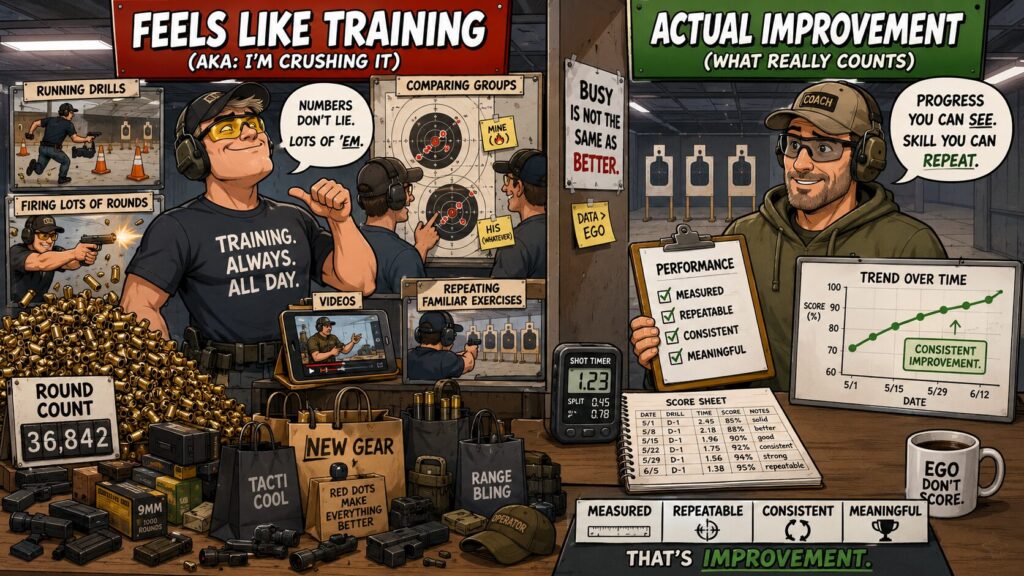
This distinction is uncomfortable because many shooters live in a middle ground where they are no longer beginners, but they are not clearly developing either. They know more than they once did, they may own better equipment, they may have taken courses, and they may look more fluent on video. Still, their actual performance remains inconsistent. Some days feel good, others feel disappointing, and most sessions end with an emotional interpretation instead of a technical conclusion. The shooter leaves the range thinking that the draw felt better, the groups looked cleaner, the pace seemed faster, or the movement appeared smoother. Some of those impressions may contain useful information, but they are not enough. Human perception is selective, memory is generous, and ego is very good at converting isolated success into a story of improvement.
A serious shooter needs a better question than whether he trained today. The better question is what changed, how that change was verified, and whether it can be reproduced when the conditions are no longer convenient.
Stability Matters More Than the Best Run
One of the clearest indicators of improvement is not the occasional excellent repetition, but the stabilization of performance across repeated attempts. A single fast repetition does not define skill. A single tight group does not define accuracy. A clean drill performed once does not prove that a technique has been acquired. Skill must be judged across multiple repetitions because the relevant question is not what the shooter can do once under favorable conditions, but what he can reproduce with enough consistency to trust.
Many shooters deceive themselves without intending to. They remember the best run, the cleanest target, the one repetition that finally felt right, and then use that moment as evidence of a new level. But performance is not measured by the most flattering sample. If the best run improves while the average remains unchanged, the shooter may have produced a good moment rather than a better system. If the best shot looks excellent but the worst shot remains unacceptable, the ceiling may have risen slightly while the floor remains low. Real improvement raises both. It gives the shooter better peaks, but it also makes the poor repetitions less poor, the unstable moments less frequent, and the entire performance profile more trustworthy.
In most training cultures, shooters overvalue the highlight and undervalue the pattern. The highlight feels rewarding because it shows what the shooter wants to believe he is becoming. The pattern is more demanding because it shows what he can actually reproduce. A serious evaluation must pay close attention to averages, variation, failure points, and the recurring errors that appear when attention slips or pace increases. Those details usually reveal more than the best repetition of the day.
In most training cultures, shooters overvalue the highlight and undervalue the pattern.
Benchmarks Separate Evidence From Impression
Improvement requires comparison, and comparison requires stable points of reference. Many shooters unknowingly sabotage their own evaluation by changing too many variables at once. They train at different distances, on different targets, with different time constraints, under different rules, and then try to compare one session with another as if the conditions were equivalent. They are not. Without some consistent benchmarks, training becomes a series of anecdotes.
This does not mean every session should be identical. Variation is necessary because shooting skill must eventually survive outside of narrow, rehearsed conditions. However, variation and measurement do not serve the same function. Variation challenges the shooter. Measurement audits the shooter. If every session is completely variable, the shooter loses the ability to determine whether better performance came from actual improvement or simply from easier conditions. If every session is completely fixed, the shooter may become efficient inside one narrow script while failing to adapt elsewhere.
The solution is to keep both elements in the training process. Stable benchmark tests allow shooters to compare performance over time. Variable practice prevents the shooter from becoming dependent on one predictable arrangement. The benchmark answers the question of whether measurable improvement occurred. Variable training asks whether that improvement can survive outside the original test.
The Target Is Evidence, Not Diagnosis
As shooters improve, their errors should become less mysterious. Early in training, a miss or a poor group often appears as vague failure. The shot went low. The group opened. The time was slow. The draw felt wrong. The transition looked messy. The problem is noticed, but not yet understood. As the shooter develops, he becomes better at separating outcome from cause. This matters because the target can show what happened, but it cannot always explain why it happened.
A poor hit may result from trigger manipulation, visual disruption, grip inconsistency, poor timing, anticipation, unstable posture, excessive pace, or a chain of events that began before the shot was fired. Two shooters may produce similar targets for entirely different reasons. The same shooter may produce the same error on different days through different mechanisms. Treating the target as the full diagnosis creates shallow correction. The target should begin the investigation, not end it.
This is one of the reasons video analysis is so valuable. The shooter experiences the repetition from the inside, while the camera records behavior from the outside. Those two perspectives often disagree. A shooter may believe the problem occurred at the moment of the shot, while the video shows that the error started earlier. He may feel aggressive and decisive, while the footage shows hesitation. He may believe his movement is efficient, while the recording reveals wasted motion. He may think his technique is consistent, while frame-by-frame review exposes subtle changes from one repetition to the next. The camera does not care about self-image. It records behavior.
Better Corrections Are More Specific
Poor training usually produces broad advice. Go slower. Grip harder. Focus more. Be smoother. Practice more. Some of these phrases may contain truth, but they are too vague to guide serious adaptation. A useful correction identifies a specific behavior, connects it to a performance outcome, and gives the shooter a clear priority for the next training cycle. The issue is not simply that the shooter needs to “get better.” The issue is that one element is currently limiting performance more than the others, and that element must be addressed first.
Specificity separates better practice from more repetition. Repetition only strengthens the pattern being repeated. If the pattern is useful, repetition can help consolidate it. If the pattern is flawed, repetition may preserve the flaw and make it more resistant to change. A shooter who practices without diagnosis may be working hard while reinforcing the exact behavior that limits him.
This is where many shooters need external feedback. Self-observation has value, but it has limits. The shooter cannot see everything he is doing while he is doing it. Even when video is available, interpretation requires knowledge. A student may record a session and still miss the primary limiting factor. He may focus on a visible but secondary issue while ignoring the deeper pattern. He may try to correct too many things at once. He may mistake a symptom for a cause. Good feedback narrows the problem and gives the next training session a purpose.
Transfer Is the Test
Many shooters become good at individual drills without becoming broadly better shooters. They learn the rhythm, expectation, sequence, and narrow demand of a specific exercise. The drill improves, but the underlying ability does not always transfer. This creates an illusion of improvement. The shooter sees better numbers inside a familiar task and assumes that skill has increased globally. Sometimes it has. Sometimes he has merely become efficient at that drill.
Drills are useful when they isolate variables and develop technical components. They become misleading when the shooter mistakes drill familiarity for durable skill. Real improvement appears when the relevant ability carries into related but non-identical tasks. Better control should show up in more than one target arrangement. Better timing should survive more than one rhythm. Better visual discipline should remain visible under changes in distance, target size, or sequence. Better decision-making should persist when the shooter does not know exactly what is coming next.
A skill that exists only inside one drill is not yet robust. It is rehearsed behavior under narrow conditions. The purpose of training is not to make shooters good at performing exercises for their own sake. The purpose is to build capacities that remain available when the task changes.
Speed and Accuracy Must Improve Together
Shooters often treat speed and accuracy as competing identities. They either shoot carefully and slowly, or they shoot quickly and poorly. Better training changes that relationship. The purpose is not simply to go faster, and it is not to worship accuracy under conditions so slow and comfortable that the result has little performance meaning. The purpose is to develop enough technical efficiency that speed can increase without destroying control, while accuracy remains tied to the actual demand of the task.
This relationship has to be measured honestly. If speed increases while accuracy collapses, the shooter has not necessarily improved; he may have lowered the standard. If accuracy improves only because all time pressure disappeared, the result may not represent better functional performance. Improvement lives in the relationship between the two. The shooter has to determine whether he can produce the required accuracy within the required time, across enough repetitions to trust the result.
The best shooters are not merely fast or accurate. They understand cost. They know when speed is useful, when it is excessive, when precision matters more, and when hesitation is doing more harm than movement. That kind of judgment does not come from emotion. It comes from measured exposure to the relationship between pace, control, and consequence.
Training Decisions Should Become Less Emotional
In the absence of measurement, shooters often choose future training based on frustration, boredom, ego, or novelty. If they performed badly, they chase the error impulsively. If they performed well, they repeat the drill because it feels good. If they get bored, they change everything. If a new video appears online, they abandon the plan and copy what looks interesting. This creates noise instead of development.
A serious training process has continuity. The shooter knows what he is working on, why it matters, how it will be measured, and when it is time to progress. That does not make training rigid or sterile. It simply prevents every session from becoming an isolated emotional event. Training is a process of adaptation, and adaptation depends on information. Information depends on measurement. Measurement depends on standards. Standards require interpretation. When those elements are missing, the shooter is left with activity rather than development.
This is why training should produce records, not just memories. A useful training record does not need to be complicated. It should preserve enough information to reveal whether performance is changing. What was the task? What was the standard? What happened? What failed? What improved? What should be addressed next? Without that continuity, the shooter is forced to rely on mood and memory, both of which are unreliable evaluators.
Video Turns Training Into Feedback
ABA | Debrief was built around a simple but neglected truth: many shooters do not need another random drill. They need someone to look at what they are actually doing and identify the highest-value correction. The student sends video. ABA analyzes performance. The result is not encouragement, entertainment, or vague commentary. The result is diagnosis: what is happening, what matters most, what should be corrected first, and how the next stage of training should be organized.
This changes the relationship between effort and improvement. Guessing feels active because the shooter is doing something, but diagnosis gives training a direction. ABA | Debrief does not replace practice. It makes practice more intelligent. It transforms video into feedback, feedback into priorities, and priorities into a clearer path forward.
The shooter who trains without feedback often has energy but lacks orientation. He repeats, but he does not always know what the repetition is building. He records, but he does not necessarily know what the video means. He senses that something is wrong, but he may not know which correction should come first.

The Evidence Should Be Visible
If you want to know whether your shooting is actually improving, examine the evidence rather than the feeling. Look at the stability of your results, not only your best runs. Look at the relationship between speed and accuracy. Look at whether your errors are becoming clearer. Look at whether your corrections are more specific. Look at whether your skill survives outside the original drill. Look at whether your training decisions follow a method or simply react to mood.
Most shooters do not fail because they lack effort. They fail because their effort lacks direction. They repeat, but they do not measure. They record, but they do not analyze. They train, but they do not diagnose. Over time, this produces a frustrating loop: activity without clarity, effort without adaptation, confidence without verification.
Improvement is not a feeling. It is a visible pattern in performance. If you cannot see the pattern, you need better feedback.