
Introduction: The Persistent Question of Automaticity
Among the many questions that arise in the study of human performance, few are as persistent—or as frequently misunderstood—as the question of automaticity. Whether the discussion takes place among athletes, musicians, surgeons, pilots, martial artists, military personnel, or firearms instructors, the underlying concern remains remarkably similar. Practitioners want to know how long it takes before a skill no longer requires deliberate thought, why certain actions eventually appear effortless, and what separates a behavior that can be performed only under ideal conditions from one that remains available under stress, fatigue, uncertainty, and environmental complexity.
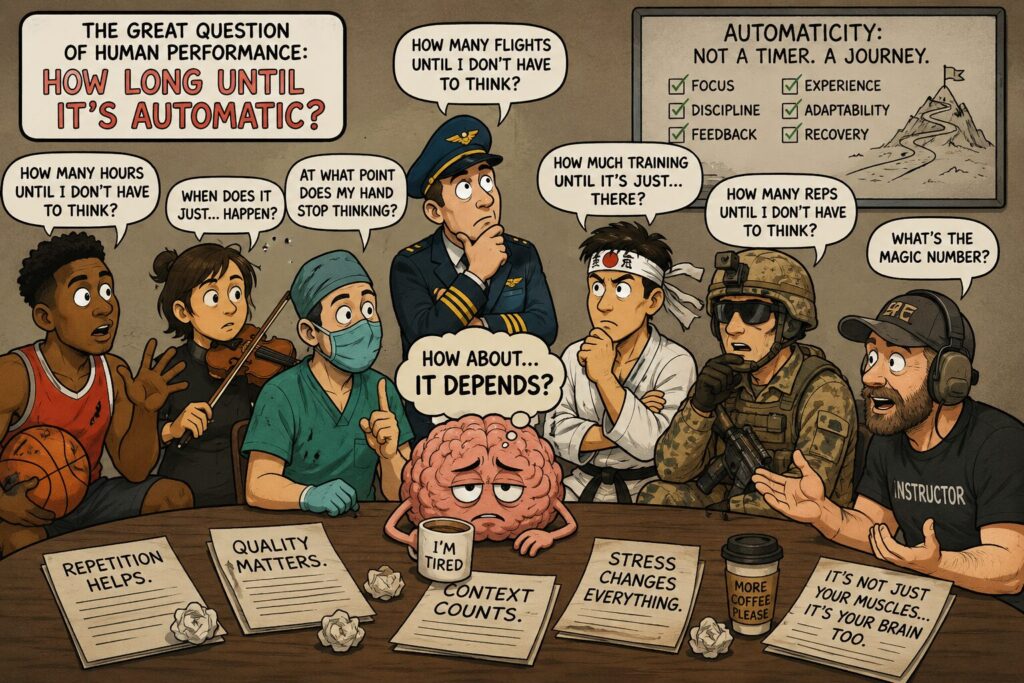
The appeal of the question is easy to understand. Individuals engaged in the development of high-level performance quickly discover that technical knowledge alone does not guarantee execution. A novice shooter may intellectually understand grip, stance, sight alignment, trigger manipulation, and recoil management, yet remain incapable of combining those elements into a coherent and reliable performance. Similarly, a beginning musician may understand musical notation without being able to perform fluently, just as a medical student may possess extensive anatomical knowledge without demonstrating surgical competence. Across domains, a gap exists between knowing what to do and being capable of doing it consistently. Automaticity occupies a central position within that gap because it describes the process through which behavior becomes increasingly efficient, increasingly stable, and increasingly resistant to disruption.
What separates a behavior that can be performed only under ideal conditions from one that remains available under stress, fatigue, uncertainty, and environmental complexity?
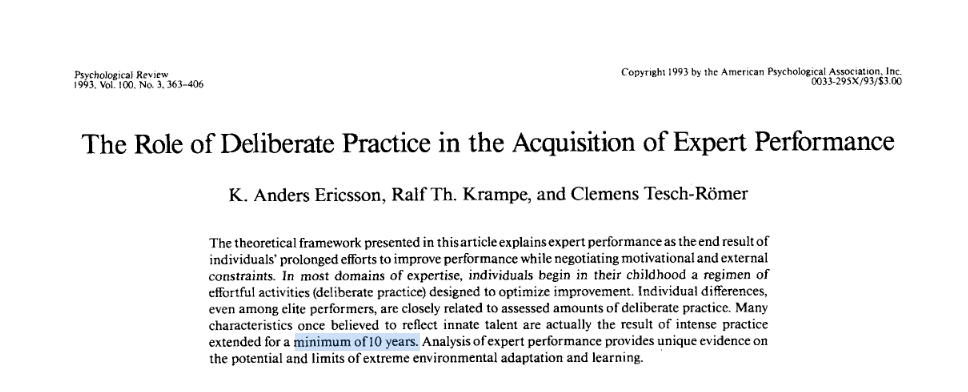
Popular culture has not always treated the subject with the same degree of nuance. Public discussions of expertise became heavily influenced by simplified interpretations of research on deliberate practice and expert performance. The widespread popularity of the so-called “10,000-hour rule” contributed to the belief that mastery could be reduced to a numerical threshold and that sufficient exposure would eventually transform any performer into an expert. Although this interpretation gained enormous cultural traction, it bears only limited resemblance to the scientific literature from which it emerged. Ericsson, Krampe, and Tesch-Römer (1993) never proposed a universal number of hours required for expertise, nor did they suggest that accumulated practice volume alone could explain expert performance. Actually, their work emphasized the importance of deliberate practice—highly structured activities specifically designed to improve performance through feedback, error correction, and progressive challenge. Subsequent research has reinforced the conclusion that practice quantity explains only a portion of performance variability and that the quality, structure, and objectives of training often exert a greater influence on long-term development than exposure alone (Macnamara, Hambrick, & Oswald, 2014).
The persistence of the 10,000-hour narrative nevertheless reveals something important about how humans think about skill acquisition. Numerical answers are attractive because they provide certainty. They imply that performance development follows a predictable trajectory and that expertise can be achieved through accumulation. The reality appears considerably more complex. Individuals exposed to similar training volumes often display markedly different rates of improvement. Some skills become highly automated after relatively modest practice, while others require years of development despite extensive exposure. Furthermore, the same performer may exhibit different levels of automaticity across different components of a task. A shooter, for example, may display highly automated weapon presentation mechanics while still relying heavily on conscious processing for visual search, target discrimination, or tactical decision-making. Such observations suggest that automaticity is not a singular event but a multidimensional process involving numerous interacting systems.
Understanding this process requires moving beyond popular descriptions and examining automaticity through the lens of scientific research. Over the past century, investigators from cognitive psychology, neuroscience, motor learning, and expertise research have attempted to explain how repeated practice alters the relationship between cognition and action. Although these disciplines differ in terminology and theoretical emphasis, they converge on several important observations. First, automaticity does not represent the absence of thought; it represents a reduction in the attentional resources required for execution. Second, automaticity appears to emerge gradually through repeated adaptation, not abruptly after a specific amount of practice. Third, the development of automaticity depends not merely on repetition but on the interaction between repetition, feedback, environmental conditions, and task demands. Finally, automaticity should not be confused with expertise itself. Highly automated behavior may contribute to expert performance, but expertise also requires adaptability, perception, judgment, and decision-making capabilities that extend beyond the automation of motor skills.
These distinctions become particularly relevant in firearms training because discussions of automaticity frequently intersect with questions of performance under stress. Military personnel, law enforcement officers, competitive shooters, and armed citizens often seek skills that remain available when attentional resources are compromised by physiological arousal or environmental uncertainty. Under such conditions, actions that require extensive conscious processing may become unreliable, while behaviors that have undergone sufficient adaptation may remain accessible despite substantial cognitive load. This observation has led many instructors to emphasize repetition as a means of creating automatic responses. While the underlying intuition is reasonable, the scientific literature suggests that the relationship between repetition and automaticity is considerably more sophisticated than commonly assumed.
The purpose of this text is therefore not to identify a specific number of hours, repetitions, or training sessions required to achieve automaticity. Such a number almost certainly does not exist. Instead, the objective is to examine what automaticity actually represents, how it develops, which mechanisms appear responsible for its emergence, and why some forms of practice accelerate the process while others produce surprisingly little adaptation despite substantial effort. By integrating findings from motor learning, cognitive psychology, neuroscience, and expertise research, the manuscript seeks to provide a more scientifically grounded understanding of what performers are attempting to accomplish when they train for automaticity and why the path toward that objective is far more dependent upon the nature of adaptation than upon the simple accumulation of experience.
Defining Automaticity: What the Scientific Literature Actually Means
Few concepts in the performance sciences have generated as much practical interest—and as much conceptual confusion—as automaticity. Within professional communities concerned with skill development, the term is frequently invoked to explain everything from expert marksmanship and elite athletic performance to emergency decision-making and combat effectiveness. Despite its widespread use, however, automaticity is often described in ways that differ substantially from how the concept is understood within cognitive psychology and motor learning research. Popular discussions frequently portray automaticity as a state in which conscious thought disappears and behavior unfolds independently of cognitive control. Scientific descriptions are considerably more nuanced. Rather than representing the absence of cognition, automaticity refers to a change in the relationship between cognition and action, whereby the attentional resources required for task execution are progressively reduced through adaptation and experience.
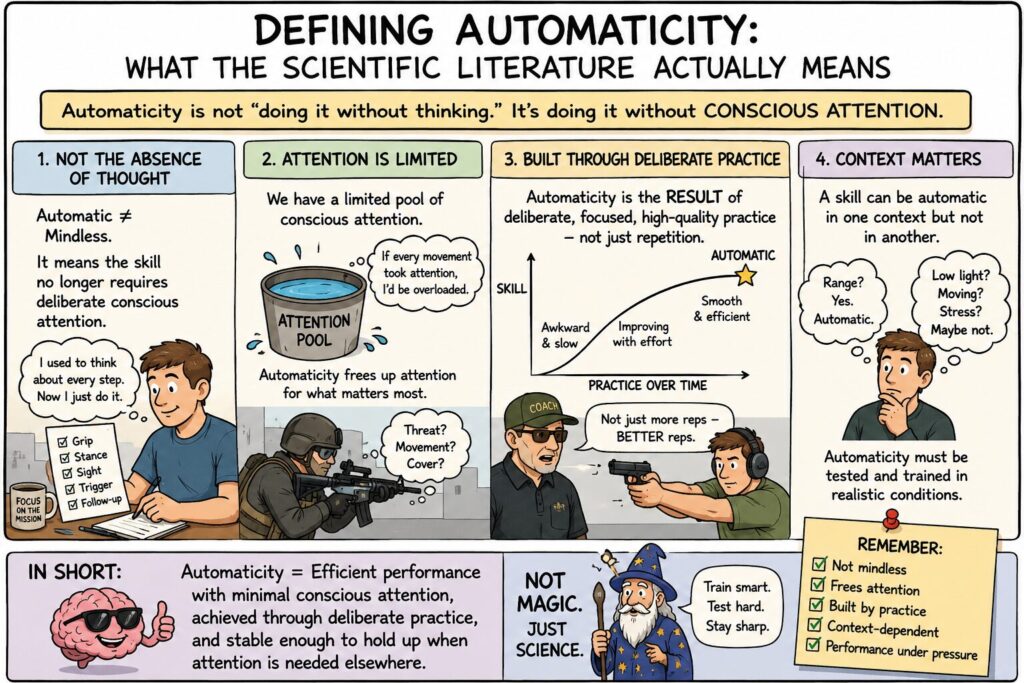
Understanding this distinction is essential because many misconceptions surrounding training originate from misunderstandings regarding the nature of automatic performance. If automaticity is incorrectly interpreted as unconscious behavior, training may become focused on accumulating repetitions in the hope that thought itself eventually disappears. If, however, automaticity is understood as a specific form of information processing characterized by efficiency, consistency, and reduced attentional demand, then the discussion shifts from repetition alone toward the mechanisms through which practice reorganizes cognitive and motor functions. The difference is not merely theoretical. It directly influences how instructors design training, how performers evaluate progress, and how organizations conceptualize readiness.
The modern scientific study of automaticity emerged largely from research examining human attention and information processing during the latter half of the twentieth century. One of the most influential contributions came from Schneider and Shiffrin (1977), who distinguished between controlled processing and automatic processing. Controlled processes were described as effortful, capacity-limited, and dependent upon conscious attention. Automatic processes, in contrast, required comparatively little attentional involvement and could often occur concurrently with other cognitive activities. Although subsequent research refined many aspects of this distinction, the fundamental observation remains influential: human performance appears to undergo qualitative changes as experience accumulates. Tasks that initially demand substantial cognitive resources gradually become executable with increasing efficiency and decreasing attentional cost.
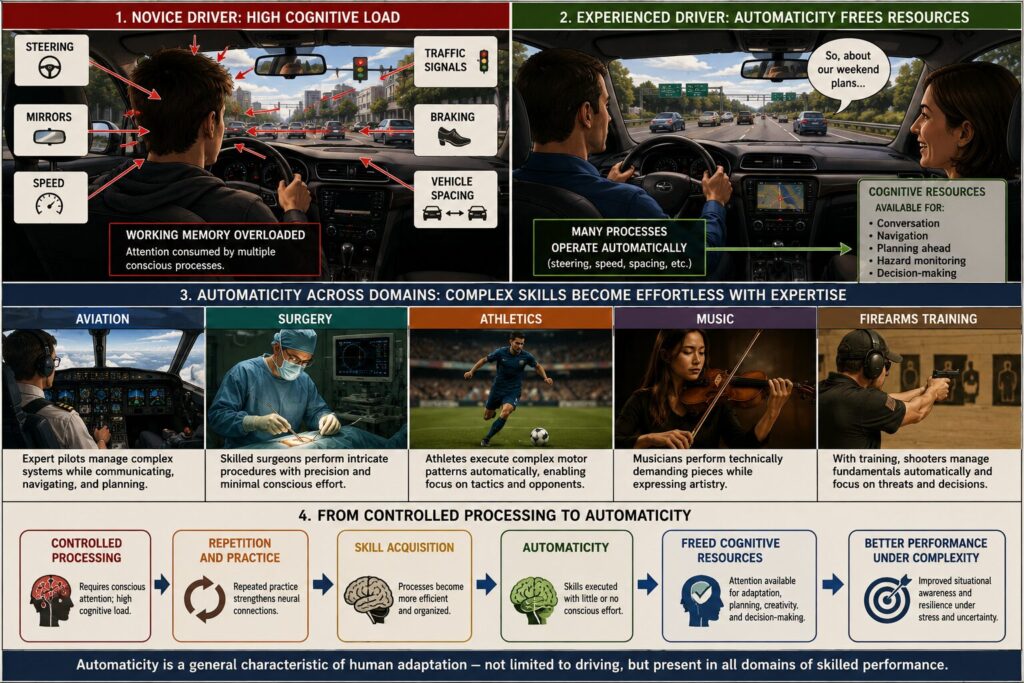
This principle can be observed in virtually every domain involving skilled performance. A novice driver allocates attention to steering, braking, lane positioning, speed regulation, mirrors, traffic signals, and vehicle spacing simultaneously. The experience is often cognitively exhausting because working memory becomes heavily occupied by processes that have not yet been organized efficiently. An experienced driver performs the same task under identical environmental conditions while carrying on a conversation, monitoring navigation instructions, and planning future activities. The complexity of the task has not diminished. What has changed is the degree to which task execution depends upon conscious oversight. Similar observations can be made in aviation, surgery, athletics, music, and firearms training, suggesting that automaticity represents a general characteristic of human adaptation instead of a phenomenon specific to any particular activity.
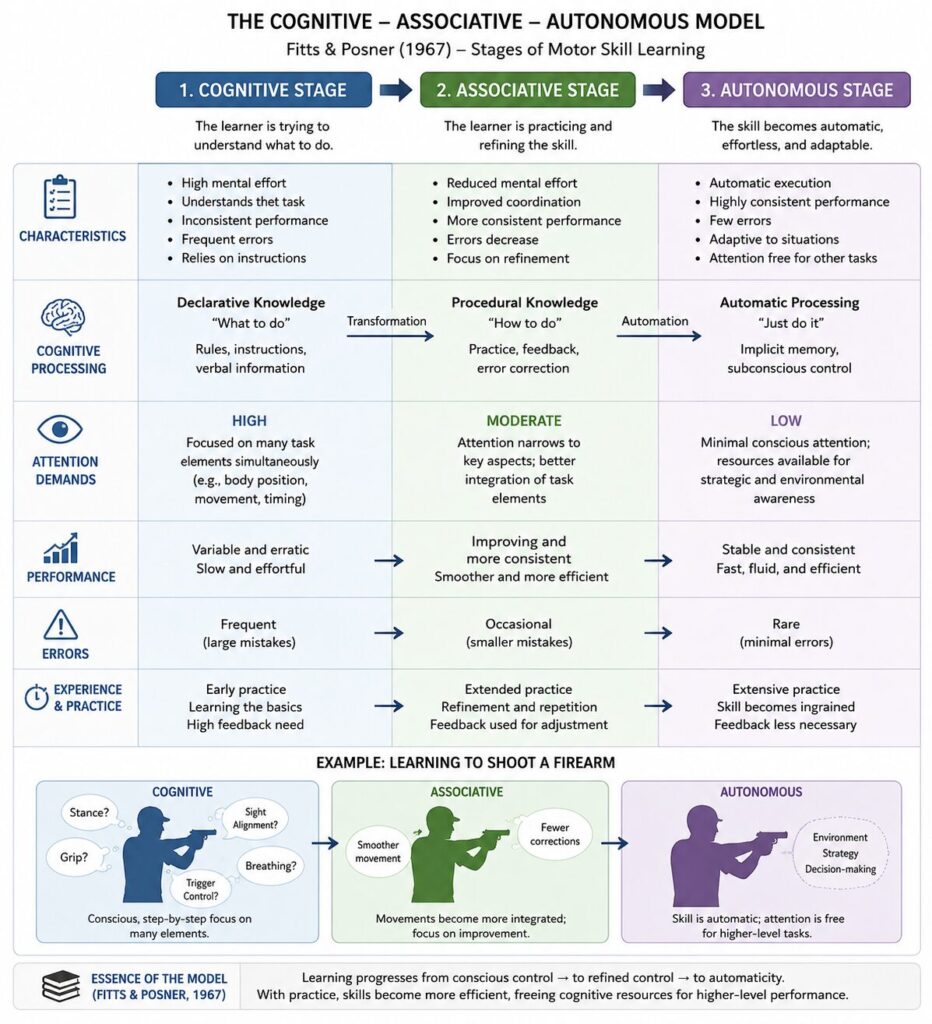
Within motor learning literature, one of the most enduring frameworks for understanding this progression was proposed by Fitts and Posner (1967). Their three-stage model of skill acquisition remains influential not because it perfectly captures every aspect of learning but because it provides a useful conceptual structure for understanding how performers transition from deliberate control toward increasingly automatic execution. During the cognitive stage, individuals rely heavily upon conscious processing. Performance is characterized by inconsistency, frequent errors, and substantial attentional demand because the performer is attempting to understand both the requirements of the task and the actions necessary to satisfy those requirements. Execution often appears fragmented because individual components of behavior have not yet been integrated into coherent functional units.
As practice continues, performers enter what Fitts and Posner described as the associative stage. During this phase, relationships between actions and outcomes become progressively clearer, movement organization improves, and errors become more predictable. Importantly, the reduction in error frequency is accompanied by a reduction in attentional demand. Behaviors that previously required deliberate monitoring begin occurring with greater efficiency because the performer no longer needs to allocate equal attention to every component of the task. The resulting increase in fluency is often interpreted subjectively as improved confidence, although from a scientific perspective it reflects a deeper reorganization of perceptual, cognitive, and motor processes.
The autonomous stage represents the culmination of this progression. By this point, execution becomes increasingly resistant to distraction and increasingly independent of conscious supervision. The performer remains capable of directing attention toward the task when necessary, but moment-to-moment control is no longer required for successful execution. Crucially, this stage should not be interpreted as the elimination of cognition. Expert performers continue thinking, analyzing, planning, and adapting. What changes is the object of attention. Resources that were previously consumed by basic execution become available for higher-order concerns such as environmental assessment, tactical decision-making, anticipation, and strategy.
This observation highlights one of the most important misconceptions surrounding automaticity. Many practitioners assume that automaticity represents an endpoint of learning. The scientific literature suggests otherwise. Automaticity can be understood as a characteristic of certain components of performance. Even highly experienced individuals routinely execute some aspects of behavior automatically while consciously regulating others. A competitive shooter may possess highly automated presentation mechanics while simultaneously engaging in deliberate visual analysis of targets. A pilot may operate aircraft systems automatically while consciously evaluating weather conditions and navigational decisions. A surgeon may perform familiar procedural movements with minimal attentional demand while carefully considering unexpected complications. Automaticity therefore exists alongside conscious processing, but not replacing it.
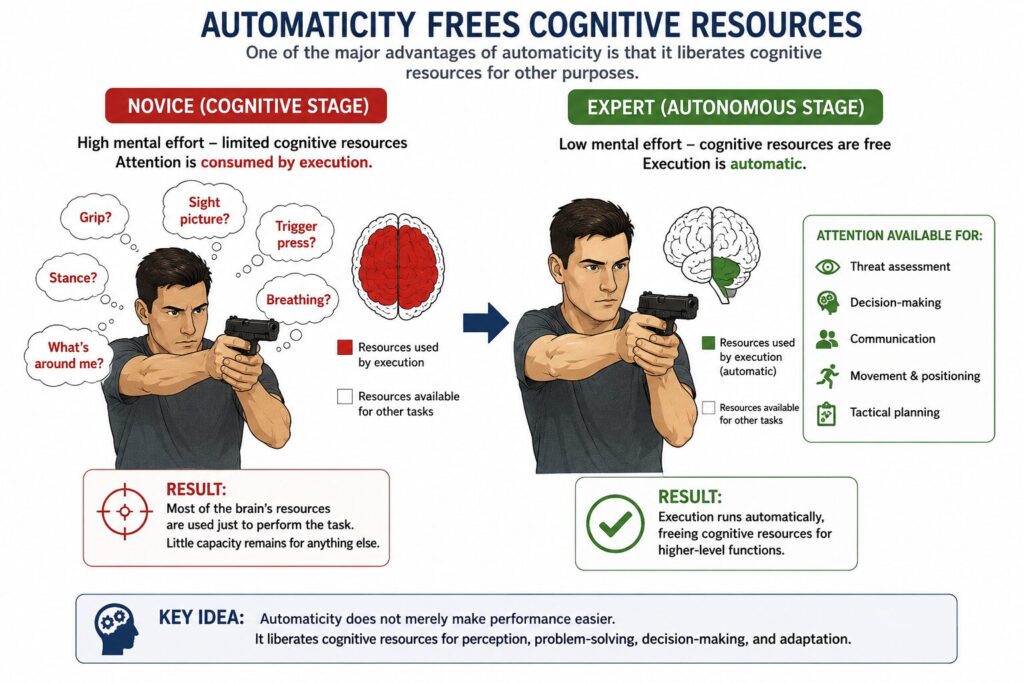
The distinction becomes clearer when examined through the lens of working memory research. Human cognitive architecture imposes strict limitations on the amount of information that can be actively processed at any given moment. Tasks that consume large portions of working-memory capacity reduce the performer’s ability to attend to additional information. Consequently, one of the major advantages of automaticity is not merely that it makes execution easier but that it liberates cognitive resources for other purposes. In complex operational environments, this benefit may be more important than the automated behavior itself. A shooter whose weapon manipulation requires continuous conscious attention possesses fewer resources available for identifying threats, interpreting environmental cues, communicating with teammates, or making decisions under pressure. Automaticity therefore contributes to performance not simply by increasing speed or consistency but by reducing the cognitive burden associated with execution.
Theories of cognitive architecture have attempted to explain how these transformations occur. Anderson’s Adaptive Control of Thought (ACT) theory provides one influential perspective. According to Anderson (1982), learning involves a gradual transition from declarative knowledge—knowledge that can be consciously articulated—to procedural knowledge, which is expressed through performance rather than verbal explanation. Early in learning, performers rely heavily upon explicit rules and conscious reasoning. With continued practice, those rules become proceduralized, allowing execution to occur more efficiently and with less cognitive effort. Although different theoretical models describe the process using different terminology, the central idea remains remarkably consistent across the literature: automaticity emerges through the reorganization of knowledge and behavior, not through simple repetition count.
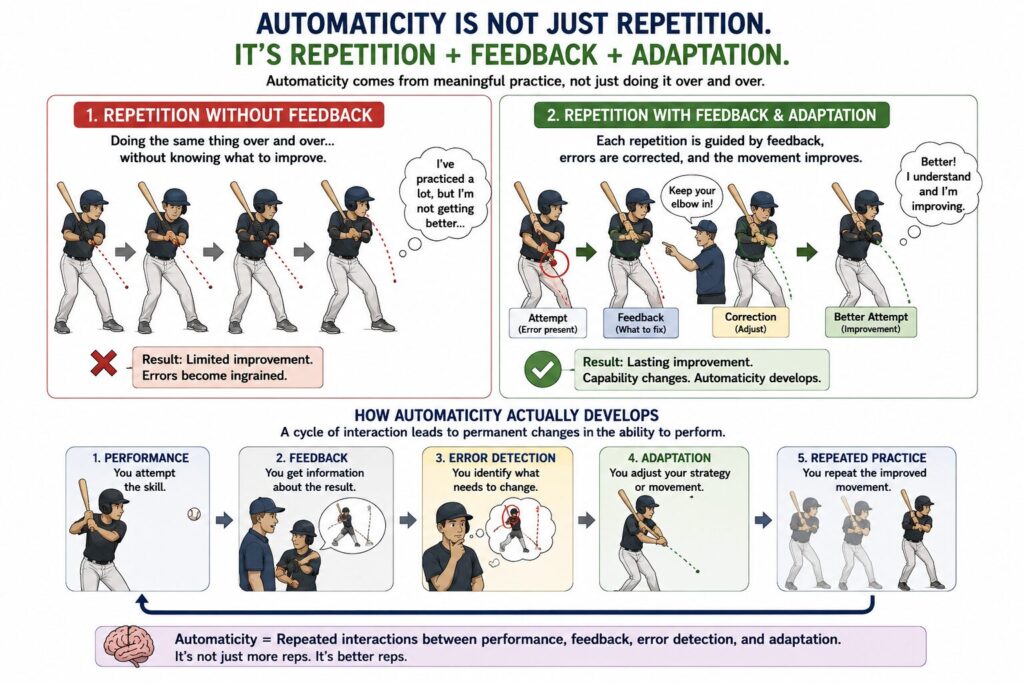
This point deserves emphasis because repetition is frequently treated as the primary mechanism responsible for automaticity. The scientific evidence suggests a more complex relationship. Repetition undoubtedly contributes to learning, but repetition without feedback, correction, or adaptation often produces surprisingly limited improvements. Schmidt and Lee (2019) emphasize that motor learning involves relatively permanent changes in the capability for skilled action. The implication is that repeated exposure becomes valuable only to the extent that it produces meaningful adaptation. Consequently, automaticity should not be understood as the inevitable consequence of accumulated repetitions but as the product of repeated interactions between performance, feedback, error detection, and behavioral adjustment.
These considerations ultimately lead to a broader conclusion regarding the nature of expertise itself. Automaticity is undoubtedly one of the defining characteristics of high-level performance, but it does not constitute expertise in isolation. Expert performers are distinguished not merely by the existence of automated behaviors but by their ability to integrate those behaviors within complex perceptual, cognitive, and environmental contexts. Automaticity allows execution to become efficient; expertise determines how that efficiency is applied. Confusing the two concepts risks reducing performance to mechanics while ignoring the broader systems within which skilled behavior actually occurs.
For this reason, understanding automaticity requires more than identifying the number of repetitions associated with proficiency. It requires understanding how human beings allocate attention, how knowledge becomes proceduralized, how cognitive resources are conserved, and how practice gradually transforms deliberate action into efficient behavior. Only then does the question of training volume begin to make sense, because the issue is no longer how many times a task has been performed, but how profoundly the performer has been changed by performing it.
Automaticity as a Product of Motor Learning
Any serious discussion of automaticity must ultimately confront a more fundamental question: how does a behavior evolve from an effortful, consciously regulated action into a stable and efficient performance requiring relatively little attentional supervision? Although automaticity is often discussed as an outcome, its origins lie within the broader processes of motor learning. The concept cannot be understood independently of the mechanisms through which humans acquire, refine, organize, and stabilize movement. Consequently, an examination of automaticity requires moving beyond descriptions of expert performance and into the domain of learning itself.
How does a behavior evolve from an effortful, consciously regulated action into a stable and efficient performance requiring relatively little attentional supervision?
The relationship between motor learning and automaticity is neither incidental nor merely sequential. Automaticity emerges from learning. More precisely, it emerges from specific forms of learning that alter the organization of perception, cognition, and action over time. The transition from novice to expert is therefore not simply a matter of accumulating knowledge or increasing familiarity with a task. It involves a progressive reorganization of the systems responsible for producing behavior. This reorganization affects not only how movements are executed but also how information is perceived, interpreted, and integrated into action.
The importance of variability during the practice is often underestimated. Inexperienced performers frequently interpret inconsistency as evidence of failure, while instructors may become concerned when performance fluctuates from repetition to repetition. From a motor learning perspective, however, variability often represents an inevitable and even necessary feature of adaptation. The learner is exploring potential solutions, testing relationships between actions and outcomes, and gradually identifying movement patterns capable of satisfying task demands. What appears externally as inconsistency may reflect a process of problem-solving occurring within the motor system itself.
As practice continues, performers enter the phase which is characterized less by discovery and more by refinement. Relationships that were initially unclear become increasingly stable. The performer begins distinguishing relevant information from irrelevant information and develops more efficient strategies for producing desired outcomes. Error rates decrease, movement efficiency improves, and attentional demands begin to decline. Importantly, the reduction in attentional demand does not occur because the task itself has become simpler. It reflects the emergence of increasingly effective organizational structures within the performer. This process introduces one of the central ideas in motor learning theory: the concept of motor programs.
The notion of motor programs emerged in response to a practical problem. Human movement often occurs too rapidly to be explained solely through continuous feedback processing. A fast draw stroke, a tennis serve, a baseball pitch, or a martial arts strike frequently unfolds more quickly than sensory feedback can be processed and used to modify execution. Researchers therefore proposed that movements are organized through pre-structured neural commands capable of controlling action without requiring continuous conscious supervision.
Schmidt’s Schema Theory (1975) represented one of the most influential developments in this area. Instead of proposing that the nervous system stores individual solutions for every possible movement, Schmidt suggested that performers develop generalized motor programs capable of generating entire classes of actions. Through practice, individuals learn relationships among movement parameters, environmental conditions, sensory consequences, and performance outcomes. These relationships form schemas that allow the performer to adapt existing motor solutions to new situations rather than requiring entirely new learning each time conditions change.
If every variation of a task required a completely separate motor program, automaticity would be extraordinarily limited. Expertise would consist primarily of memorization. Instead, the evidence suggests that skilled performers develop flexible movement structures capable of adaptation. A proficient shooter does not learn thousands of independent draw strokes. He develops a generalized solution that can be adjusted to accommodate different equipment, body positions, environmental constraints, and operational demands. Frankly, this is where most shooters waste years.
This distinction helps explain why automaticity should not be confused with rigid repetition. Popular descriptions often imply that automatic behavior results from repeating identical movements until they become permanently ingrained. Motor learning research paints a more sophisticated picture. Automaticity emerges not from preserving identical solutions but from developing robust solutions capable of surviving variation. The performer becomes increasingly capable of maintaining functional outcomes despite changes in context, timing, environmental conditions, and task requirements. At this point, variability assumes an even more important role.
Automaticity should not be confused with rigid repetition
Variability was often viewed as undesirable because it appeared inconsistent with the objective of producing reliable performance. More recent perspectives have challenged this assumption. Research in motor learning and ecological dynamics increasingly suggests that variability is not merely noise within the system but may serve important adaptive functions (Davids, Button, & Bennett, 2008). Variability allows performers to explore different movement solutions, identify effective strategies, and develop behaviors capable of functioning across a wider range of conditions.
This does not imply that all variability is beneficial. A distinction must be made between variability associated with ineffective execution and variability that contributes to adaptation. Excessive randomness may interfere with learning just as excessive rigidity may limit adaptability. Effective motor learning appears to involve a dynamic balance between exploration and stabilization. Early stages of learning often require substantial exploration as performers search for workable solutions. As experience accumulates, successful solutions become increasingly stabilized. However, stabilization should not be confused with inflexibility. Highly skilled performers often display remarkable consistency in outcomes while simultaneously exhibiting subtle variability in movement execution that allows adaptation to changing circumstances.
This observation becomes particularly relevant in firearms training because operational environments rarely present identical problems. Targets appear at different distances. Visual conditions change. Positions change. Equipment changes. Time constraints change. The performer who has developed only rigid, context-dependent solutions may display impressive performance under familiar conditions while experiencing significant degradation when circumstances change. By contrast, the performer whose learning history incorporated appropriate variability often demonstrates greater resilience because the underlying motor structures were developed through adaptation not by simple repetition.
The autonomous stage described by Fitts and Posner emerges from this prolonged process of refinement, stabilization, and adaptation. By this point, many aspects of execution require minimal conscious supervision. The performer remains capable of directing attention toward movement when necessary, but such intervention is no longer essential for successful performance. Resources previously devoted to execution become available for perception, decision-making, anticipation, and environmental assessment. Automaticity therefore represents not merely a change in movement quality but a redistribution of cognitive resources throughout the performance system.
Viewed through this lens, automaticity appears less as a destination and more as a consequence of successful motor learning. It emerges when repeated adaptation produces movement solutions that are sufficiently stable to function with reduced attentional demand while remaining sufficiently flexible to accommodate changing conditions. The path toward automaticity is therefore not defined by a specific number of repetitions or hours of practice. It reflects the gradual construction of increasingly efficient relationships among perception, cognition, and action—a process that lies at the very heart of motor learning itself.
The Neurobiology of Skill Automation
Although automaticity is often described in behavioral terms, its origins are ultimately biological. Every reduction in attentional demand, every increase in execution speed, and every improvement in consistency reflects underlying changes within the nervous system. The observable transition from effortful performance to fluid execution is therefore not merely a psychological phenomenon but the manifestation of a complex neurobiological process involving large-scale reorganization across multiple neural structures. Understanding this process requires moving beyond the language of training and performance and examining the mechanisms through which the brain transforms repeated experience into increasingly efficient behavior.
Historically, explanations of skilled performance were often constrained by the limited tools available for studying the nervous system. Researchers could observe behavior, measure outcomes, and infer underlying processes, but direct examination of neural activity remained difficult. Advances in neuroimaging and neuroscience have substantially expanded this understanding. Although many details remain subjects of ongoing investigation, a broad consensus has emerged regarding several neural systems that appear central to the development of automatic performance. Among these, the basal ganglia, cerebellum, and cortical networks occupy particularly important roles, each contributing differently to the transition from conscious control toward efficient and largely proceduralized execution.
One of the most significant findings in contemporary neuroscience is that expertise is not simply a consequence of strengthening existing neural pathways. Expertise appears to involve extensive reorganization of information processing. Novices and experts often activate different neural networks while performing the same task. The difference is not merely quantitative but qualitative. As skill develops, the nervous system appears to modify how information is represented, integrated, and utilized, allowing behavior to be executed with greater efficiency and reduced cognitive cost.
The basal ganglia have received particular attention within this context because of their well-established role in habit formation, action selection, and procedural learning. Located deep within the cerebral hemispheres, the basal ganglia consist of several interconnected structures that contribute to the initiation and regulation of movement. Their importance extends far beyond simple motor control. Research has increasingly demonstrated that these structures participate in the gradual transformation of consciously controlled behaviors into proceduralized actions that can be executed with minimal attentional involvement (Graybiel, 2008).
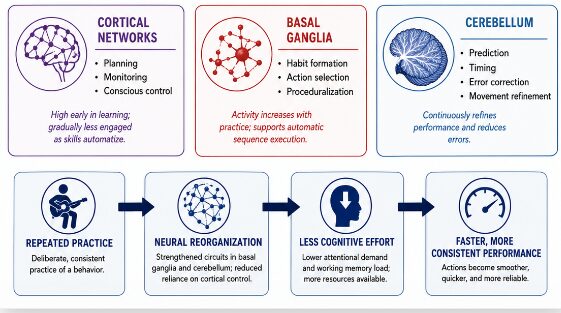
One way to conceptualize the contribution of the basal ganglia is to view them as a system responsible for reducing the computational burden associated with frequently repeated behaviors. Early in learning, performers rely heavily upon conscious decision-making processes to determine what actions should occur and when they should occur. Repeated practice gradually shifts portions of this burden toward neural systems specialized for procedural execution. As a result, behaviors that initially require substantial cognitive oversight become increasingly automatic. This transition helps explain why experienced performers often struggle to verbally describe actions they execute exceptionally well. The knowledge has not disappeared; it has become embedded within procedural systems that operate differently from conscious declarative reasoning.
The significance of proceduralization becomes particularly evident in performance domains characterized by speed and uncertainty. A combat shooter engaging multiple targets, a fighter pilot responding to rapidly evolving conditions, or a surgeon managing unexpected complications cannot consciously calculate every component of execution. The temporal constraints of the task exceed the limitations of deliberate reasoning. Procedural systems therefore provide a substantial adaptive advantage because they allow action selection and execution to occur at speeds incompatible with purely conscious control.
The cerebellum represents another critical component of this process. Traditionally associated with coordination and balance, the cerebellum is now recognized as playing a central role in motor learning, prediction, timing, and error correction. Unlike the basal ganglia, which contribute heavily to proceduralization and habit formation, the cerebellum appears particularly important for refining movement through the continuous comparison of intended and actual outcomes.
This function becomes increasingly relevant during skill acquisition because learning depends upon the detection and correction of error. Every attempt to perform a movement generates sensory information regarding the consequences of that movement. The cerebellum contributes to the construction of internal models that allow performers to anticipate those consequences before they occur. As experience accumulates, these predictive models become progressively more accurate, reducing the need for conscious monitoring and facilitating smoother, more efficient execution.
Highly skilled performance depends not merely on reacting to sensory information but on anticipating it. A novice shooter often experiences recoil as a disruptive event requiring conscious recovery. An experienced shooter, by contrast, has developed predictive models that allow the nervous system to prepare for recoil before discharge occurs. Similar phenomena are observed in athletics, where elite performers frequently appear capable of responding to events before those events are fully visible. Such capabilities emerge not from supernatural reflexes but from neural systems that have become increasingly effective at predicting future states based on prior experience.
The gradual development of these predictive mechanisms contributes to one of the most consistent findings in expertise research: experts often appear to possess more time than novices despite operating within identical environments. In reality, they are not experiencing more time. They are processing information more efficiently and generating more accurate predictions regarding future events. The resulting reduction in uncertainty creates the appearance of effortless performance.
(…) experts often appear to possess more time than novices despite operating within identical environments.
Changes occurring within cortical networks further contribute to this process. Neuroimaging studies repeatedly demonstrate that expertise is frequently associated with increased neural efficiency. Novices often exhibit widespread cortical activation while performing unfamiliar tasks, reflecting the substantial attentional and cognitive demands associated with conscious control. Experts performing the same tasks frequently display more focused and economical patterns of activation. In many cases, superior performance is accompanied by reduced cortical activity (Hatfield & Kerick, 2007).
This phenomenon has important implications for understanding automaticity. Popular descriptions often imply that expertise requires more mental effort. Neurobiological evidence suggests the opposite. As skill develops, the nervous system appears to become increasingly economical in its use of resources. Information processing becomes streamlined, irrelevant activity decreases, and execution requires less conscious intervention. Automaticity therefore reflects not only learning but efficiency.
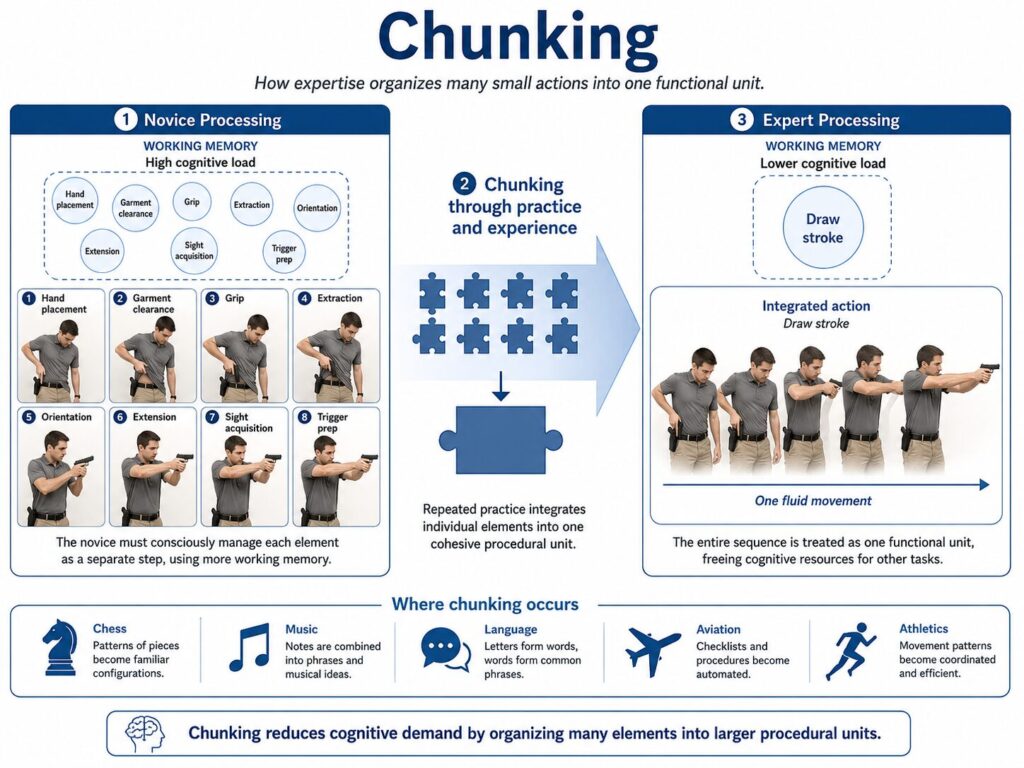
One of the mechanisms believed to contribute to this efficiency is chunking. Originally described within cognitive psychology, chunking refers to the process through which individual elements become organized into larger functional units. Human working memory possesses limited capacity, making it difficult to manage large quantities of independent information simultaneously. Through experience, however, the nervous system begins grouping related elements into coherent structures that can be processed as single units, not as collections of separate components.
Consider the draw stroke performed by an experienced shooter. A novice may perceive the movement as a sequence of independent actions involving hand placement, garment clearance, grip establishment, weapon extraction, orientation, extension, sight acquisition, and trigger preparation. An experienced performer often perceives the same sequence as a single integrated behavior. The individual components have not disappeared. They have become organized into a larger procedural unit.
Chunking dramatically reduces cognitive demand because the nervous system no longer treats each component as a separate problem requiring independent attention. Similar processes have been documented in chess, music, athletics, language acquisition, and aviation. Across domains, expertise appears closely associated with the ability to organize information into increasingly sophisticated structures that permit rapid processing and efficient action.
This process ultimately intersects with the development of procedural memory. Unlike declarative memory, which involves conscious recollection of facts and events, procedural memory concerns knowledge expressed through performance. Procedural memories are often difficult to verbalize despite exerting powerful influences on behavior. Individuals may struggle to explain how they ride a bicycle, execute a tennis serve, or perform a rapid presentation from a holster despite being fully capable of doing so. The underlying knowledge exists, but it exists in a form optimized for action.
The transition from declarative to procedural memory represents one of the defining characteristics of skill automation. Early learning depends heavily on explicit rules and conscious instruction. With continued practice, those rules become increasingly embedded within procedural systems capable of generating behavior without requiring continuous conscious reference. Automaticity emerges as these systems become sufficiently refined to support reliable performance under a wide range of conditions.
Viewed collectively, the contributions of the basal ganglia, cerebellum, cortical efficiency, chunking, and procedural memory reveal automaticity as a process of neural reorganization. The nervous system is not merely strengthening movements through practice. It is constructing increasingly efficient systems for perception, prediction, decision-making, and action. What performers experience subjectively as fluidity, instinct, or effortless execution reflects the cumulative result of countless adaptations occurring throughout the brain. Automaticity, therefore, is best understood not as the elimination of cognition but as the creation of neural architectures capable of accomplishing more while demanding less.
Why Repetition Alone Does Not Produce Expertise
Few ideas enjoy greater acceptance within training culture than the belief that repetition is the primary pathway to mastery. The assumption appears intuitive and, at first glance, difficult to challenge. Individuals who become highly skilled in any domain invariably accumulate large amounts of practice. Elite athletes train for thousands of hours. Musicians spend years refining their craft. Military operators repeatedly rehearse critical procedures. Combat shooters perform countless presentations, reloads, transitions, and live-fire repetitions throughout their careers. Because extensive experience appears universally associated with high performance, it becomes tempting to conclude that repetition itself is the mechanism responsible for expertise. The scientific literature, however, presents a more complicated picture.
Although experience undoubtedly contributes to skill development, researchers have repeatedly demonstrated that exposure alone provides an incomplete explanation for the emergence of expertise. Individuals with similar amounts of experience often display dramatically different levels of performance. Years of participation frequently fail to predict competence with the accuracy one might expect. In some cases, performers who have accumulated decades of experience continue to exhibit technical limitations that are readily identifiable to observers, while others achieve exceptional levels of proficiency in substantially shorter periods of time. Such observations suggest that the relationship between practice and expertise cannot be reduced to a simple matter of quantity.
This realization occupies a central position within contemporary expertise research and forms the foundation of one of the most influential theories in performance science: the theory of deliberate practice.
As discussed earlier, the modern discussion of deliberate practice is inseparably associated with the work of K. Anders Ericsson and his colleagues. In their landmark 1993 paper, The Role of Deliberate Practice in the Acquisition of Expert Performance, Ericsson, Krampe, and Tesch-Römer challenged explanations of expertise based primarily upon innate talent and argued that exceptional performance emerges through prolonged engagement in highly structured forms of practice specifically designed to improve performance. According to Ericsson and colleagues, deliberate practice differs fundamentally from ordinary experience. Mere participation in an activity does not necessarily generate adaptation. Individuals may perform the same behaviors repeatedly for years while producing relatively little improvement. Deliberate practice, by contrast, involves activities specifically selected to target weaknesses, challenge existing capabilities, provide immediate feedback, and encourage continuous refinement. The objective is not participation but adaptation. Training becomes valuable not because it consumes time but because it systematically alters future performance.
This distinction is particularly relevant within firearms training because the shooting community often treats experience and development as interchangeable concepts. It is not uncommon to encounter individuals who have fired tens of thousands of rounds while demonstrating surprisingly modest levels of technical proficiency. Conversely, some shooters progress rapidly despite comparatively limited exposure. The discrepancy becomes easier to understand once experience is viewed not as a measure of adaptation but merely as a measure of opportunity. Experience creates the possibility of learning; it does not guarantee that learning will occur.
Research conducted across music, chess, athletics, medicine, aviation, and numerous other domains has repeatedly shown that expertise depends heavily upon the nature of practice activities. Expert performers tend to engage in training characterized by clear objectives, focused attention, immediate feedback, and repeated efforts to improve specific aspects of execution. These conditions create a learning environment in which errors become informative rather than merely undesirable. The performer continuously encounters challenges positioned near the limits of current capability, forcing adaptation to occur.
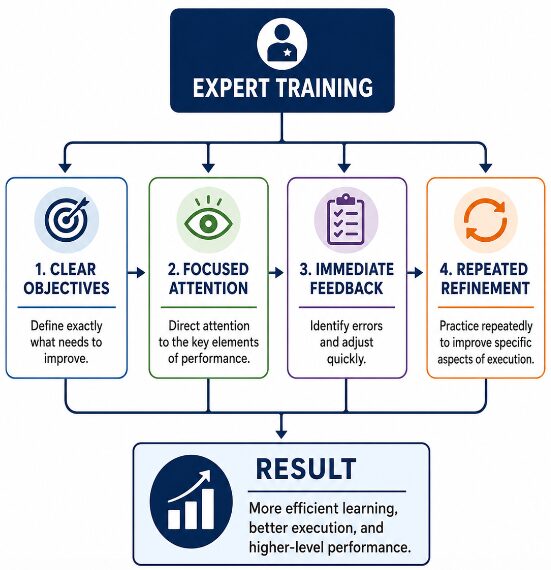
Importantly, deliberate practice should not be confused with effort alone. Many individuals train intensely without engaging in deliberate practice. Intensity may increase physiological demand, but adaptation depends upon whether the activity generates information capable of improving future performance. A shooter who spends an afternoon repeatedly engaging targets without identifying specific limitations may accumulate substantial experience while producing relatively little development. By contrast, a shooter who spends the same amount of time systematically analyzing presentation mechanics, visual behavior, trigger manipulation, and recoil management may generate far greater improvement despite firing fewer rounds.
Despite its enormous influence, the deliberate practice framework has not escaped criticism. During the decades following Ericsson’s original publication, researchers increasingly sought to quantify the extent to which deliberate practice explains performance differences among individuals. Although there is broad agreement that deliberate practice contributes significantly to expertise, the magnitude of its contribution remains the subject of ongoing debate.
One of the most influential critiques emerged from the work of Macnamara, Hambrick, and Oswald (2014). Conducting a large meta-analysis that examined deliberate practice across multiple domains, the authors concluded that practice accounted for a substantial but far from complete proportion of performance variability. Depending on the domain, deliberate practice explained between approximately 12 and 26 percent of the observed differences in performance. These findings challenged popular interpretations suggesting that practice alone could fully explain expertise.
The Macnamara findings did not demonstrate that practice is unimportant. On the contrary, practice remained one of the strongest predictors of performance. What the findings demonstrated was that expertise appears to emerge through the interaction of multiple factors. Cognitive abilities, physical attributes, motivation, environmental opportunities, coaching quality, personality characteristics, and numerous other variables likely contribute to performance outcomes. Expertise, in other words, appears more complex than any single explanatory model.
This debate has occasionally been presented as a conflict between practice and talent. Such a characterization is misleading. The more scientifically productive interpretation is that performance emerges from interactions among several variables. Deliberate practice remains essential because it represents the primary mechanism through which adaptation occurs. At the same time, adaptation does not occur within a vacuum. The characteristics of the performer influence the extent to which practice produces change.
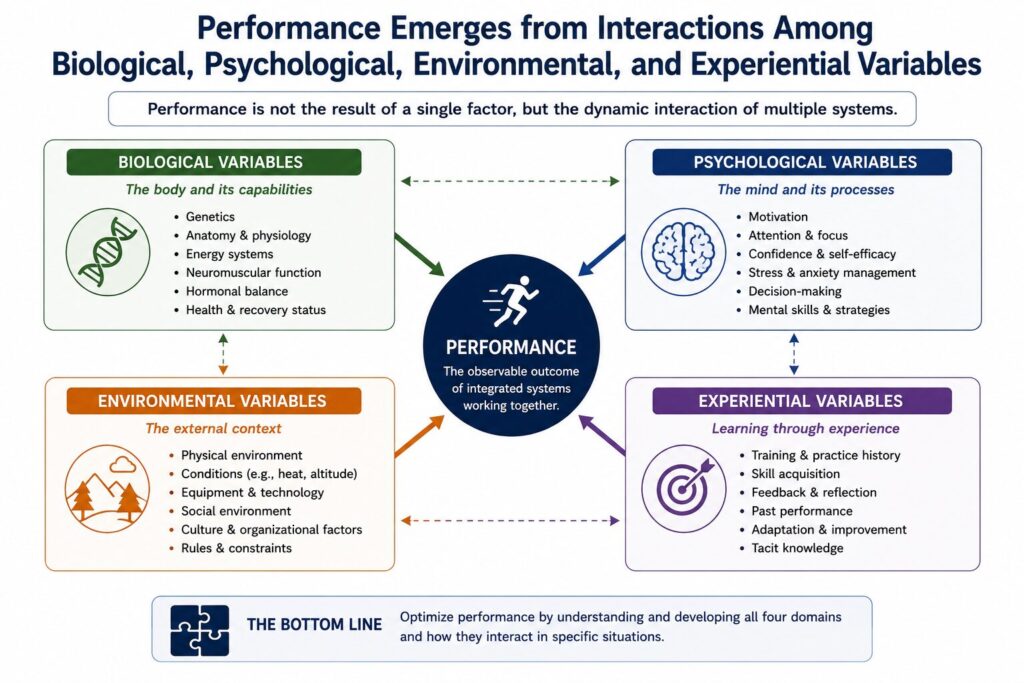
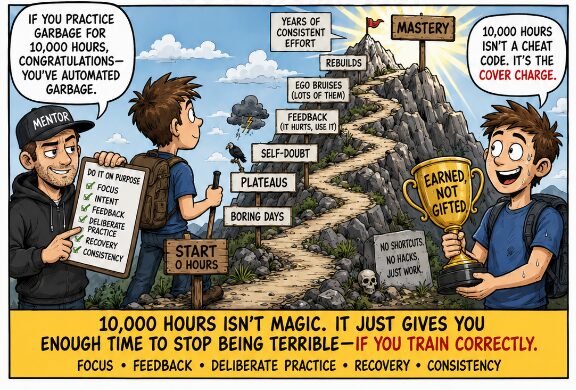
For practitioners, however, the most important lesson emerging from this literature concerns the distinction between quantity and quality. The history of training is filled with examples of individuals who equated volume with improvement. The logic is understandable. If some practice is beneficial, then more practice should be even better. Yet adaptation rarely follows such linear relationships. Repeating ineffective behavior thousands of times may strengthen familiarity without substantially improving capability. The nervous system becomes increasingly efficient at reproducing whatever it practices, whether that behavior is effective or ineffective. Consequently, repetition functions less as a mechanism for creating quality than as a mechanism for stabilizing existing patterns.
A shooter who repeatedly performs technically flawed presentations may become increasingly efficient at producing flawed presentations. A marksman who consistently anticipates recoil may gradually stabilize that anticipation. A practitioner who repeatedly engages in training devoid of measurement may become highly proficient at repeating errors without recognizing them. The nervous system does not automatically distinguish between desirable and undesirable adaptations. It simply adapts.
For this reason, expertise research repeatedly emphasizes feedback as a central component of effective practice. Adaptation depends upon information. Without information regarding performance quality, errors may remain undetected and therefore uncorrected. Feedback allows performers to compare intended outcomes with actual outcomes and modify behavior accordingly. Whether the source is an instructor, a timer, a scoring system, video analysis, or self-observation, feedback transforms repetition into a learning process.
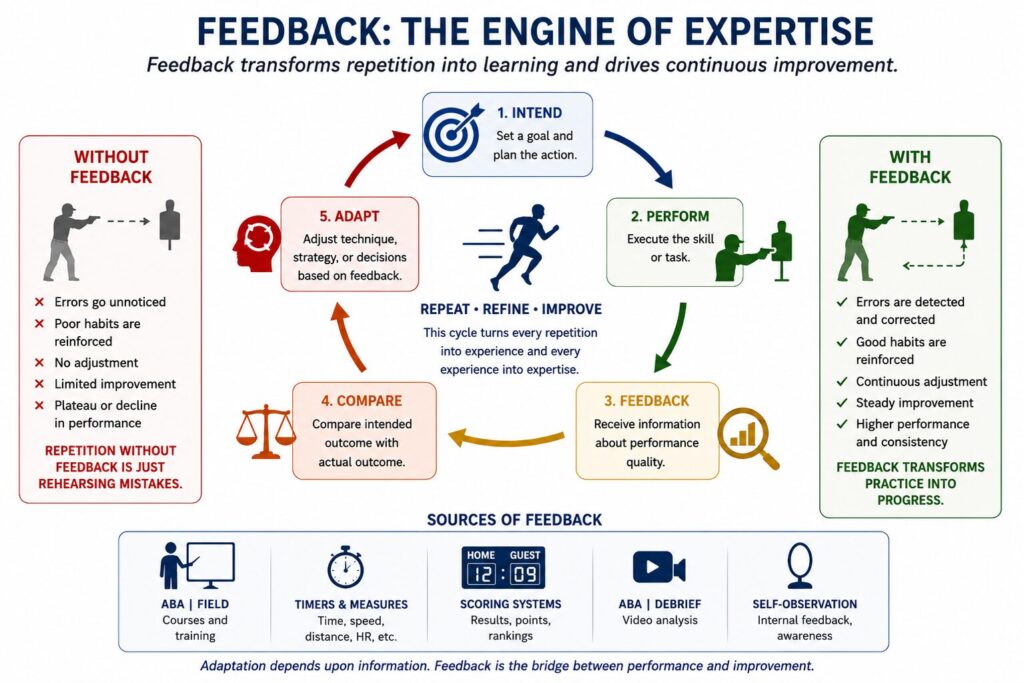
The distinction between quantity and quality therefore becomes less a matter of preference than a matter of mechanism. Quantity determines the volume of exposure. Quality determines the probability that exposure will produce meaningful adaptation. Both matter. Neither is sufficient alone. High-quality practice performed too infrequently may generate limited improvement. Massive quantities of low-quality practice may produce little more than highly stabilized mediocrity. Expertise emerges through the interaction of both variables, with quality often exerting a disproportionate influence on the efficiency of development.
Viewed from this perspective, the question of automaticity acquires a different meaning. The issue is no longer how many repetitions are required before a skill becomes automatic. The more relevant question concerns what kind of repetitions are being performed and whether those repetitions create the adaptations necessary for automaticity to emerge. The nervous system does not count repetitions. It responds to conditions. The quality of those conditions ultimately determines whether practice produces expertise or merely experience.
Stress, Attention, and Performance Under Pressure
The relationship between automaticity and performance becomes particularly important when performers are required to operate under conditions of elevated stress. Although automaticity is often discussed as a desirable outcome of training in its own right, its practical value becomes most apparent when attentional resources are constrained by factors such as uncertainty, time pressure, fatigue, physiological arousal, environmental complexity, or perceived threat. Under such circumstances, performers frequently discover that the distinction between what they can do under ideal conditions and what they can do under pressure is considerably larger than anticipated. The resulting degradation in performance has been documented across a wide range of domains, including athletics, aviation, medicine, military operations, and law enforcement, suggesting that the problem reflects fundamental characteristics of human cognition.
Discussions of performance under pressure were often framed in relatively simplistic terms. Success was attributed to confidence, mental toughness, courage, composure, or experience, while failure was frequently explained through concepts such as panic, hesitation, or loss of focus. Although these descriptions capture certain aspects of the phenomenon, they provide limited insight into the underlying mechanisms responsible for performance degradation. Advances in cognitive psychology and neuroscience have produced a more sophisticated understanding of how stress influences attention, perception, memory, and decision-making. One of the most influential frameworks to emerge from this literature is Attentional Control Theory, developed by Eysenck and colleagues (2007), which offers a useful explanation for why performance often deteriorates under conditions of anxiety despite the absence of changes in technical capability.
Human attentional capacity is limited. As task demands increase, the nervous system must continuously determine which information receives priority and which information is ignored. Under low-stress conditions, experienced performers can often allocate attention efficiently because basic execution requires relatively little conscious supervision. Under high-stress conditions, however, the balance begins to shift. Threat-related stimuli become increasingly salient. Internal dialogue increases. Concerns regarding outcomes become more prominent. Working memory becomes occupied by information that would otherwise be irrelevant to successful execution. As a result, behaviors that depend heavily upon conscious control become increasingly vulnerable to disruption.
This phenomenon is particularly relevant in the context of skill automation because automaticity effectively reduces the cognitive cost of execution. A performer whose weapon manipulation requires continuous conscious monitoring possesses fewer attentional resources available for environmental assessment, communication, target discrimination, or tactical decision-making. Conversely, a performer whose technical actions have undergone substantial proceduralization can allocate greater cognitive capacity toward higher-order demands. Automaticity therefore contributes to performance under stress not because it eliminates anxiety but because it frees the shooter from having to think about every detail of execution.
The interaction between anxiety and motor performance has been extensively investigated within sport psychology. Nieuwenhuys and Oudejans (2012), reviewing the literature on anxiety and perceptual-motor performance, concluded that elevated anxiety frequently influences visual behavior, attentional allocation, movement control, and decision-making processes. Importantly, the resulting performance deficits are not uniformly distributed across all aspects of execution. Some behaviors appear relatively resistant to stress, while others deteriorate substantially. Tasks requiring fine motor control, precise attentional regulation, or complex cognitive processing often prove particularly vulnerable when anxiety levels increase.
One of the more interesting findings emerging from this literature is that stress does not necessarily impair all performers equally. Experience appears to moderate the effects of anxiety, although not always in the ways traditionally assumed. Highly experienced performers are not immune to stress. Instead, they often possess more effective mechanisms for managing its consequences. Some of these mechanisms involve superior attentional control, while others appear to result from the existence of more highly automated behavioral repertoires. Because execution itself requires fewer cognitive resources, experienced performers retain greater capacity for dealing with environmental demands that would otherwise overwhelm attentional systems.
Expertise should not be interpreted merely as the ability to perform well under ideal conditions. In many operational domains, the defining characteristic of expertise may be the ability to preserve functional performance despite deteriorating conditions. The difference is subtle but significant. A shooter capable of producing exceptional groups on a static range demonstrates technical competence. A shooter capable of maintaining acceptable performance while processing uncertainty, movement, communication, environmental complexity, and time pressure demonstrates something broader. The latter performance depends not only upon technical skill but also upon the interaction between technical skill and cognitive architecture.
Military and law enforcement research provides particularly valuable insight into this relationship because these professions routinely involve performance under conditions of elevated stress. Numerous investigations have documented changes in perception, attention, memory, and motor behavior during high-pressure encounters. Although findings vary across studies, several recurring patterns emerge. Officers and soldiers frequently report perceptual distortions, including attentional narrowing, altered time perception, diminished awareness of peripheral information, and incomplete memory formation. These observations have been described in both laboratory and field settings, suggesting that they represent predictable responses to elevated arousal.
Importantly, the presence of such effects does not necessarily indicate failure. They illustrate the extent to which human performance becomes constrained by biological realities during threatening situations. The nervous system evolved to prioritize survival, not perfect information processing. Consequently, attentional resources become concentrated toward stimuli perceived as immediately relevant to threat management. While this response may confer evolutionary advantages, it can also create challenges in modern operational environments where successful performance depends upon the integration of multiple streams of information simultaneously.
Research conducted within military populations has repeatedly demonstrated that physiological arousal influences marksmanship, decision-making, memory, and situational awareness. Similar findings have emerged from studies involving law enforcement officers. These observations help explain why training environments designed exclusively around technical execution often fail to prepare individuals adequately for operational performance. Technical competence remains necessary, but competence acquired under conditions of minimal cognitive demand may not transfer effectively to environments characterized by uncertainty and stress.
This distinction leads directly to one of the most important questions surrounding automaticity:
Does automation eliminate performance degradation under pressure?
The evidence suggests that the answer is no.
Automaticity provides substantial protection against stress-related disruption, but it does not render performers immune to the effects of anxiety or physiological arousal. Even highly automated behaviors may deteriorate under sufficiently demanding conditions. What automaticity appears to do is reduce the probability that execution itself becomes the primary source of failure. By lowering the attentional cost of performance, automaticity allows limited cognitive resources to be allocated elsewhere.
This conclusion aligns closely with contemporary perspectives on performance under pressure. Successful execution in operational environments appears to depend not upon the elimination of stress but upon the efficient management of limited attentional resources. Automaticity contributes to that process by reducing the amount of attention required for basic task execution. Consequently, performers become better equipped to manage the perceptual, cognitive, and environmental demands that characterize real-world performance.
Viewed in this manner, automaticity emerges not as the final objective of training but as an enabling condition. Its primary value lies in creating cognitive space. By reducing the resources required for execution, automaticity allows attention to be directed toward perception, judgment, anticipation, communication, and decision-making. In environments where performance unfolds under uncertainty and pressure, those capabilities may ultimately prove more important than the automated behaviors that made them possible.
Why There Is No Universal Number
The question that motivated this post—how much training does it take to build automaticity—contains an assumption that becomes increasingly difficult to defend as one moves deeper into the scientific literature. The assumption is not that practice matters; few researchers would dispute that repeated experience plays a central role in skill acquisition. The problematic assumption is that automaticity emerges according to a predictable numerical threshold that can be generalized across performers, tasks, and contexts. Whether expressed through the popularized notion of 10,000 hours, through estimates based on repetition counts, or through various training formulas commonly encountered in professional communities, the underlying belief remains the same: somewhere beyond a certain quantity of practice, conscious control gives way to automatic performance.
The appeal of such explanations is obvious. Numerical answers provide clarity. They transform a complex biological and psychological process into something that appears measurable and predictable. Unfortunately, the accumulated evidence from cognitive psychology, motor learning, neuroscience, and expertise research provides little support for the existence of a universal threshold. Automaticity does not emerge after a fixed number of repetitions, a predetermined number of hours, or a specific amount of exposure. The process appears considerably more dynamic, influenced by interactions among individual characteristics, task demands, environmental conditions, feedback quality, and the structure of practice itself.
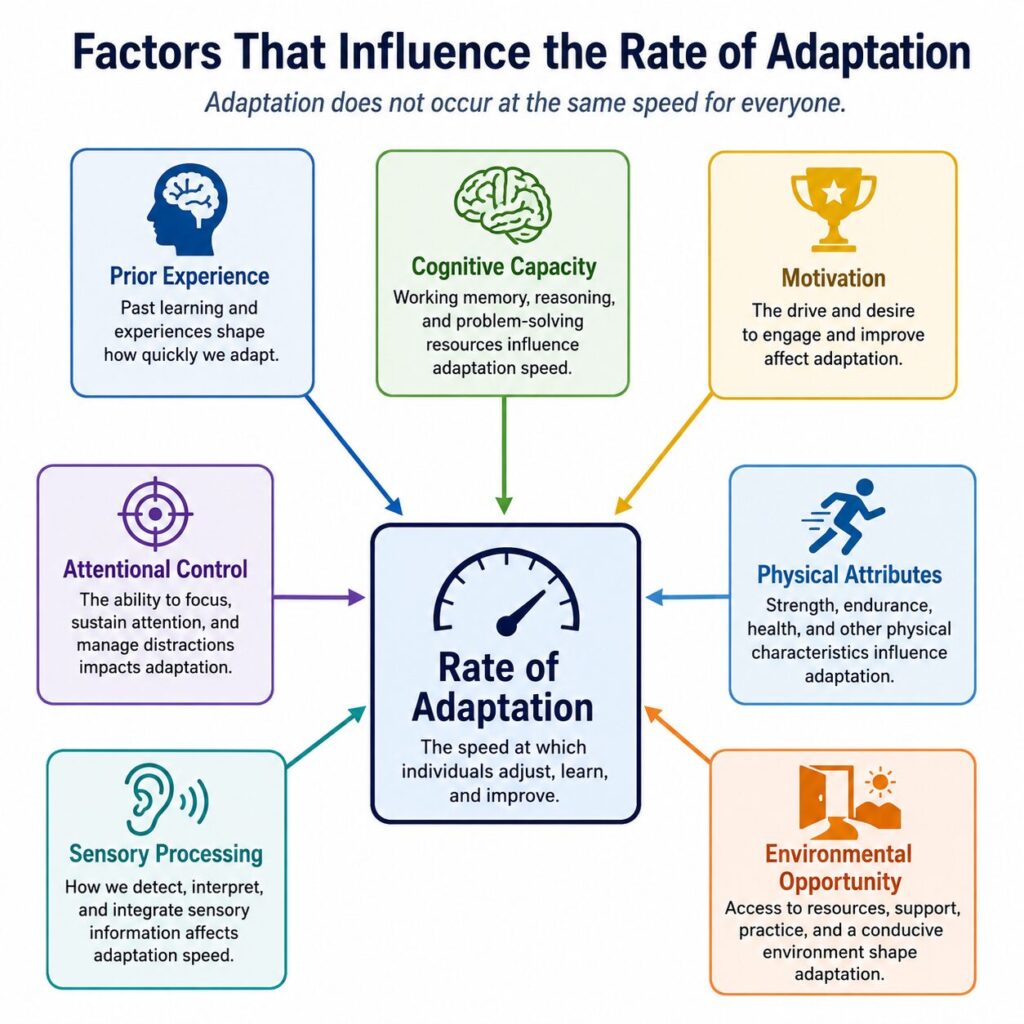
Human beings differ in ways that directly influence learning. Differences in prior experience, cognitive capacity, motivation, attentional control, physical attributes, sensory processing, and environmental opportunity all affect the rate at which adaptation occurs. Consequently, two individuals exposed to nearly identical training conditions may display substantially different developmental trajectories. One performer may require relatively little practice before demonstrating highly stable execution, while another may require considerably more exposure despite equivalent effort and commitment.
This observation is neither controversial nor particularly surprising. Similar variability appears throughout virtually every domain of human performance. Some individuals acquire foreign languages rapidly, while others progress more slowly despite comparable instructional exposure. Some athletes demonstrate exceptional rates of technical development, while others require longer periods of practice to achieve similar levels of competence. Such differences do not necessarily imply superior potential, nor do they suggest that one individual is inherently more capable than another. They simply illustrate that adaptation occurs within biological systems that differ meaningfully from person to person.
The importance of prior experience deserves particular attention because learning rarely begins from a true zero point. Performers arrive at training environments carrying extensive histories of previous adaptation. These histories influence how new information is interpreted and integrated. A novice shooter with years of experience in other visually demanding sports may acquire certain perceptual skills more rapidly than someone lacking such experience. Similarly, an individual with extensive background in martial arts, aviation, or competitive athletics may possess attentional and self-regulatory abilities that facilitate learning despite having no prior firearms experience. The resulting differences often create the illusion that some people learn unusually quickly when, in reality, they may be drawing upon adaptations acquired in entirely different domains.
Task complexity introduces another major obstacle to the idea of a universal training threshold. Not all skills place equivalent demands upon the performer, and therefore not all skills require equivalent amounts of adaptation. Some behaviors involve relatively straightforward motor patterns that can be stabilized through modest amounts of practice. Others require the integration of perceptual, cognitive, and motor processes operating simultaneously under changing environmental conditions. As task complexity increases, the relationship between repetition and automaticity becomes increasingly difficult to predict.
Consider the difference between learning a simple trigger press and developing effective threat discrimination during dynamic force-on-force training. The first task, while certainly requiring refinement, involves a comparatively limited set of variables. The second requires the integration of perception, decision-making, attention allocation, movement, communication, emotional regulation, and contextual judgment. Both involve learning, but they involve fundamentally different forms of learning. Consequently, the amount of practice required to achieve automaticity in one domain provides little information regarding the requirements of the other.
This distinction becomes clearer when skills are categorized according to the primary systems they engage. Motor skills, cognitive skills, and perceptual skills often follow different developmental trajectories despite interacting continuously during performance. Although the boundaries among these categories are neither absolute nor mutually exclusive, the distinction remains useful because each domain presents unique learning challenges.
Motor skills generally involve the organization and control of movement. Examples include weapon presentation, trigger manipulation, reloads, and movement mechanics. Such skills often exhibit relatively rapid improvements during early stages of practice because performers can directly observe and modify their actions. Feedback tends to be immediate, and the relationship between movement and outcome is often comparatively clear. As a result, substantial gains may occur within relatively short periods of focused training.
Cognitive skills present a different challenge. Decision-making, problem-solving, tactical reasoning, and judgment depend upon information processing rather than movement execution alone. Improvements in these areas frequently require exposure to varied situations capable of challenging existing mental models. Because cognitive skills depend heavily upon interpretation and context, they often resist the kind of straightforward repetition that facilitates motor learning. A performer may execute a technically sound draw stroke thousands of times, yet still struggle with deciding when, whether, or how to employ that skill under realistic conditions.
Perceptual skills introduce yet another layer of complexity. Perception involves the extraction of meaningful information from the environment and the ability to recognize patterns that guide action. Research involving athletes, pilots, military personnel, and expert performers consistently demonstrates that experts often differ from novices not because they move faster but because they perceive more effectively. They identify relevant cues earlier, recognize meaningful patterns more accurately, and anticipate future events more efficiently. Developing these capabilities frequently requires extensive exposure to representative environments not only mechanical repetition. Consequently, perceptual expertise often continues evolving long after many motor skills have become highly automated.
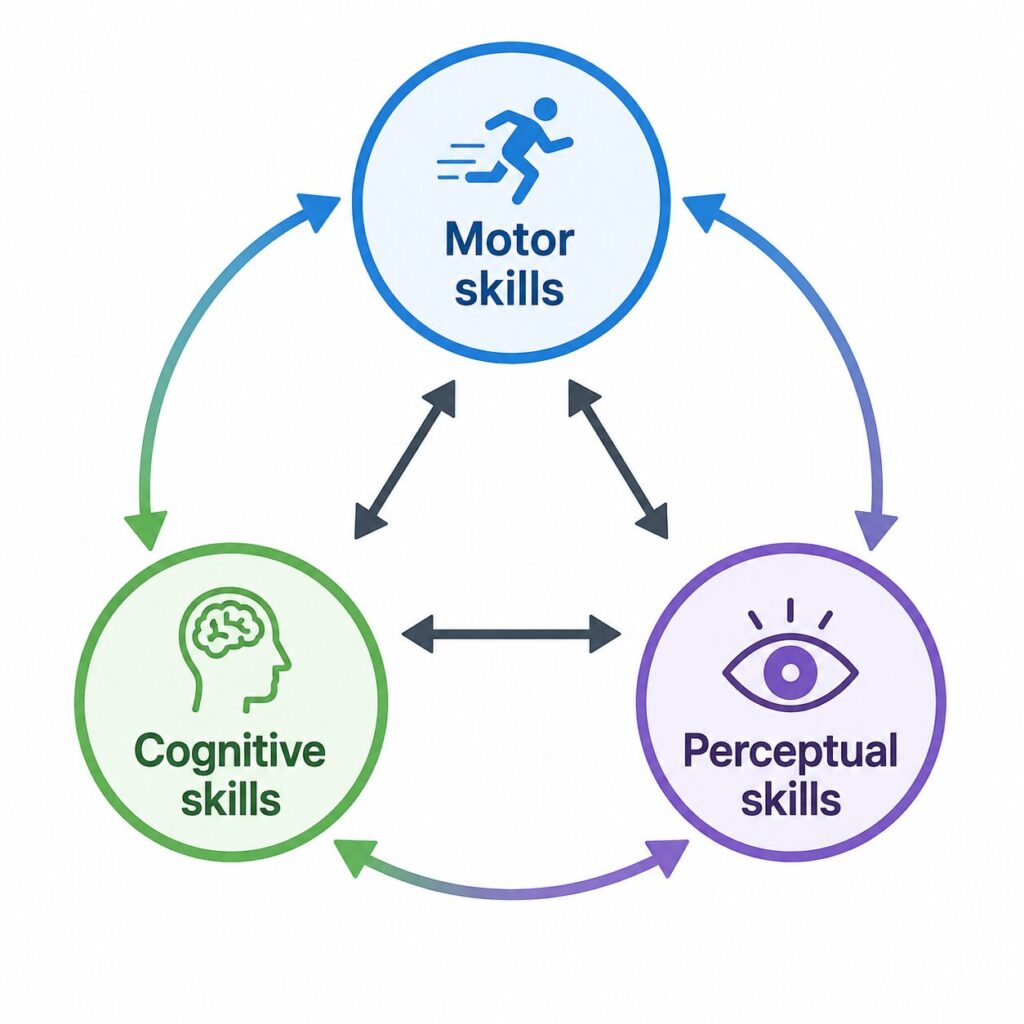
The interaction among these domains further complicates attempts to identify universal timelines for automaticity. In real-world performance, motor, cognitive, and perceptual processes rarely operate independently. A shooter engaging a threat is simultaneously perceiving information, interpreting that information, making decisions, and executing actions. Improvements in one area may influence performance in another, creating developmental trajectories that are highly individualized and difficult to predict. Automaticity therefore emerges not from the isolated automation of a single behavior but from the gradual integration of multiple systems operating together.
Research on expertise increasingly supports this interpretation. Investigators have consistently observed enormous variability across individuals and domains. Ericsson’s work emphasized the importance of deliberate practice while simultaneously demonstrating that elite performers often accumulate different amounts of training despite reaching similar levels of competence. Subsequent analyses by Macnamara and colleagues reinforced the conclusion that practice explains only part of the observed variation in performance outcomes.
Training systems built around arbitrary numerical goals may create the illusion of progress without necessarily measuring meaningful adaptation. Counting repetitions, hours, or rounds fired can provide useful information regarding exposure, but exposure should not be confused with learning. The nervous system does not possess a counter that signals automaticity after a predetermined quantity of practice. What matters is the extent to which practice alters future capability.
For this reason, the most scientifically defensible answer to the question posed at the beginning of this article is also the least satisfying to those seeking certainty. There is no universal number. Automaticity emerges at different rates for different people performing different tasks under different conditions. The process is influenced by the characteristics of the performer, the complexity of the skill, the quality of practice, the availability of feedback, and the interaction of motor, cognitive, and perceptual systems. Any attempt to reduce such complexity to a single numerical threshold inevitably sacrifices accuracy for simplicity.
The absence of a universal number should not be interpreted as a limitation of the scientific literature. If anything, it reflects a more sophisticated understanding of human performance. Skill acquisition is not a manufacturing process in which identical inputs reliably produce identical outputs. It is a biological process occurring within adaptive systems that differ from one individual to another. The search for a universal threshold may therefore be misguided from the outset. The more productive objective is not determining how much practice should be sufficient for everyone, but understanding the conditions under which practice becomes most effective for each individual performer.
Implications for Firearms Training
If the evidence reviewed throughout this article is accepted, then the implications for firearms training are difficult to ignore. For much of the twentieth century, marksmanship instruction was built around a relatively straightforward assumption: if technical shooting skills improved, overall performance would improve as well. Consequently, enormous attention was devoted to refining trigger control, sight alignment, recoil management, weapon manipulation, and target engagement. These skills remain important, and nothing presented in this article should be interpreted as an argument against technical competence. The issue is not that traditional marksmanship training is incorrect. The issue is that it explains only a portion of what determines performance in real-world environments.
The modern body of evidence emerging from motor learning, cognitive psychology, expertise research, neuroscience, and human factors suggests that shooting accuracy is better understood as an outcome than as a cause. The bullet striking its intended target is merely the final observable consequence of a much larger process involving perception, attention, decision-making, emotional regulation, movement coordination, and environmental interaction. When viewed from this perspective, firearms instruction becomes less about teaching people how to shoot and more about developing the systems that make effective shooting possible under operational conditions.
The bullet striking its intended target is merely the final observable consequence of a much larger process involving perception, attention, decision-making, emotional regulation, movement coordination, and environmental interaction
Dry-fire training remains one of the most efficient methods available for developing technical proficiency because it allows extraordinarily high repetition volumes without the logistical constraints associated with ammunition, range access, or financial cost. The scientific literature provides strong support for the value of repeated technical rehearsal during skill acquisition, particularly during the early and intermediate stages of learning. Through repeated exposure, movement patterns become more organized, attentional demands decrease, and procedural representations become increasingly refined. For tasks such as presentation from the holster, trigger manipulation, visual indexing, reloads, and weapon handling, dry fire offers opportunities for focused practice that would be difficult to replicate through live fire alone.
Live-fire training addresses some of its limitations: Recoil, blast, noise, timing demands, visual disruption, and performance accountability all contribute information that shapes learning. Live fire therefore plays an important role in validating technical skills and exposing weaknesses that may remain hidden during dry rehearsal. Yet live fire is not immune to the same criticisms often directed at dry fire. Large portions of contemporary range training remain highly predictable, with shooters engaging known targets from known positions under known conditions. Such activities may improve marksmanship scores while doing relatively little to develop the broader capabilities associated with operational performance.
The distinction is important because many shooters mistakenly assume that firing more rounds necessarily produces greater competence. The evidence reviewed throughout this article suggests otherwise. Learning depends less upon the presence of ammunition than upon the nature of the adaptive problem confronting the performer. A shooter may expend hundreds of rounds reinforcing existing patterns without generating meaningful adaptation. Conversely, a comparatively small number of rounds fired within carefully structured training environments may produce substantial improvements if those environments challenge perception, decision-making, timing, and execution simultaneously.
This observation naturally leads to the issue of measurement. One of the recurring themes throughout expertise research is that adaptation requires feedback. Without objective information regarding performance, individuals often struggle to distinguish genuine improvement from familiarity. The human tendency toward overconfidence and self-deception has been extensively documented across numerous domains, and firearms training is unlikely to represent an exception. Shooters frequently believe they are improving because performance feels smoother, more comfortable, or more familiar. Objective measurement often reveals a different reality.
The importance of measurement extends far beyond shot placement. Accuracy remains valuable, but it represents only one dimension of performance. Time, consistency, decision quality, target discrimination, movement efficiency, visual behavior, and performance under varying conditions may all provide useful information regarding adaptation. In many respects, measurement functions as the bridge connecting training to learning. Without it, instructors and students are often left evaluating performance through intuition alone. With it, they gain the ability to identify limitations, track progress, and make informed adjustments to training design.
Traditional training environments often separate perception from action. The shooter is told what the target is, where it is located, when to engage it, and how the exercise will unfold. Real-world environments rarely provide such conveniences. Operational performance requires individuals to perceive information, interpret its meaning, decide upon an appropriate response, and execute that response within a continuously evolving environment. Removing these informational demands during training may simplify instruction, but it also risks developing competencies that remain highly dependent upon predictable conditions.
Representative learning design attempts to address this problem by preserving the informational characteristics of the environment in which performance will ultimately occur. Representative training seeks to integrate perception, cognition, and action. Scenario-based exercises, force-on-force training, decision-making drills, and other forms of context-rich practice derive much of their value from this principle. Their purpose is not merely to increase realism. Their purpose is to ensure that the performer learns to perceive the information necessary to support effective action.
This perspective also forces a reconsideration of automaticity itself. Throughout firearms culture, automaticity is frequently treated as the ultimate objective of training. The reasoning is understandable. Automated skills require less conscious attention and generally remain more resilient under pressure. Yet the evidence reviewed throughout this article suggests that automaticity, while important, may not represent the highest level of performance. The environments in which firearms are employed are often characterized by uncertainty, novelty, ambiguity, and rapidly changing conditions. Under such circumstances, rigid behavioral routines may become liabilities.
What appears increasingly valuable is not automaticity alone but the interaction between automaticity and adaptability. Technical skills should become highly automated because conscious attention is too limited a resource to devote continuously to basic weapon manipulation. At the same time, performers must remain capable of modifying behavior in response to changing circumstances. The most effective shooters are not necessarily those who execute the fastest preprogrammed responses. More often, they are the individuals who can recognize what situation is unfolding, select an appropriate response, and adapt that response as new information becomes available.
The objective of training, therefore, should not be the creation of robotic consistency. It should be the development of performers capable of combining stable technical foundations with flexible decision-making. Automaticity provides efficiency. Adaptability provides relevance. Operational effectiveness requires both.
Conclusion
The question posed at the beginning of this article appears deceptively simple: how much training does it take to build automaticity? The scientific literature, however, provides no universal answer. It does not emerge after a predetermined number of hours of work. It develops through a complex process of adaptation influenced by individual characteristics, task demands, environmental conditions, feedback quality, and the structure of practice itself.
More importantly, the evidence suggests that automaticity should not be viewed as an endpoint. Rather, it represents one component of a broader performance architecture that includes perception, cognition, decision-making, emotional regulation, and motor execution. The transition from novice to expert involves far more than the automation of movement. It involves the gradual development of systems capable of extracting information from the environment, interpreting that information effectively, and generating adaptive responses under conditions of uncertainty and pressure.
This conclusion carries paramount implications for firearms instruction. Traditional marksmanship training has often emphasized technical execution as the primary determinant of performance. Contemporary research paints a more complex picture. Technical skill remains necessary, but it is only one element within a much larger system. Performance under operational conditions appears to depend just as heavily upon attentional control, situational awareness, perceptual expertise, emotional regulation, and decision-making as it does upon trigger control or sight alignment.
Viewed through this lens, marksmanship ceases to be a purely mechanical activity and becomes something considerably more interesting. It becomes a problem of human performance. The bullet striking the target is not simply the product of shooting technique. It is the visible consequence of countless interactions occurring among neural systems, perceptual processes, cognitive mechanisms, learned behaviors, and environmental demands.
For instructors, the challenge is clear. The future of firearms training may depend less upon finding better ways to teach people how to shoot and more upon understanding how humans learn, adapt, perceive, decide, and perform. The most effective training systems will likely be those that recognize this reality and design practice environments accordingly.
References
Anderson, J. R. (1982). Acquisition of cognitive skill. Psychological Review, 89(4), 369–406.
Davids, K., Button, C., & Bennett, S. (2008). Dynamics of skill acquisition: A constraints-led approach. Human Kinetics.
Ericsson, K. A. (2006). The influence of experience and deliberate practice on the development of superior expert performance. In K. A. Ericsson, N. Charness, P. J. Feltovich, & R. R. Hoffman (Eds.), The Cambridge handbook of expertise and expert performance. Cambridge University Press.
Ericsson, K. A., Krampe, R. T., & Tesch-Römer, C. (1993). The role of deliberate practice in the acquisition of expert performance. Psychological Review, 100(3), 363–406.
Ericsson, K. A., & Pool, R. (2016). Peak: Secrets from the new science of expertise. Eamon Dolan/Houghton Mifflin Harcourt.
Eysenck, M. W., Derakshan, N., Santos, R., & Calvo, M. G. (2007). Anxiety and cognitive performance: Attentional Control Theory. Emotion, 7(2), 336–353.
Fitts, P. M., & Posner, M. I. (1967). Human performance. Brooks/Cole.
Graybiel, A. M. (2008). Habits, rituals, and the evaluative brain. Annual Review of Neuroscience, 31, 359–387.
Hatfield, B. D., & Kerick, S. E. (2007). Cognitive neuroscience of sport performance. In G. Tenenbaum & R. C. Eklund (Eds.), Handbook of sport psychology (3rd ed., pp. 84–109).
Kahneman, D. (2011). Thinking, fast and slow. Farrar, Straus and Giroux.
Klein, G. (2008). Sources of power: How people make decisions. MIT Press.
LeDoux, J. (1996). The emotional brain: The mysterious underpinnings of emotional life. Simon & Schuster.
Macnamara, B. N., Hambrick, D. Z., & Oswald, F. L. (2014). Deliberate practice and performance in music, games, sports, education, and professions: A meta-analysis. Psychological Science, 25(8), 1608–1618.
McEwen, B. S. (2007). Physiology and neurobiology of stress and adaptation: Central role of the brain. Physiological Reviews, 87(3), 873–904.
Meichenbaum, D. (1985). Stress inoculation training. Pergamon Press.
Morrow, J. R., Jackson, A. W., Disch, J. G., & Mood, D. P. (2011). Measurement and evaluation in human performance (4th ed.). Human Kinetics.
Murray, K. (2004). Training at the speed of life. Armiger Publications.
Newell, K. M. (1986). Constraints on the development of coordination. In M. G. Wade & H. T. A. Whiting (Eds.), Motor development in children: Aspects of coordination and control. Martinus Nijhoff.
Nieuwenhuys, A., & Oudejans, R. R. D. (2012). Anxiety and perceptual-motor performance: Toward an integrated model of concepts, mechanisms, and processes. Psychological Research, 76(6), 747–759.
Schmidt, R. A. (1975). A schema theory of discrete motor skill learning. Psychological Review, 82(4), 225–260.
Schmidt, R. A., & Bjork, R. A. (1992). New conceptualizations of practice: Common principles in three paradigms suggest new concepts for training. Psychological Science, 3(4), 207–217.
Schmidt, R. A., & Lee, T. D. (2019). Motor learning and performance: From principles to application (6th ed.). Human Kinetics.
Schneider, W., & Shiffrin, R. M. (1977). Controlled and automatic human information processing: I. Detection, search, and attention. Psychological Review, 84(1), 1–66.
Vickers, J. N., & Lewinski, W. (2012). Performing under pressure: Gaze control, decision making, and shooting performance. Human Factors, 54(3), 365–376.
Wulf, G. (2013). Attentional focus and motor learning: A review of 15 years. International Review of Sport and Exercise Psychology, 6(1), 77–104.