Introduction
In armed combat, speed is often incorrectly understood as a purely physical attribute—something related to how fast one can draw, aim, or fire. In reality, the most critical delays are frequently cognitive. Before any physical action occurs, the brain must interpret information, identify the problem, and select a response. This process, although often invisible, consumes time—and in combat, time is the most limited resource.
This cognitive dimension of performance was rigorously studied by William Edmund Hick in his 1952 paper On the Rate of Gain of Information. In this work, Hick established what is now known as Hick’s Law, a principle that quantifies how decision time increases as the number of available choices increases. While originally developed within experimental psychology, this concept has profound implications for any environment where rapid and accurate decisions are required under pressure—especially armed confrontations.
Historical Context and Research Objective
Hick’s research emerged during a period when psychology was becoming increasingly quantitative, influenced by developments in information theory and communication systems. His objective was deceptively simple: to understand how humans process information when required to choose between multiple alternatives. More specifically, he sought to determine how the number of possible responses influences the time required to make a decision.
This question, although abstract in its original formulation, translates directly to operational environments. In combat, decision-making is rarely binary or isolated. Instead, it involves multiple variables, incomplete information, and severe time constraints. Hick’s work provides a framework for understanding how these factors interact at a cognitive level.
Methodology and Experimental Design
To investigate this relationship, Hick designed controlled laboratory experiments in which participants were asked to respond to visual stimuli. Subjects were positioned in front of a panel containing multiple lights, each corresponding to a specific response—typically pressing a designated button. When a light was activated, the participant was required to respond as quickly as possible by selecting the correct input.
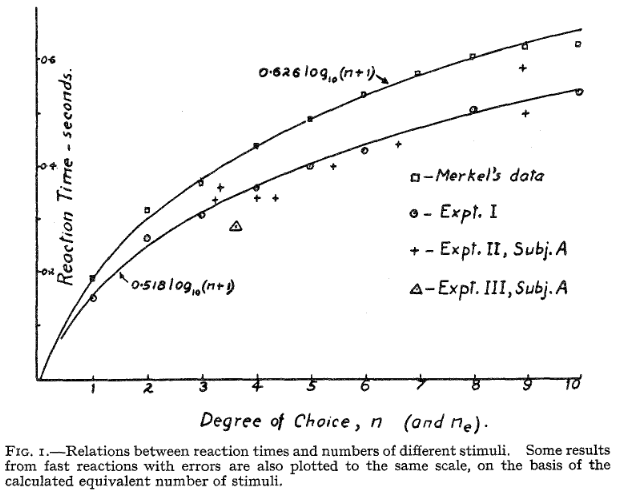
The key variable manipulated in the experiment was the number of possible stimuli. In some trials, participants had only one possible response, effectively eliminating decision-making. In others, the number of options increased progressively—two, four, eight, and beyond. Reaction time was carefully measured across these conditions, allowing Hick to isolate the effect of choice complexity on decision speed.
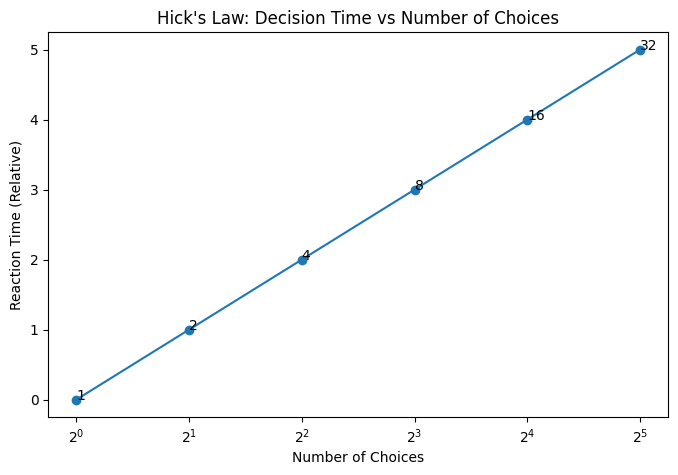
The results revealed a consistent and mathematically predictable pattern. Reaction time did not increase linearly with the number of choices; instead, it followed a logarithmic relationship. This led to the formulation of what is now expressed as:
In this equation, reaction time increases as a function of the logarithm of the number of available options, reflecting the amount of information the brain must process before selecting a response.
Interpretation of Findings
The implications of Hick’s findings are often oversimplified as “more choices lead to slower decisions,” but the underlying mechanism is more precise and more important. Each additional option introduces a layer of cognitive processing. The brain must discriminate between alternatives, evaluate their relevance, and select an appropriate response. This process requires time, even under ideal conditions.
Crucially, the increase in decision time is not uniform. The addition of initial options has a disproportionately large impact, meaning that going from one to two choices introduces more delay than going from seven to eight. This highlights a fundamental limitation of human cognition: the brain is not optimized for handling large numbers of alternatives under time pressure.
Relevance to Armed Combat
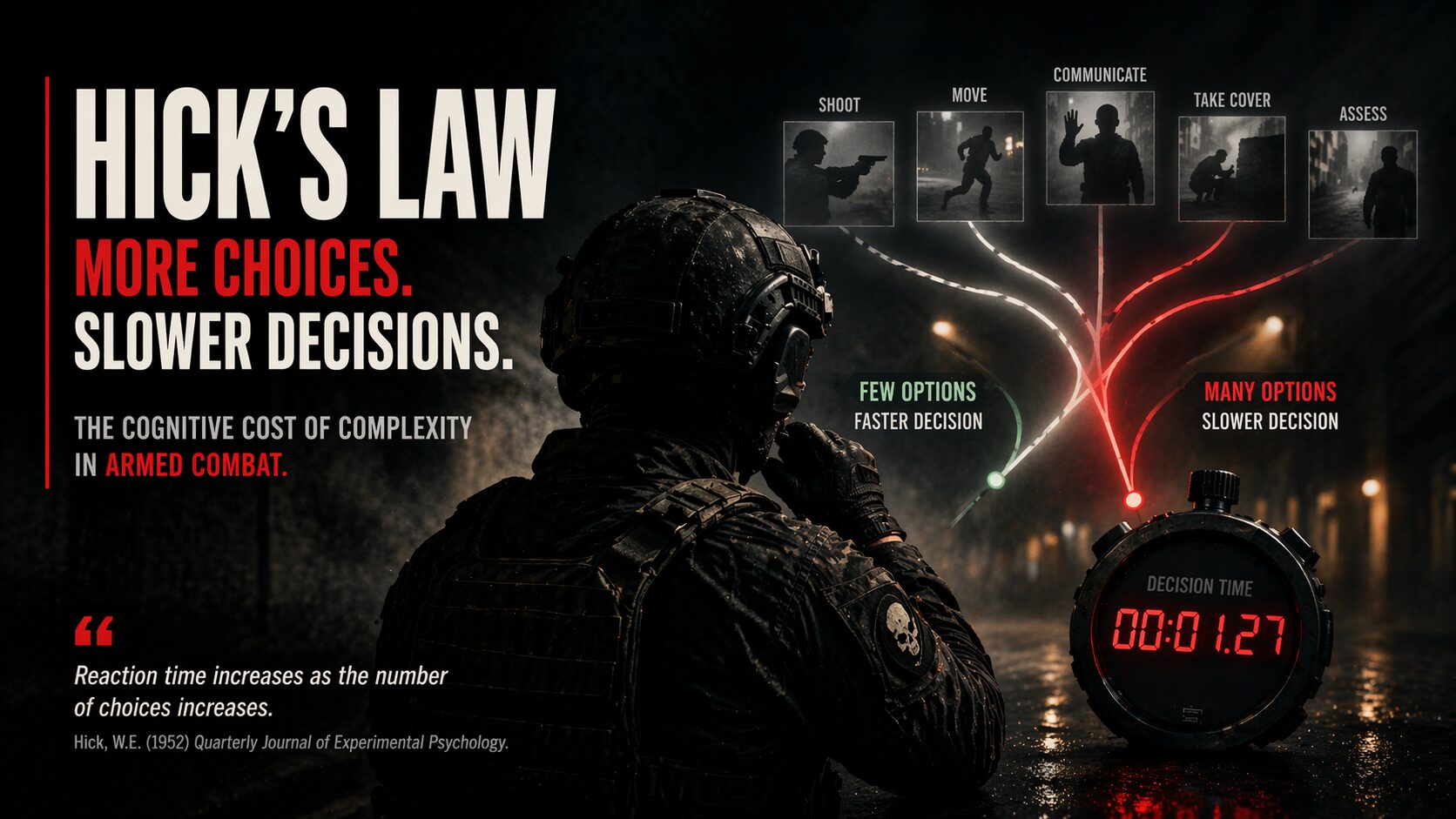
In the context of armed combat, Hick’s Law becomes more than an abstract principle—it becomes a practical constraint. Real-world engagements are characterized by complexity: multiple actors, uncertain intentions, environmental clutter, and rapidly evolving conditions. Each of these elements effectively increases the number of “choices” the brain must process.
Consider the moment of threat recognition. The individual must determine whether a perceived stimulus constitutes a real danger, whether lethal force is justified, and what immediate action should be taken. These decisions are not made sequentially in a calm environment; they occur simultaneously, under stress, and often with incomplete information. As the number of variables increases, so does the time required to reach a decision—time that may not be available.
This is particularly evident in the classic shoot/no-shoot dilemma. In a simplified training environment, this decision may appear binary and straightforward. However, in reality, it is influenced by numerous factors: body language, context, background risk, presence of bystanders, and legal considerations. Each added layer increases cognitive load, which, according to Hick’s Law, increases decision latency.
Cognitive Overload and Stress Interaction
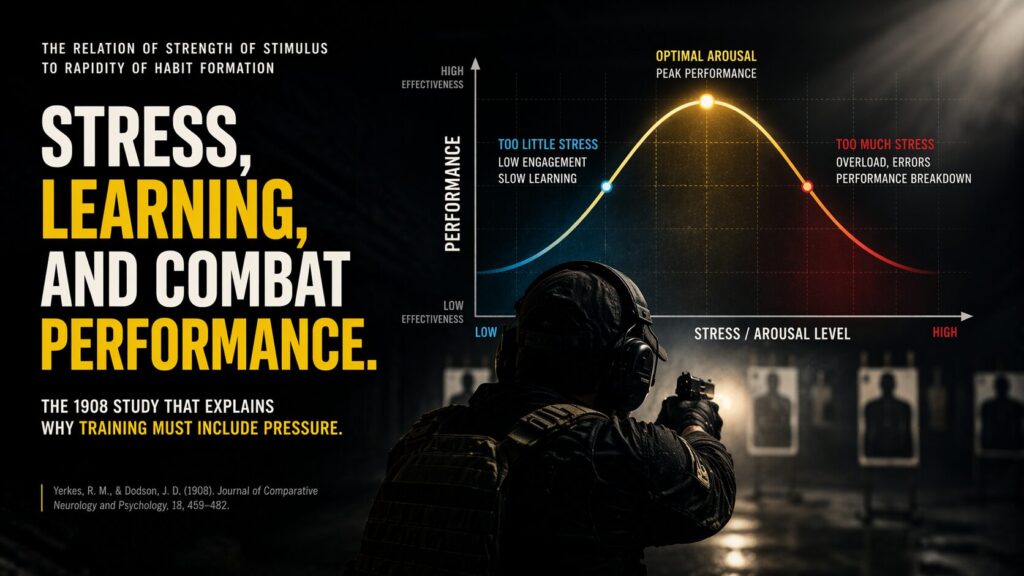
The impact of Hick’s Law is further amplified when combined with physiological stress. Under high levels of arousal, as described by the Yerkes–Dodson framework, cognitive capacity is reduced. Attention narrows, working memory becomes constrained, and the ability to process multiple inputs deteriorates.
This creates a critical intersection: as the environment becomes more complex, the brain’s capacity to handle that complexity decreases. The result is a form of cognitive overload in which decision-making slows, becomes less accurate, or fails entirely. In practical terms, this may manifest as hesitation, incorrect engagement decisions, or complete paralysis.
Implications for Training
The implications for combat training are significant and often counterintuitive. Many training systems attempt to increase preparedness by expanding the range of techniques, responses, and scenarios available to the practitioner. While this may increase theoretical knowledge, it also increases the number of decisions that must be made under pressure—thereby slowing response time.
Effective training, therefore, must prioritize reduction of decision complexity rather than expansion. This involves standardizing responses to classes of problems, defining clear criteria for action, and minimizing unnecessary variation. The goal is not to limit capability, but to align it with the constraints of human cognition.
Additionally, experienced operators rely less on conscious decision-making and more on pattern recognition. Through repeated exposure to structured scenarios, they develop mental templates that allow for rapid identification of situations and immediate selection of appropriate responses. This shifts the cognitive process from analysis to recognition, significantly reducing decision time.
Scenario-based training plays a critical role in this process, as it exposes the individual to variability while reinforcing consistent response patterns. However, this exposure must be carefully controlled to avoid overwhelming the trainee and reinforcing inefficient decision processes.
Conclusion
Hick’s Law reveals a fundamental and often overlooked truth: speed in combat is not merely a function of physical execution, but of cognitive efficiency. The more options an individual must consider, the longer it will take to act. In controlled environments, this delay may be negligible. In combat, it can be decisive.
Understanding and applying this principle requires a shift in how training is conceptualized. Rather than increasing complexity in the name of preparedness, effective systems must reduce cognitive load, simplify decision-making, and build automaticity through structured repetition.
Ultimately, the objective is not to create individuals who know more, but individuals who can decide faster and act effectively when it matters most.
References (APA 7th Edition)
Hick, W. E. (1952). On the rate of gain of information. Quarterly Journal of Experimental Psychology, 4(1), 11–26.
Continue from research to practice
Knowledge is useful when it changes what you do next.
Connect technical execution with perception, judgment and decision-making in the Cognitive Operator pathway.
Explore Cognitive Operator