A Foundational Framework for Combat Performance Under Stress
Introduction
In the pursuit of excellence in armed combat training, practitioners often prioritize technique, equipment, and repetition. However, one of the most critical determinants of real-world performance lies not in what is trained, but in how the human organism responds under stress.
More than a century ago, Robert M. Yerkes and John D. Dodson published a seminal paper titled The Relation of Strength of Stimulus to Rapidity of Habit Formation (1908). Although not originally intended for combat or tactical applications, this study established a principle that remains fundamental to understanding performance in high-stress environments.
Today, this principle is widely known as the Yerkes–Dodson Law, and its implications are directly applicable to armed encounters, decision-making under threat, and the design of effective training systems.
Historical Context and Publication
The original study was published in 1908 in the Journal of Comparative Neurology and Psychology, a leading academic journal of its time focused on experimental psychology and neurobehavioral research.
At the time, psychology was transitioning toward a more empirical and experimental discipline. Yerkes and Dodson contributed to this shift by investigating how stimulus intensity influences learning and performance, using controlled laboratory conditions.
Despite its age, the study remains one of the most cited and enduring contributions to behavioral science, particularly in fields involving performance under pressure, such as aviation, law enforcement, military operations, and high-risk decision-making.
Research Objective
The central question investigated by Yerkes and Dodson was:
How does the strength of a stimulus affect the speed and effectiveness of habit formation?
In modern terms, this translates to:
- How does stress or arousal level influence learning?
- At what point does increased pressure enhance or degrade performance?
Methodology
The study employed a controlled experimental design using animal subjects (specifically mice), which were tasked with learning a discrimination problem.
Experimental Setup
- The animals were placed in a simple apparatus with two pathways.
- One path led to a neutral or safe outcome.
- The other path resulted in an aversive stimulus (a mild electric shock).
Independent Variable
The key variable manipulated by the researchers was the intensity of the electrical stimulus, which served as a proxy for arousal or stress.
The stimulus intensity was systematically varied across different trials:
- Low intensity
- Moderate intensity
- High intensity
Dependent Variable
The primary outcome measured was:
- Speed of habit formation, defined as how quickly the animal learned to consistently choose the correct path.
Results
The findings revealed a non-linear relationship between stimulus intensity and learning performance.
Key Observations
- Low Stimulus Intensity
- Animals exhibited slower learning.
- Engagement with the task was limited.
- Performance remained suboptimal.
- Moderate Stimulus Intensity
- Learning occurred more rapidly.
- Performance improved significantly.
- Behavioral adaptation was efficient.
- High Stimulus Intensity
- Learning performance deteriorated.
- Animals showed signs of distress and erratic behavior.
- Task performance declined despite increased stimulus.
Theoretical Implication: The Yerkes–Dodson Law
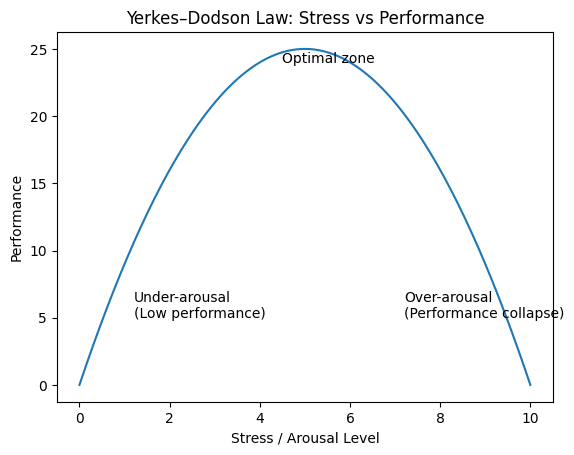
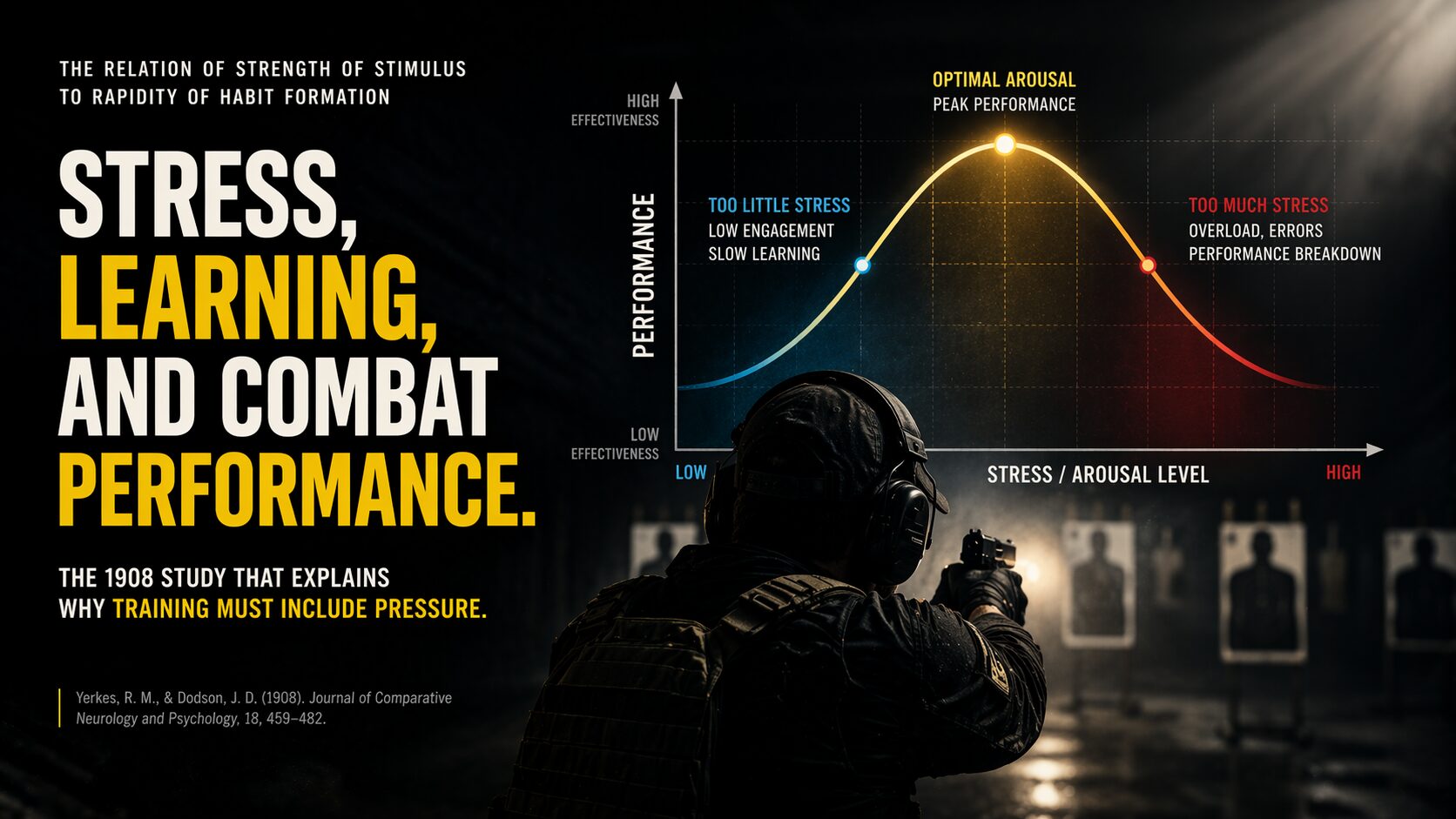
Although the original paper did not present a graphical model, subsequent interpretations led to the formulation of the now-famous inverted-U relationship between arousal and performance.
This principle can be summarized as follows:
- Insufficient arousal leads to underperformance.
- Optimal arousal enhances performance.
- Excessive arousal results in performance breakdown.
Importantly, the optimal level of arousal is not fixed. It varies based on:
- Task complexity
- Level of training
- Experience under stress
- Degree of skill automation
Relevance to Armed Combat
The application of this principle to armed combat is both direct and unavoidable.
Combat Is a High-Arousal Environment
Real-world violent encounters are characterized by:
- Elevated heart rate
- Hormonal stress responses
- Perceptual narrowing
- Time distortion
- Cognitive overload
These conditions place the individual well beyond the optimal zone of arousal, often into the performance degradation region.
Performance Degradation Under Stress
When stress exceeds optimal levels, several critical failures occur:
- Loss of fine motor control
- Delayed reaction times
- Reduced situational awareness
- Impaired decision-making
- Increased likelihood of error
These effects are not hypothetical—they are predictable outcomes of human physiology under extreme conditions.
Implications for Training
The most significant contribution of the Yerkes–Dodson framework to combat training lies in its implications for training design.
1. Training Must Include Stress Exposure
Training conducted exclusively under low-stress conditions:
- Produces technically proficient but operationally fragile individuals
- Fails to prepare practitioners for real-world performance demands
To develop transferable skills, training must incorporate:
- Time pressure
- Cognitive load
- Uncertainty and ambiguity
- Performance consequences
2. Skill Automation Is Essential
Under high stress, conscious processing is limited. Therefore:
- Skills must be trained to the level of automatic execution
- Decision-making pathways must be simplified and reinforced
In this context, repetition alone is insufficient. What matters is:
Contextualized repetition under progressively increasing stress.
3. Progressive Overload Applies to Stress, Not Just Technique
Just as physical training requires progressive overload, so does stress adaptation.
Effective training systems should:
- Gradually increase stress exposure
- Avoid overwhelming the trainee prematurely
- Build resilience over time
This allows the individual to shift the optimal performance zone, maintaining functionality under higher levels of stress.
4. Simplicity Enhances Survivability
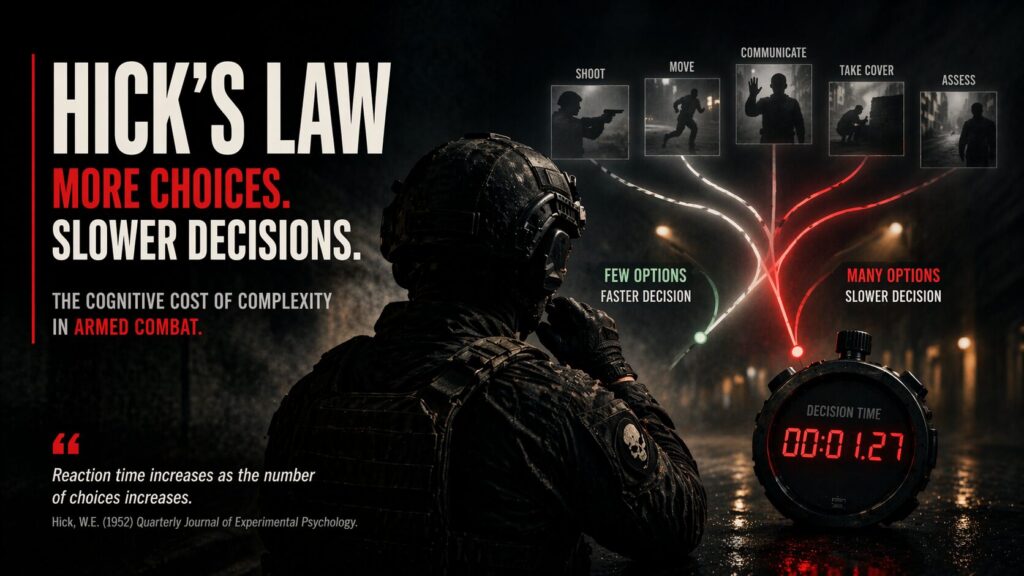
As arousal increases, cognitive capacity decreases.
Therefore:
- Complex decision trees are ineffective under stress
- Simple, robust responses are more reliable
Operational doctrine should prioritize:
- Clarity
- Consistency
- Repeatability
Conclusion
The work of Yerkes and Dodson, published in 1908, remains profoundly relevant to modern combat training.
It provides a scientifically grounded explanation for a reality that many practitioners experience but fail to fully understand:
Performance in combat is not determined by knowledge alone, but by the ability to execute under stress.
Ignoring this principle leads to training systems that produce confidence without competence under pressure.
In contrast, training that acknowledges and incorporates the relationship between stress and performance can produce individuals capable of functioning effectively in the most demanding environments.
References (APA 7th Edition)
Yerkes, R. M., & Dodson, J. D. (1908). The relation of strength of stimulus to rapidity of habit formation. Journal of Comparative Neurology and Psychology, 18, 459–482.
Continue from research to practice
Knowledge is useful when it changes what you do next.
Connect technical execution with perception, judgment and decision-making in the Cognitive Operator pathway.
Explore Cognitive Operator