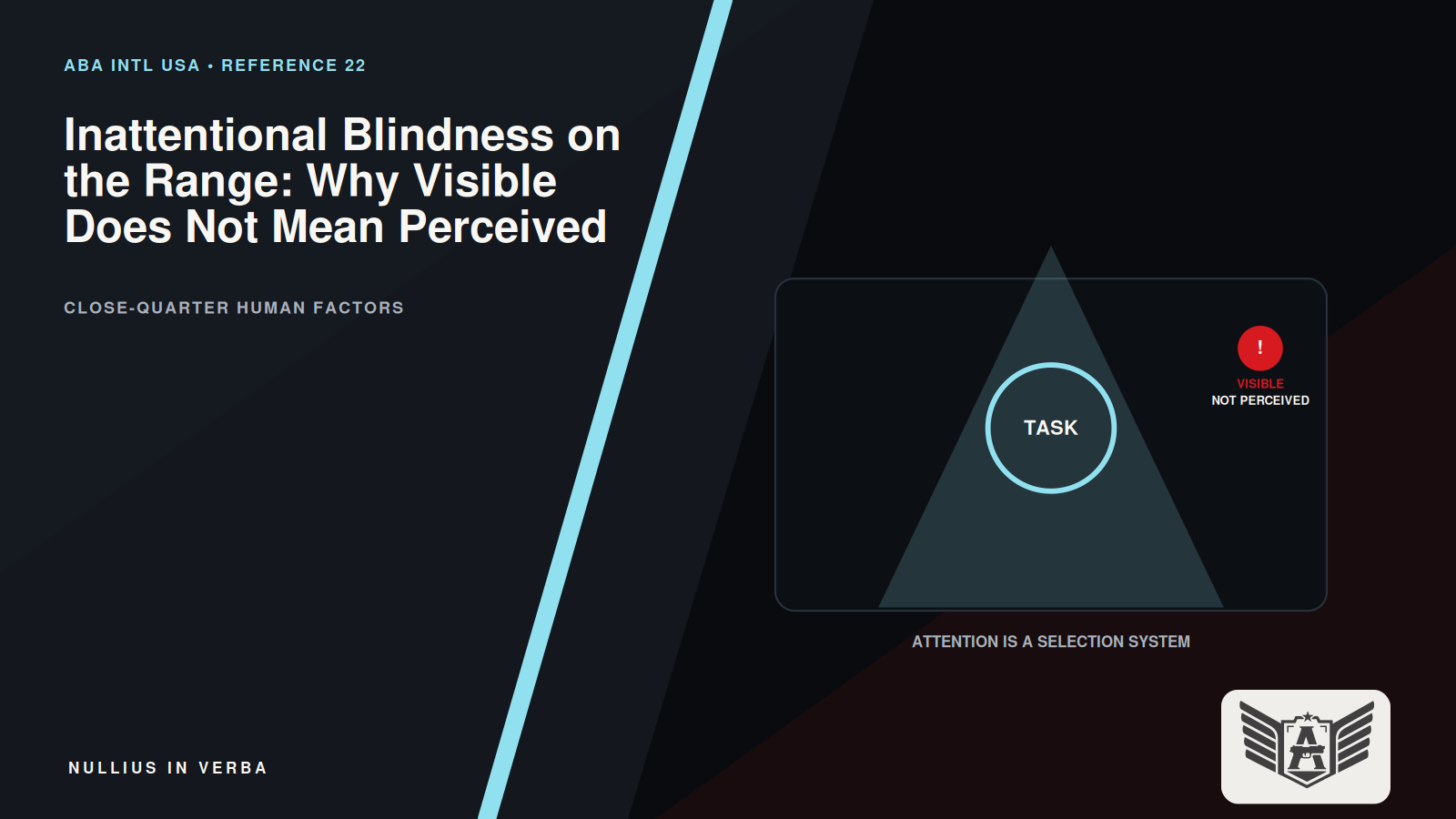
sincerely reports never seeing it. This discrepancy is often interpreted
as dishonesty, panic, or poor vision. Cognitive research offers another
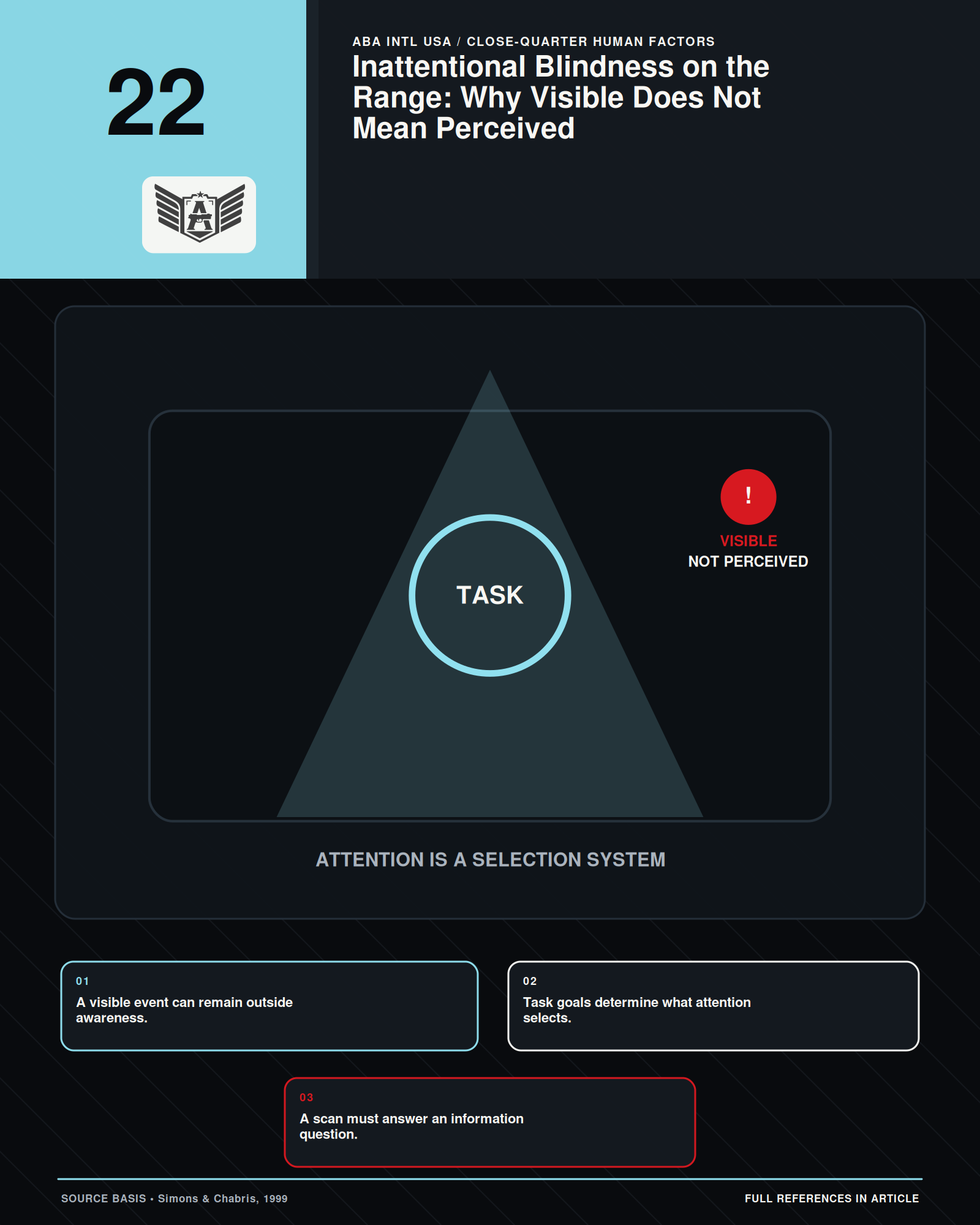
explanation: when attention is engaged by a demanding task, an
unexpected but visible event may not reach awareness. Inattentional
blindness is not literal blindness. It is a limit on conscious
perception produced by selective attention.
Simons and Chabris (1999) demonstrated the phenomenon through a
selective-looking task in which observers counted passes made by one
group while an unexpected person crossed the scene. Many participants
failed to report the unexpected event, despite its visual conspicuity.
The exact miss rate varied with conditions, so the study should not be
reduced to one viral percentage. Its durable contribution is the
demonstration that looking toward a scene does not guarantee awareness
of every event within it.
Attention is selective because complete processing of the environment
is impossible. The visual system prioritizes information according to
current goals, expectation, salience, and learned relevance. Selection
usually supports performance: a shooter cannot consciously analyze every
texture and sound while controlling a precise action. The vulnerability
appears when the current goal excludes information that later proves
important.
Range design can unintentionally train this exclusion. If the learner
is rewarded exclusively for time and target hits, gaze and attention
will organize around those outcomes. A bystander cue, altered
instruction, unsafe movement, or no-action signal becomes interference
rather than information. Instructors then complain that participants
have poor “situational awareness” even though the score taught them what
to ignore.
Expectation is a powerful filter. When every target presentation
requires action, the appearance of a target becomes sufficient evidence.
The learner stops sampling for disconfirming information because
disconfirmation never occurs. Adding one obvious no-shoot at the end
does not solve the problem; it becomes another predictable feature.
Decision uncertainty must be distributed throughout practice so that
information remains necessary.
Perceptual load and cognitive load should be distinguished. A
visually cluttered scene can make objects difficult to locate, while a
simple scene paired with a demanding counting, communication, or memory
task can consume attention. Both can increase misses through different
mechanisms. An instructor should manipulate one source of load at a time
when diagnosing performance, otherwise the failure cannot be attributed
to a useful constraint.
Salience does not guarantee perception. Sudden motion, brightness,
and threat-relevant shapes can capture attention, but capture is
probabilistic and depends on the current task. Stress may further
privilege one central cue while suppressing competitors. The correct
lesson is not that a performer will inevitably miss the obvious. It is
that visibility must be measured behaviorally rather than assumed
retrospectively from video.
Gaze position cannot by itself prove awareness. A fixation may land
on an object that is not consciously identified, and information outside
direct fixation can still be processed. Vickers and Lewinski (2012)
showed that expert and rookie police officers differed in gaze control
and decisions during simulated encounters. Eye tracking can reveal
sampling strategy, but the interpretation still requires reports,
decision outcomes, and the timing of diagnostic information.
The popular command to “scan and assess” can become an empty motor
ritual. Learners move the head after a sequence because the drill
requires it, not because they have an information question. A meaningful
scan has a purpose: locate additional people, confirm hands, identify an
exit, check equipment status, or reassess whether action remains
necessary. The instructor should test what information was acquired, not
whether the head rotated.
Prospective cues can help manage attention. Before a task, the
performer can state the top priorities and the events that would cancel
or change the response. This creates attentional sets without revealing
the exact scenario. Afterward, the debrief compares expected cues with
observed behavior. The exercise teaches attention as resource allocation
rather than as an undefined state of constant awareness.
Unexpected-event trials should be rare enough to remain unexpected
and common enough to matter. If every scenario contains a surprise,
surprise becomes the script and participants begin searching for the
trick. A larger library of variations, counterbalanced order, and
credible ordinary trials reduces this problem. The objective is not to
deceive the learner; it is to prevent prediction from replacing
task-relevant sampling.
Inattentional blindness also affects instructors and investigators.
An observer focused on muzzle movement may miss an earlier decision cue,
while a reviewer who knows the outcome may find the decisive object
“obvious.” Multiple camera angles, independent coding, and initial
reports collected before group discussion can reduce hindsight
reconstruction. Nullius in verba applies to the debrief as strongly as
to the drill.
O Cérebro Sob Fogo explains that acute stress redistributes
attention rather than merely reducing it globally (Silveira &
Bearare, 2026). A salient threat cue can receive intense processing
while peripheral or contextual information disappears from awareness.
Regulation techniques are therefore valuable when they restore flexible
sampling and inhibition, not simply when they make the performer feel
calmer.
TMM makes awareness measurable. Technique includes search,
prioritization, decision, and reassessment. Metrics include detection
rate, false alarms, response validity, time to cue report, and what
information was recalled without prompting. Method manipulates
attentional load, expectation, and cue probability while holding the
decision rule stable (Bearare & Silveira, 2026). The resulting data
distinguish a visual limitation from a task-design failure.
Visible does not mean perceived, and perception cannot be guaranteed
by a slogan. A reference program teaches performers what information
deserves priority, creates consequences for both misses and false
actions, and tests awareness under controlled load. The aim is not
omniscience. It is an adaptive attentional system that can disengage
from the current action long enough to discover that the situation has
changed.
References
Bearare, S. C., & Silveira, L. (2026). Technique-Method-Metric
Triad in firearms training under extreme stress. RECIMA21 – Revista
Científica Multidisciplinar, 7(7), e778536.
https://doi.org/10.47820/recima21.v7i7.8536
Silveira, L., & Bearare, S. C. (2026). O cérebro sob fogo: O
que o estresse extremo faz com a mente e o corpo do atirador.
Editora Ludus.
Simons, D. J., & Chabris, C. F. (1999). Gorillas in our midst:
Sustained inattentional blindness for dynamic events. Perception,
28(9), 1059–1074. https://doi.org/10.1068/p281059
Vickers, J. N., & Lewinski, W. J. (2012). Performing under
pressure: Gaze control, decision making and shooting performance of
elite and rookie police officers. Human Movement Science,
31(1), 101–117. https://doi.org/10.1016/j.humov.2011.04.004
TRAIN. MEASURE. EQUIP.
Continue learning through ABA research and training. When equipment is the next variable, go directly to the ABA Store.
GET THE EQUIPMENT →Continue from research to practice
Knowledge is useful when it changes what you do next.
Connect technical execution with perception, judgment and decision-making in the Cognitive Operator pathway.
Explore Cognitive Operator