Equipment discussions often begin with product categories and end
with preference. A holster is declared fast, a garment is declared
realistic, or a retention mechanism is declared safe without defining
the wearer, task, posture, or failure criterion. Human-factors analysis
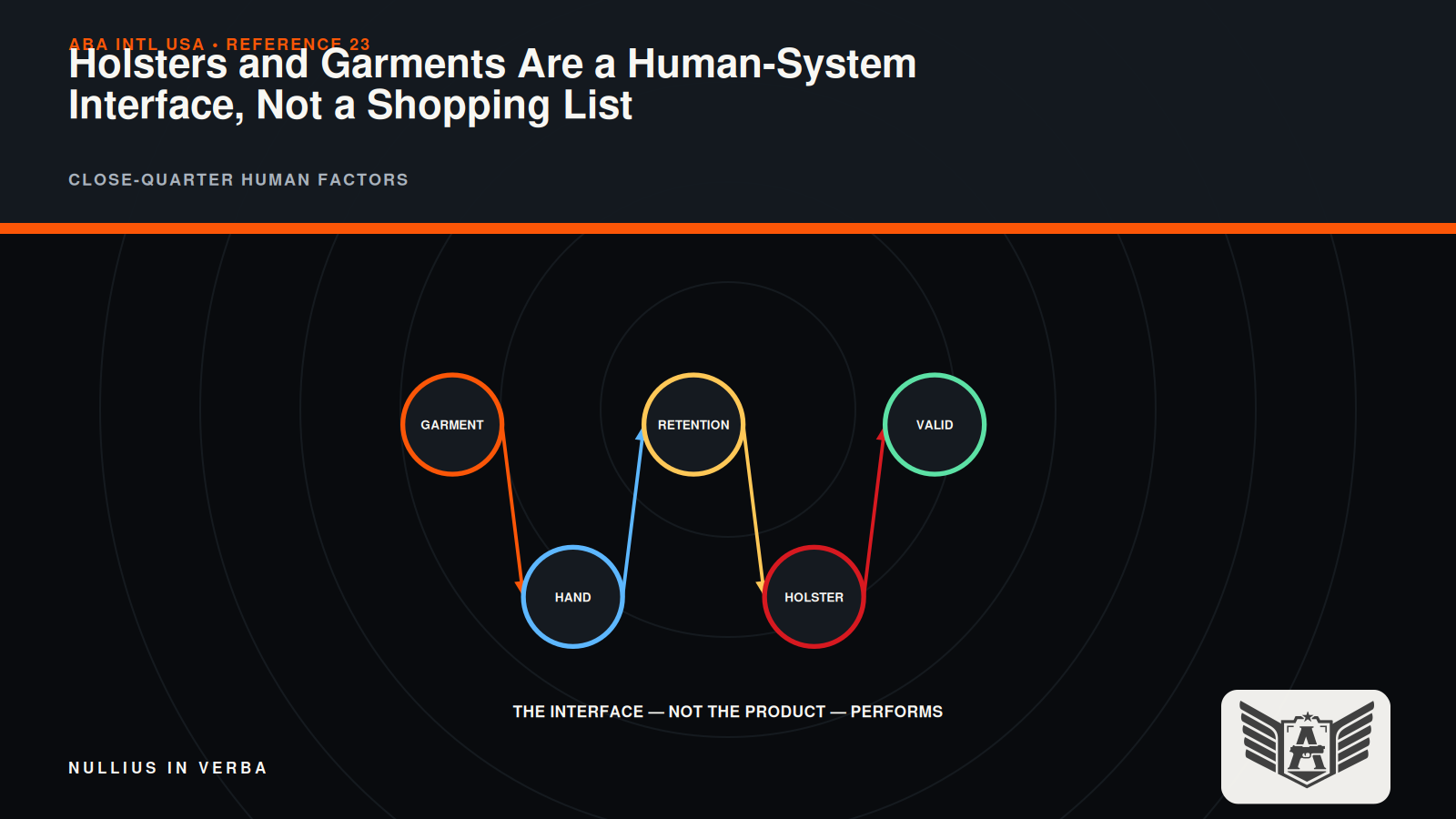
starts elsewhere. The relevant unit is the complete interface among
person, equipment, clothing, environment, and method. A component has no
operational performance independent of the system that uses it.
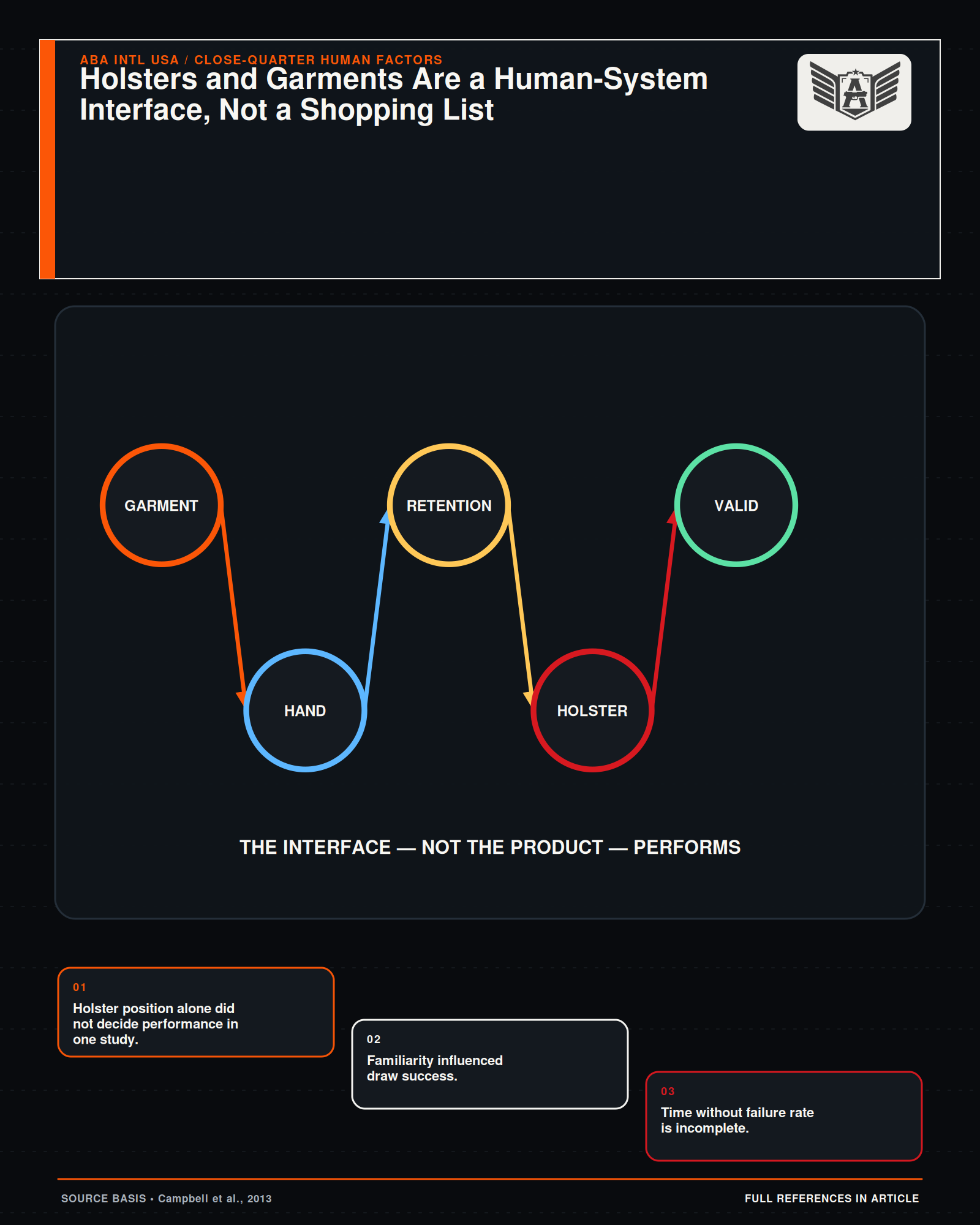
Campbell et al. (2013) examined 27 police officers drawing a training
pistol from hip and thigh holsters using three-dimensional motion
analysis. They found no significant overall differences in temporal
variables, fire-position variability, or draw success between locations.
Familiarity did matter: participants were more successful with the
holster position they normally used. This result is more informative
than a simple equipment ranking because it identifies adaptation as part
of the system.
The study does not prove that every hip and thigh holster is
equivalent. It compared specific configurations, required three
successful trials, and used a trained police sample. Retention
mechanisms, ride height, belt stiffness, body proportions, armor,
vehicle seats, and movement can alter performance. The proper inference
is that position alone did not determine the measured outcomes under the
protocol and that unfamiliar change can reduce success.
Success rate should be reported beside time. A new setup may produce
a faster best trial while increasing failed access, incomplete release,
garment entanglement, or an unstable initial grip. If only successful
trials are timed, the analysis conditions on the outcome it should
evaluate. A slower configuration with a narrow distribution and
near-perfect valid rate may create a better operational profile than a
volatile “fast” configuration.
Garments add another layer of geometry. Fabric weight, cut, closure,
pocket content, wind, moisture, and body position change how the access
path behaves. A single open-front training garment teaches one solution
to one predictable obstacle. Representative practice samples the
clothing actually worn while preserving enough control to locate which
variable caused failure. Random wardrobe novelty without diagnosis is no
more scientific than using no garment at all.
Retention is a tradeoff, not a virtue measured by mechanism count. A
system must resist unintended removal while permitting authorized access
under realistic postures and loads. Additional retention can change
movement sequence and cognitive demand; insufficient retention can
create loss risk during contact or movement. Evaluation should include
both access and retention challenges, with safe inert equipment and
trained role players.
Posture determines accessibility. Seated, supine, kneeling,
compressed, or entangled positions can block a path that works during an
upright range repetition. Vehicle interiors are especially consequential
because seat design, belt webbing, steering components, consoles, armor,
and equipment compete for space. The solution should not be assumed from
a standing draw test.
Hand availability must also be varied. Injury, communication,
physical control, or environmental support may remove the preferred hand
from the task. An equipment arrangement should be assessed for what
remains possible, which alternatives are safe, and where access creates
unacceptable orientation. This assessment is about resilience, not
performing theatrical one-handed feats at maximum speed.
Anthropometry makes universal placement claims suspect. Torso length,
hip geometry, limb proportions, sex-related equipment-fit differences,
and body composition influence reach and contact pressure. Issuing one
configuration and labeling adaptation problems as individual weakness is
poor systems engineering. Fit, adjustability, and task testing are
safety requirements.
Equipment changes require a familiarization phase before performance
comparison. Campbell et al. (2013) provide direct evidence that
familiarity influenced success. A crossover protocol can allocate
sufficient repetitions to each setup, rotate order, and retest after a
delay. Comparing a long-used system with a newly installed alternative
on day one measures familiarity confounded with design.
The metrics should include access latency, valid completion, failure
type, spatial variability, retention performance, comfort, movement
interference, and recovery after perturbation. Subjective preference
belongs in the dataset because discomfort and confidence influence
adoption, but it should not replace behavior. A setup that feels fast
and repeatedly fails under a garment has supplied a useful
contradiction.
Changes should be isolated. Replacing the holster, belt, optic,
garment, and technique simultaneously may improve performance, but the
program will not know why. TMM favors bounded experiments: define
Technique, collect Metrics, change one Method variable, and retest
(Bearare & Silveira, 2026). Operational transitions can then combine
proven components after their individual effects are understood.
Training methods should preserve equipment condition. Worn fasteners,
altered tension, contamination, battery state, damaged fabric, and
unauthorized adjustment change the interface over time. Inspection data
can explain sudden performance shifts and prevent a technical coaching
problem from being assigned to the shooter. Maintenance is part of human
performance because the human acts through the device.
Silveira (2023) positions combat-shooting instruction as an
evidence-based pedagogical system. Equipment selection follows the same
principle: the instructor does not endorse a product through authority
or aesthetics but states the task, protocol, and observed distribution.
Nullius in verba is especially valuable in a market saturated with
confident demonstrations that show one successful trial and conceal the
denominator.
A holster and garment should ultimately disappear as separate topics
and reappear as one tested interface. The standard is not ownership of a
recommended item. It is reliable, safe access and retention across the
postures, clothing, and environments that define the wearer’s actual
role. Equipment can expand capability, but only a measurement system can
show whether it did.
References
Bearare, S. C., & Silveira, L. (2026). Technique-Method-Metric
Triad in firearms training under extreme stress. RECIMA21 – Revista
Científica Multidisciplinar, 7(7), e778536.
https://doi.org/10.47820/recima21.v7i7.8536
Campbell, A., Roelofs, A., Davey, P., & Straker, L. (2013).
Response time, pistol fire position variability, and pistol draw success
rates for hip and thigh holsters. Human Factors, 55(2),
425–434. https://doi.org/10.1177/0018720812453466
Silveira, L. (2023). Introduction to combat shooting: Scientific
foundations, training, and application for instructors and
trainees. Editora CRV. https://doi.org/10.24824/978652514835.9
TRAIN. MEASURE. EQUIP.
Continue learning through ABA research and training. When equipment is the next variable, go directly to the ABA Store.
GET THE EQUIPMENT →Continue from research to practice
Knowledge is useful when it changes what you do next.
Establish a baseline, locate the limiting factor and measure whether training produced a real change.
Ask about ABA | Performance