
Police seat-belt use is sometimes argued as a contest between courage
and compliance. One side emphasizes proven crash protection; the other
emphasizes entanglement, equipment access, and rapid exit in a
threatening environment. Both concerns belong to the same operational
system. The correct question is not whether transport safety or tactical
mobility matters more in the abstract. It is how often each hazard
occurs, how severe its consequences are, and which engineering, policy,
and training controls reduce the combined risk.
Von Kuenssberg Jehle et al. (2005) retrospectively analyzed Fatality
Analysis Reporting System data from 1997 through 2001 for fatal crashes
involving marked U.S. police vehicles. Their inclusion criteria produced
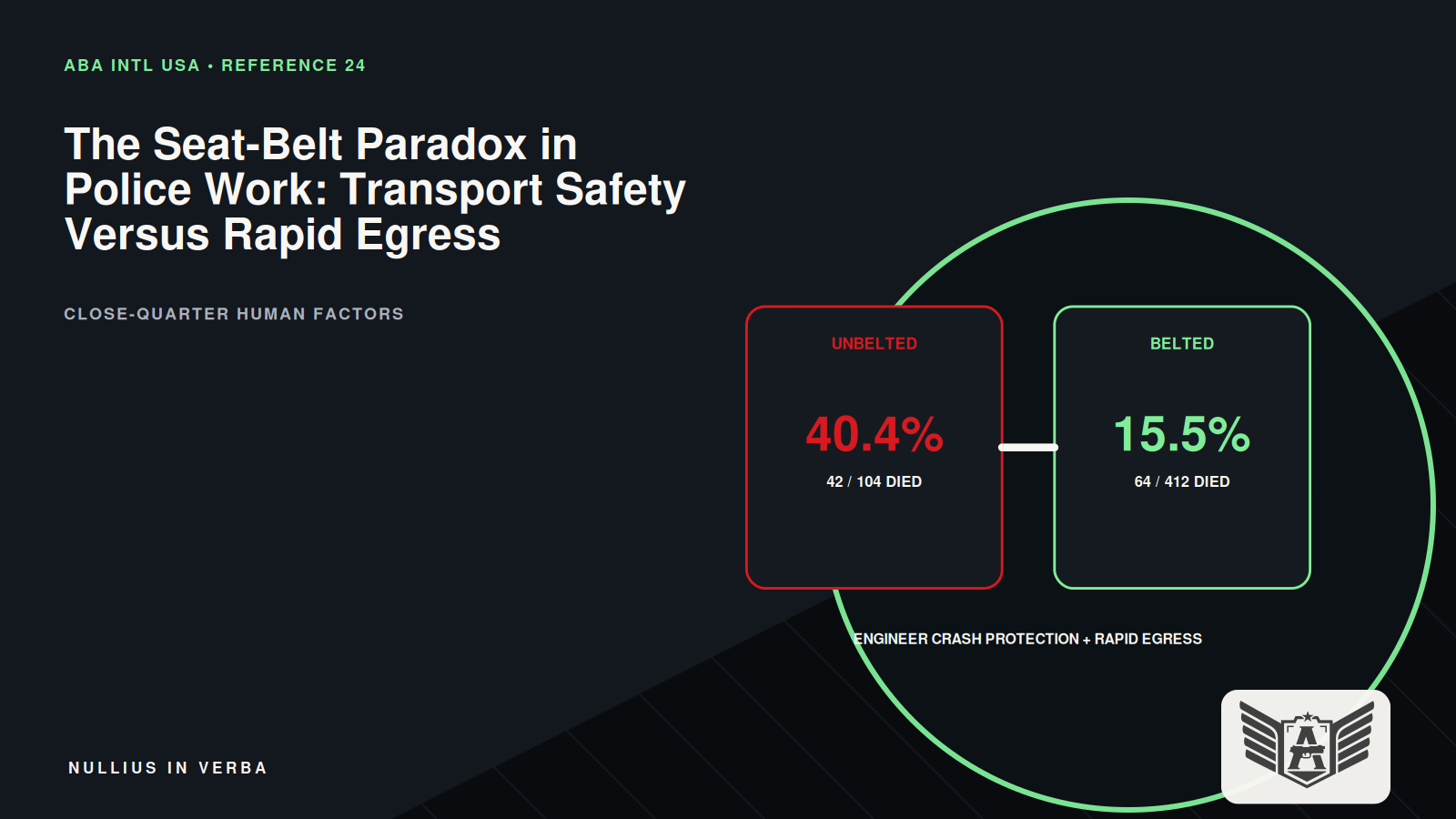
516 police-vehicle occupants. Of 104 unbelted occupants, 42 died, a
mortality proportion of 40.4%. Of 412 belted occupants, 64 died, a
mortality proportion of 15.5%.
The relative risk of death for unbelted occupants was 2.6, with a 95%
confidence interval from 1.9 to 3.6. The odds ratio was 3.7, with a 95%
confidence interval from 2.3 to 5.9. These are large associations in the
selected fatal-crash dataset. Belt use was not statistically related to
whether the vehicle was on an emergency or nonemergency call,
challenging the assumption that nonuse was confined to extraordinary
response conditions.
The study does not estimate mortality for every police trip. It
included crashes in which at least one person in an involved vehicle
died, excluded cases with unknown belt status, and used retrospective
records. Selection into a fatal-crash dataset affects the population to
which the percentages apply. The relative comparison within that
population is nevertheless difficult to dismiss: unbelted occupants died
much more frequently.
Impact direction mattered. The reported protective association was
stronger in frontal crashes than in lateral crashes. This detail
illustrates why “seat belts work” is true but incomplete. Restraint
performance interacts with crash direction, vehicle structure, airbags,
occupant position, and intrusion. Operational policy should be informed
by the full crash-protection system rather than one component in
isolation.
Officer nonuse is not explained only by ignorance. Oron-Gilad et
al. (2005) surveyed 341 police officers in the southeastern United
States and identified five influential factors: travel context, crime
context, confidence in seat-belt design, speed and distance of travel,
and seat-belt ergonomics. The survey documented a perceived conflict
between transport protection and rapid response in high-threat settings.
Perception does not quantify actual egress risk, but it predicts
behavior that policy must address.
Ergonomics makes the conflict concrete. Duty belts, armor, holsters,
radios, vehicle partitions, consoles, and belt geometry occupy the same
limited space. Webbing can contact equipment, the buckle may be
difficult to reach, and repeated entry and exit can create friction.
Telling officers to comply without testing the interface leaves a design
failure intact and encourages informal workarounds.
The strongest control hierarchy begins with engineering. Vehicle
interiors, restraint routing, buckle location, seat shape, and equipment
carriage should be designed together for the intended user. A system
that provides crash protection while reducing snag and release time is
preferable to a policy that asks the officer to trade one hazard for
another. Procurement trials should include anthropometrically diverse
officers wearing full duty equipment.
Policy follows engineering but needs bounded exceptions. A vague
“tactical reason” exemption can expand until nonuse becomes routine,
while an absolute rule that ignores a known entanglement condition can
lose legitimacy. Agencies should define specific circumstances, document
them, and review whether the exception remains necessary after equipment
or vehicle changes. The default should follow the much larger and
better-established crash risk while maintaining a pathway for
evidence-based adjustment.
Training should measure egress rather than repeat anecdotes. Officers
can be timed exiting from belted and unbelted conditions across
representative vehicle seats, equipment configurations, and door states.
Errors, snags, dropped equipment, unsafe orientation, and distribution
of times matter more than one best trial. The exercise may reveal that a
perceived delay is small, or it may expose a specific interface that
needs redesign.
Risk communication should use absolute numbers with denominators.
“Forty-two unbelted occupants died” means little without the 104
exposed; “64 belted occupants died” can sound worse without the 412
exposed. Presenting 40.4% versus 15.5%, together with the selected
fatal-crash population and confidence intervals, prevents rhetorical
misuse. Scientific literacy is a safety intervention.
Seat-belt habits also interact with cognitive mode. Repeatedly
deciding whether to buckle on every short movement increases variability
and invites omission when attention is divided. A clear default reduces
decision load. If an operational exception applies, it should be
activated by a defined cue and terminated explicitly rather than
becoming the officer’s general state for the remainder of the shift.
TMM can govern the system. Technique includes buckling, equipment
placement, release, and egress. Metrics include usage rate, release
time, snag frequency, crash and near-miss outcomes, and exception
frequency. Method tests vehicles and policies under representative
conditions and revises them when data reveal an interface problem
(Bearare & Silveira, 2026). The aim is not perfect compliance as an
abstract score; it is lower total injury risk.
The two 2005 studies complement rather than contradict each other.
Fatal-crash data quantify a strong association between nonuse and death,
while the survey explains why officers may resist the device. One
identifies the consequence; the other identifies adoption barriers.
Responsible doctrine needs both because a protective technology that
users avoid is an incomplete intervention.
The seat-belt paradox is solved neither by dismissing officer
concerns nor by ignoring mortality data. It is solved through
user-centered vehicle design, full-equipment testing, a defensible
default, narrow exceptions, and transparent outcome review. ABA’s
evidence standard turns a cultural dispute into a solvable human-systems
problem: protect the officer during the journey and preserve functional
egress at the destination.
References
Bearare, S. C., & Silveira, L. (2026). Technique-Method-Metric
Triad in firearms training under extreme stress. RECIMA21 – Revista
Científica Multidisciplinar, 7(7), e778536.
https://doi.org/10.47820/recima21.v7i7.8536
Oron-Gilad, T., Szalma, J. L., Stafford, S. C., & Hancock, P. A.
(2005). Police officers’ seat belt use while on duty. Transportation
Research Part F: Traffic Psychology and Behaviour, 8(1), 1–18.
https://doi.org/10.1016/j.trf.2004.10.005
Von Kuenssberg Jehle, D., Wagner, D. G., Mayrose, J., & Hashmi,
U. (2005). Seat belt use by police: Should they click it? Journal of
Trauma, 58(1), 119–120.
https://doi.org/10.1097/01.TA.0000105887.89467.E5

Continue from research to practice
Knowledge is useful when it changes what you do next.
Use this evidence to identify the next capability you need to build and the ABA route designed for it.
Find your ABA training path