Low-light firearms programs often begin with the mechanics of holding
or activating a light and end with target groups. That order assumes the
central problem has already been solved: the performer knows what is
present and whether action is justified. In darkness, however,
detection, object identification, depth, contrast, and confidence change
before trigger control becomes relevant. A technically accurate response
to a misidentified object is not skilled performance.
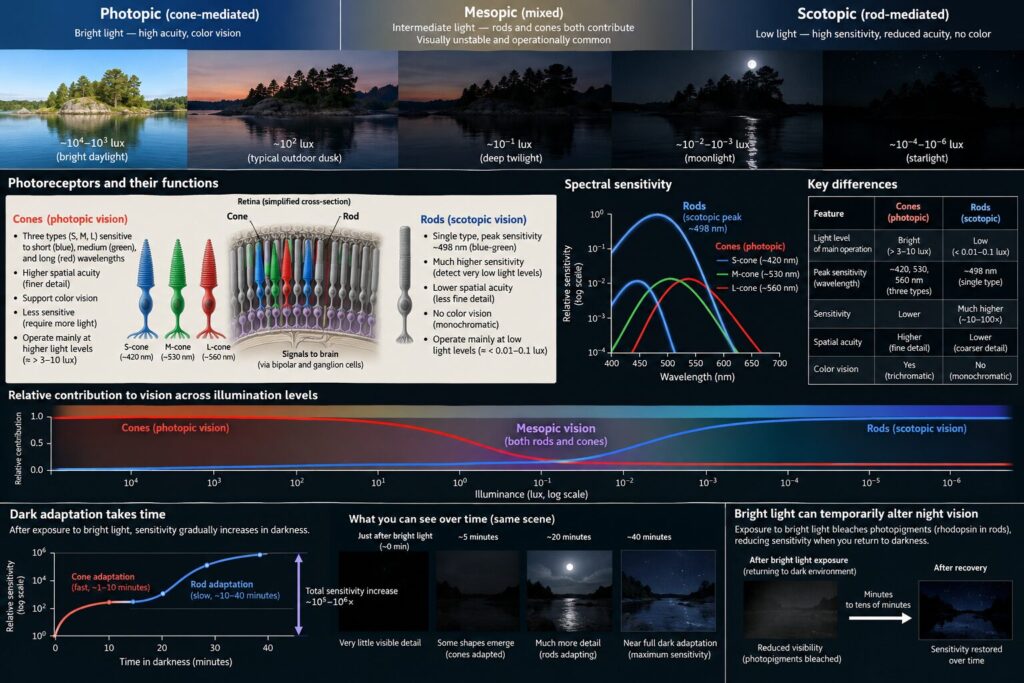
Human vision changes as illumination decreases. Cone-mediated
photopic vision supports fine detail and color in brighter conditions,
while rod-mediated scotopic vision becomes more influential in darkness
and provides greater sensitivity with reduced acuity and color
information. Mesopic conditions between those ranges are especially
operationally common and visually unstable. Adaptation also takes time,
and exposure to bright light can temporarily alter what is visible when
darkness returns.
Michel (1998) conducted a small demonstration with 12 police cadets
who had corrected 20/20 vision and no reported eye disease. Each cadet
viewed one large-frame handgun and three nonlethal objects—a garden hose
segment, black pipe, and screwdriver—for one second at four low
illumination levels. The objects were held against a black jacket. The
protocol isolated object identification under controlled conditions
rather than reproducing an encounter.
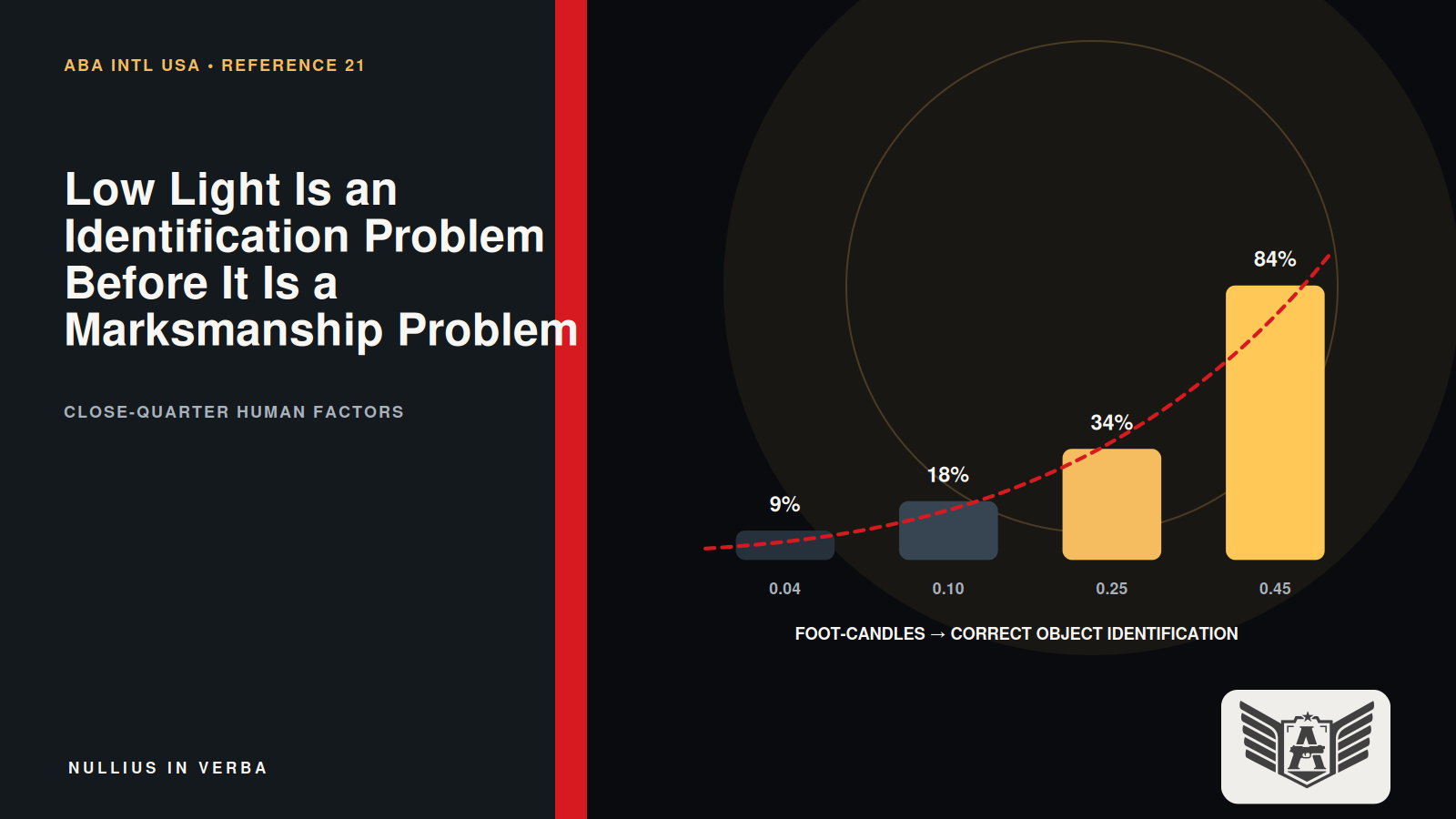
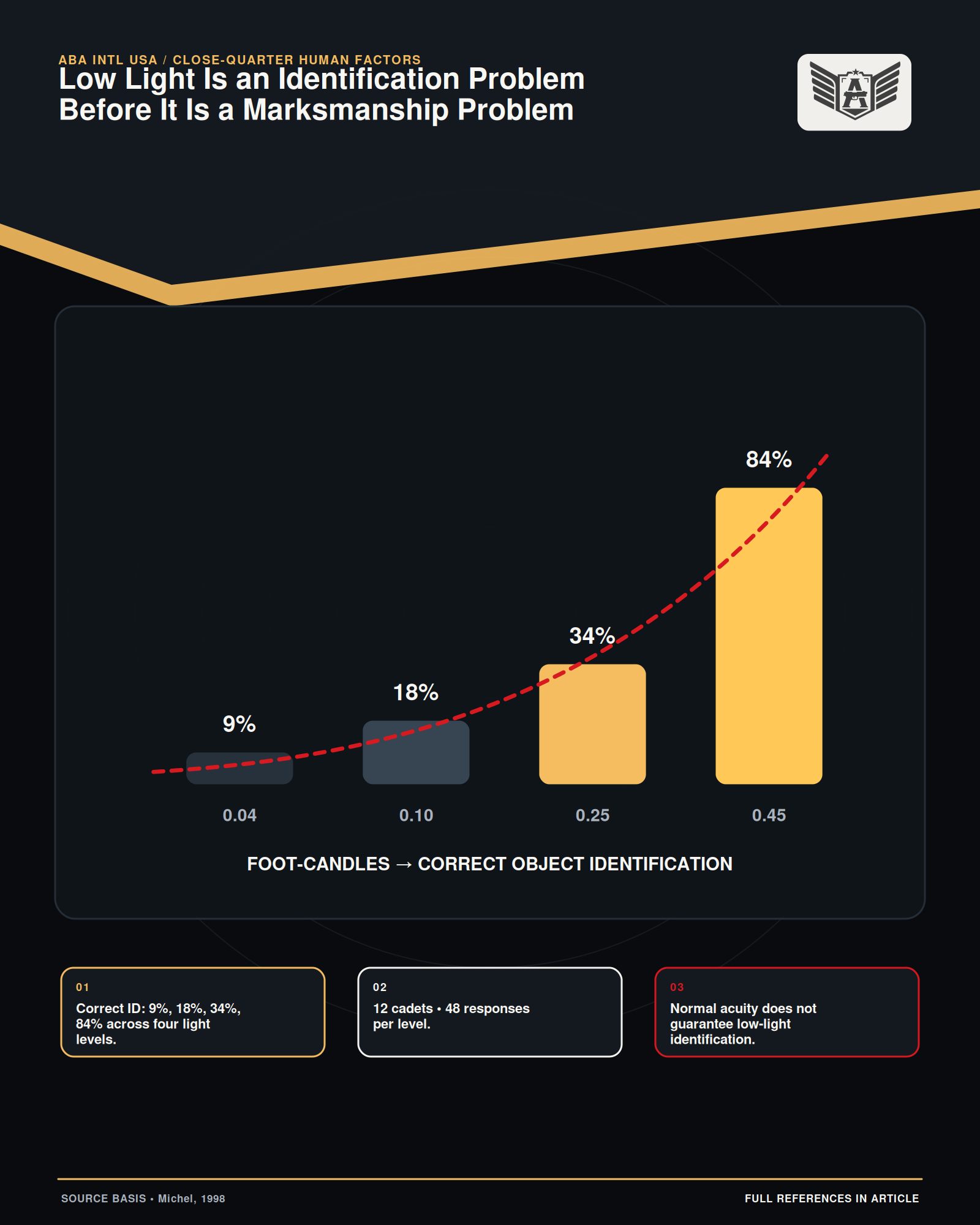
Across 48 responses at each level, correct identification was
approximately 9% at 0.04 foot-candles, 18% at 0.10, 34% at 0.25, and 84%
at 0.45. Even at the brightest tested level, 11 of 48 responses were
incorrect or uncertain. At 0.25 foot-candles, 10 of 12 cadets identified
the handgun, but object confusion remained substantial overall. The
garden-hose segment was frequently interpreted as a gun, showing that
silhouette and hand position can overpower object detail.
The study is old, small, and methodologically limited. It did not use
a randomized operational scenario, the exposure duration was fixed, the
handgun was large, and the reported percentages combine
misidentification with inability to identify. Those limitations prevent
broad prevalence claims. The data still make one robust instructional
point: normal acuity in a clinic does not guarantee reliable object
identification at low illumination.
Illumination should be measured rather than described as “dark.”
Foot-candles or lux provide an environmental value that can be recorded,
although the value at one point does not capture glare, contrast,
backlighting, adaptation state, or moving shadows. Training logs that
include actual light levels are more reproducible than labels such as
dusk, dim, or nighttime. They also allow instructors to determine
whether a learner’s performance threshold changes over time.
Contrast can be more important than total light. A dark object
against a light background may be detectable as a silhouette while its
identity remains uncertain. Backlighting can reveal body position and
hide the hands. A bright source in the field of view can create glare
and reduce useful detail elsewhere. The instructor should vary these
relations deliberately rather than merely turning the range lights
off.
Light is an information tool, not only an aiming accessory. Its
purpose can include navigation, search, communication, object
identification, and control of visual contrast. Every use also reveals
information about the user’s position and can create reflections or
self-blinding. Technique should therefore be evaluated by the
information obtained and the exposure created, not by adherence to a
named flashlight position.
Equipment cannot replace a decision rule. A high-output light may
increase available detail, but beam intensity, spill, switching,
mounting, power state, and environmental reflection change the result.
Weapon-mounted illumination also couples searching with the orientation
of a firearm, creating serious safety and policy implications. Programs
need independent illumination options and explicit rules that keep
identification separate from unjustified muzzle direction.
Low-light drills require nonthreat objects and no-action trials. If
every illuminated target contains a weapon, the learner can act on the
appearance of the target rather than identify the object. The score
should include correct identification, correct rejection, time to
decision, light-control errors, unsafe orientation, and confidence
calibration. A paper group alone measures only the final motor component
after the most consequential cognitive test has been removed.
Confidence deserves separate measurement because correct guesses can
feel like competence. The learner can rate certainty before receiving
feedback, allowing the instructor to compare calibration with accuracy.
Overconfident errors and cautious correct responses represent different
training needs. Michel reported that many cadets expressed uncertainty
even when correct, suggesting that low light affects both perception and
metacognition.
Motion makes the problem harder. Michel’s assistant and cadets were
effectively static during a one-second exposure, whereas operational
subjects, objects, lights, and observers may all move. Motion blur,
changing angles, and intermittent occlusion reduce the time during which
diagnostic features are visible. Representative progression should
introduce movement only after static identification is stable at
measured light levels.
Stress can further narrow attention toward the most threat-like
feature. O Cérebro Sob Fogo describes how arousal changes
perceptual selection and decision processes (Silveira & Bearare,
2026). In low light, that change can increase reliance on silhouette,
hand posture, or expectation. Training must create opportunities to
disconfirm an initial interpretation rather than reward immediate
commitment to the first plausible threat cue.
TMM structures the progression. Technique includes search,
illumination, communication, safe orientation, and action or inhibition.
Metrics capture light level, identification accuracy, false alarms,
confidence, timing, and equipment failures. Method varies contrast,
distance, exposure, object class, and pressure while preserving
interpretability (Bearare & Silveira, 2026). The threshold for
advancing is not a tighter group but reliable identification across more
than one visual condition.
Low light is therefore not ordinary shooting with fewer photons. It
is a different information environment in which the probability of
misidentification changes before movement begins. A reference program
trains the eyes, the decision criterion, the use of light, and the
ability to withhold action as rigorously as it trains mechanics. The
ethical standard is simple and demanding: illuminate to know, not merely
to shoot.
References
Bearare, S. C., & Silveira, L. (2026). Technique-Method-Metric
Triad in firearms training under extreme stress. RECIMA21 – Revista
Científica Multidisciplinar, 7(7), e778536.
https://doi.org/10.47820/recima21.v7i7.8536
Michel, P. (1998). Visual perception in low-light levels:
Implications for shooting incidents. FBI Law Enforcement Bulletin,
67(5), 6–9.
https://www.ojp.gov/ncjrs/virtual-library/abstracts/visual-perception-low-light-levels-implications-shooting-incidents
Silveira, L., & Bearare, S. C. (2026). O cérebro sob fogo: O
que o estresse extremo faz com a mente e o corpo do atirador.
Editora Ludus.
TRAIN. MEASURE. EQUIP.
Continue learning through ABA research and training. When equipment is the next variable, go directly to the ABA Store.
GET THE EQUIPMENT →Continue from research to practice
Knowledge is useful when it changes what you do next.
Connect technical execution with perception, judgment and decision-making in the Cognitive Operator pathway.
Explore Cognitive Operator