

Miroslav Knez and Srečko Felix Krope · Organizacija 59(3) · 2026
A national survey of 359 Slovenian police officers examined legal knowledge, perceived operational readiness, and views of firearms training.
Miroslav Knez and Srečko Felix Krope published “Training and Decision-Making in Police Firearms Use: Evidence from a Survey of Slovenian Police Officers” in Organizacija, Volume 59, Issue 3, in 2026. The article focuses on a dimension of firearms competence that is easily overshadowed by marksmanship: how prepared police officers believe they are to make firearms decisions and how well the existing training structure prepares them for decisions made under stress and uncertainty.
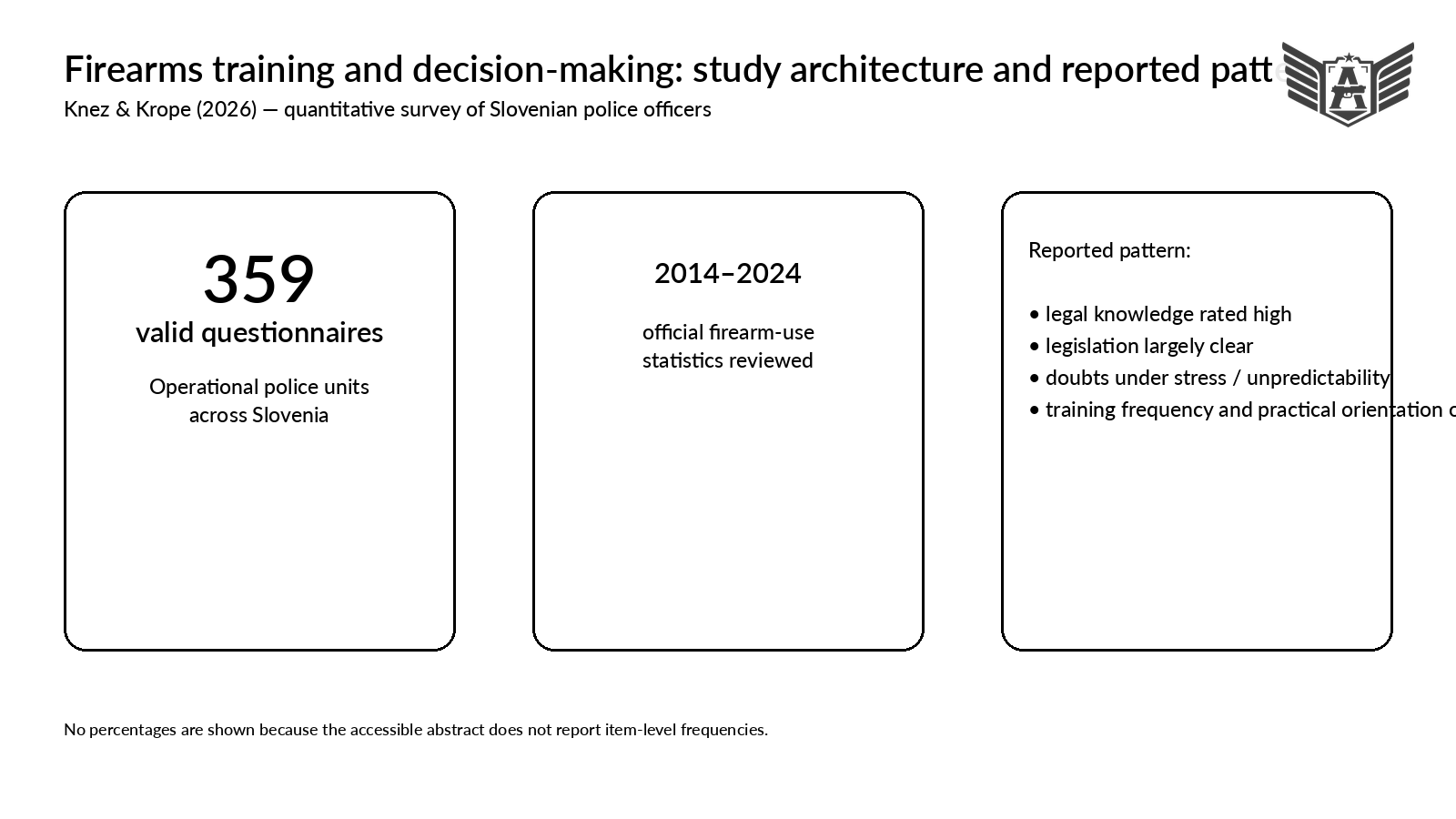
The researchers analyzed 359 valid questionnaires collected from officers serving in operational units throughout Slovenia. They supplemented the survey with official statistics on police firearm use between 2014 and 2024, creating a broader institutional context for the officers’ responses. The design therefore combines self-reported perceptions with documentary context rather than with a direct experimental test of shooting or decision performance. The distinction is important because perceived readiness, objective skill, and actual operational behavior are related but non-equivalent constructs.
Respondents generally rated their knowledge of the legal framework governing firearm use as high and considered the governing rules largely clear. The more substantial concern appeared when questions moved from formal knowledge toward real-time decision-making. A substantial proportion of officers expressed uncertainty about making firearms decisions in stressful and unpredictable circumstances. Most officers reported regular participation in firearms training, yet many considered the frequency and practical orientation of that training insufficient, especially with respect to scenario-based practice and decision-making under stress.
This difference between knowing the rules and applying them under pressure is central to the interpretation of the paper. Written legal knowledge, technical weapon handling, marksmanship, threat assessment, stress regulation, and time-constrained judgment are related components of competence, but they should not be treated as interchangeable. An officer can correctly explain policy in a classroom while still finding it difficult to apply that policy while simultaneously processing incomplete information, communicating, moving, managing physiological arousal, and deciding whether force is necessary. Training systems that assess only legal knowledge or isolated marksmanship therefore risk producing an incomplete picture of operational readiness.
The study remains a survey and should not be interpreted as a demonstration that a particular training intervention produces better field decisions. Self-reported uncertainty does not establish poor performance, just as confidence does not establish competence. The authors’ data instead identify a perceived gap between formal knowledge and operational readiness among a large national sample. For training organizations, the methodological implication concerns construct validity: if an assessment measures accuracy in a controlled shooting task, it should be described as a marksmanship assessment rather than as a complete measure of operational readiness. If the intended outcome includes judgment under uncertainty, the assessment must also observe meaningful decisions under representative conditions.
Original article visual: Original article. The paper is licensed CC BY-NC-ND 4.0; the ABA Intl post therefore uses a new factual study map rather than reproducing or adapting a publisher figure.
The purpose of this ABA Intl Science Brief is scientific communication rather than the creation of a new clinical, legal, or operational standard. Results should be interpreted within the population, measurement protocol, and statistical design used by the original investigators. Where ABA Intl has redrawn numerical results, the values are taken directly from the published article and the visualization is identified as an ABA Intl graphic rather than as an original publisher figure.
Reference
Knez, M., & Krope, S. F. (2026). Training and Decision-Making in Police Firearms Use: Evidence from a Survey of Slovenian Police Officers. Organizacija, 59(3), 259–270. https://doi.org/10.2478/orga-2026-0016
A source-based visual summary of the study is provided below. The figure caption identifies whether it reproduces reported values, study structure, or qualitative themes.
TRAIN. MEASURE. EQUIP.
Continue learning through ABA research and training. When equipment is the next variable, go directly to the ABA Store.
GET THE EQUIPMENT →Continue from research to practice
Knowledge is useful when it changes what you do next.
Connect technical execution with perception, judgment and decision-making in the Cognitive Operator pathway.
Explore Cognitive Operator