Introduction
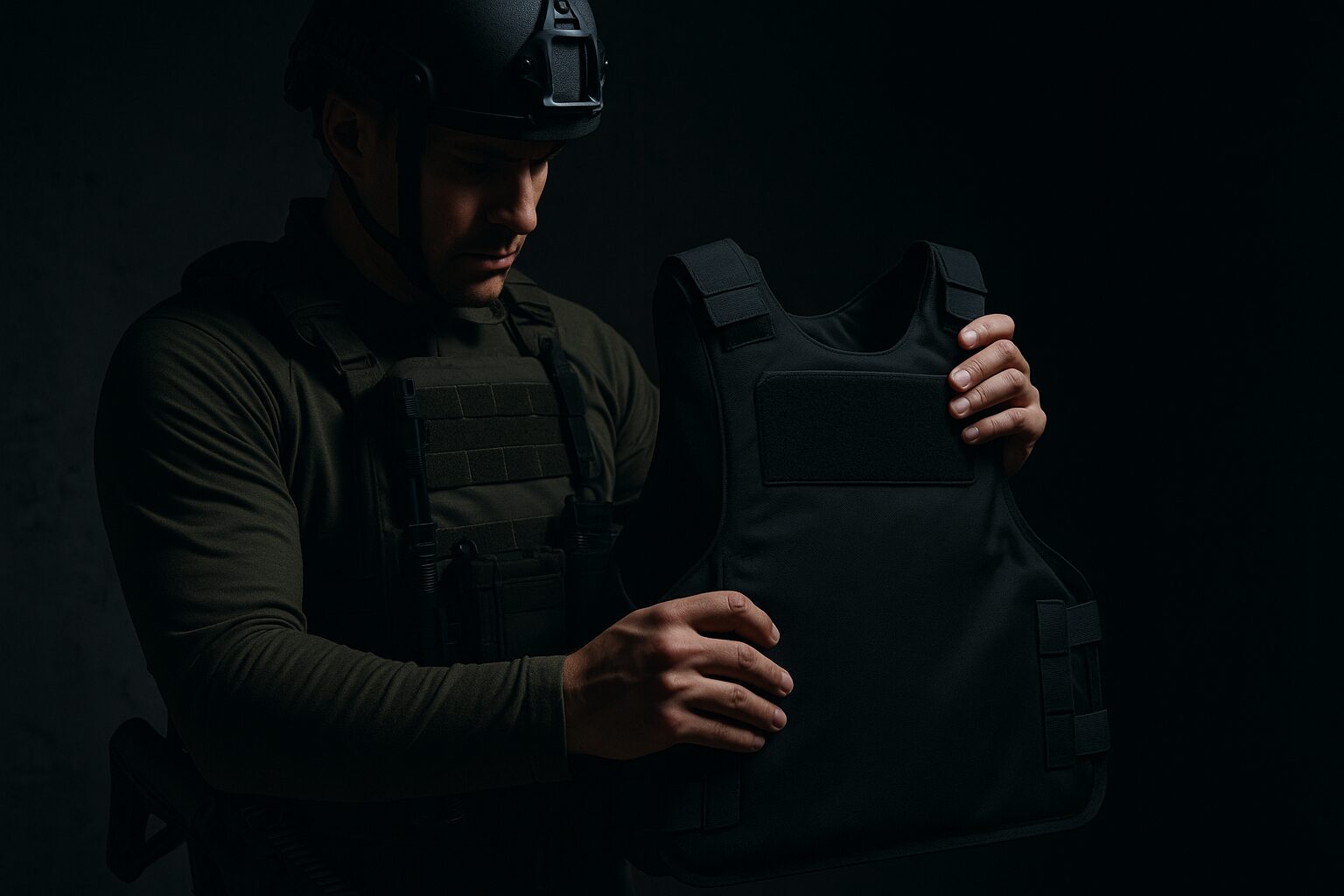
Few pieces of equipment symbolize preparedness as powerfully as body armour. Yet, the question remains: should you actually wear it?
For military operators, private security professionals, and armed citizens, the decision involves balancing protection, mobility, legality, and comfort.
Recent research by Kantor et al. (2025) published in The Police Journal revealed that a concealed knife attack from only eight feet away can reach its target in as little as 1.04 seconds. That’s less time than it takes to blink twice — and far less than it takes to draw a firearm.
With that in mind, let’s examine the purpose, types, laws, and practical considerations behind body armour — and why, in the real world, the choice to wear or not wear it can define survival itself.
1. What Is Body Armour?
Body armour (or ballistic protection) is any equipment designed to absorb or deflect the impact of projectiles, blades, or blunt trauma.
Its core function is to reduce the likelihood of injury or death from gunfire, knives, or shrapnel — offering vital seconds of life when reaction time runs out.
Modern body armour combines lightweight synthetic fibers and rigid materials to resist penetration while maintaining mobility. The most common materials include Kevlar, Dyneema, Twaron, and ceramic composites, all rated by the NIJ (National Institute of Justice) performance standards.
2. The Main Types of Body Armour
Soft Armour
Flexible and lightweight, designed to stop handgun rounds and fragmentation. Typically made of woven aramid fibers (like Kevlar), it’s the standard for law enforcement and civilian concealed use.
Protection Level: NIJ Level II or IIIA
Stops: 9mm, .357 Magnum, .44 Magnum (depending on model)
Hard Armour
Rigid plates made from steel, ceramic, or polyethylene, capable of stopping high-velocity rifle rounds. Usually inserted into carriers as front and back plates.
Protection Level: NIJ Level III to IV
Stops: 7.62×39mm, 5.56×45mm, 7.62×51mm NATO
Excellent for combat or tactical contexts, but adds considerable weight and limits mobility — factors that can be deadly in dynamic environments.
Spike- and Slash-Resistant Armour
Built to protect against edged weapon threats such as knives, machetes, or improvised blades.
Given the data from Kantor et al. (2025) — showing that knife assaults at conversational distance (around 8 ft) occur in barely over a second — this type of armour can be more relevant for civilian defense than many realize.
These vests use laminated or chainmail-like layers to prevent puncture and tearing without relying on ballistic fibers.
Multi-Threat Armour
Hybrid vests designed to handle ballistic, stab, and slash threats simultaneously.
They are heavier and pricier but are standard for corrections officers, private security, and executive protection agents in unpredictable environments.
3. Body Armour Laws in the United States
At the federal level, owning and wearing body armour is legal for civilians, except for convicted violent felons (18 U.S.C. § 931). However, several states have specific regulations:
- Connecticut: Purchase only allowed face-to-face (no online sales).
- Louisiana & New York: Illegal to wear body armour while committing a crime. (FANTASTIC, uhn?!)
- California: Periodic legislative attempts to restrict or register civilian armour use.
- All other states: Generally legal for law-abiding citizens to own and wear.
In the U.S., body armour ownership has grown rapidly since 2020 — paralleling spikes in civil unrest, mass attacks, and the general erosion of public confidence in institutional protection.
4. Body Armour Laws in Europe
Europe presents a patchwork of rules — often more restrictive than in the U.S.:
- United Kingdom:
Civilian ownership is not banned, but using armour in a crime greatly increases sentencing. Export and import of military-grade plates may require authorization under anti-terror legislation. - Germany & France:
Civilian ownership is legal but regulated. Some plates are categorized as “war material,” demanding special permits. - Scandinavia (Sweden, Norway, Finland):
Generally legal, though professional justification or background checks may be required. - Eastern Europe:
More permissive — nations like Poland, Czech Republic, and Ukraine treat armour as protective equipment rather than weaponry.
5. Body Armour Laws Around the World
- Canada:
Depends on the province. In British Columbia, buyers need a security license. In Alberta, anyone without a violent record may purchase freely. - Australia:
Among the most restrictive nations — armour is a prohibited weapon in most states, and unauthorized possession can result in imprisonment. - Brazil:
Controlled by the Army Logistics Command (COLOG). Civilians can own it, but import and sale require official authorization. - Israel:
Highly permissive. Civilian purchase and wear are legal, especially for those in security or defense sectors. - South Africa:
Legal for civilians, with widespread use among private security operators due to high violent crime rates.
6. Why You Should Wear Body Armour
A. The One-Second Reality
The Kantor et al. (2025) study revealed that an attacker can deliver a concealed knife strike from 8 feet in roughly 1.04–1.60 seconds — faster than most people can even recognize the attack, let alone respond.
This means that your physical reaction, draw speed, or martial skill might not be enough. Armour buys you time when time doesn’t exist.
B. Real-World Violence Is Unpredictable
Ambushes, robberies, domestic assaults, and spontaneous violence rarely announce themselves. Armour provides passive protection that doesn’t depend on awareness or speed — it’s already in place when you need it most.
C. Psychological Confidence
Operators often report improved composure under threat when wearing armour. The knowledge that you’re protected allows more decisive action and better judgment during combat or high-stress operations.
D. Professional Necessity
For law enforcement, private military contractors, and even journalists working in conflict areas, armour isn’t optional — it’s PPE for survival. It protects not just life, but mission continuity.
7. When Body Armour Might Not Be Worth It
- Low-Risk Environments – In extremely safe areas or for short, low-profile activities, armour might add unnecessary bulk and discomfort.
- Physical Burden – Hard plates generate heat, restrict movement, and cause fatigue, especially during prolonged operations.
- Legal and Social Consequences – In some jurisdictions, being seen wearing armour can draw police suspicion or public misunderstanding.
- False Sense of Security – Armour protects only where it covers. The neck, femoral artery, and head remain vulnerable. No vest replaces situational awareness, distance management, or tactical skill.
8. Final Considerations
Body armour is a tool — not a guarantee. Its effectiveness depends on context, training, and realistic expectations.
In close-quarters scenarios, where the human response window can be under one second, protection becomes less about “if” you’ll be attacked and more about how prepared you’ll be when it happens.
Wearing armour doesn’t make you paranoid. It makes you pragmatic.
At ABA International, we teach that readiness is built in layers: awareness, skill, and protection. Armour is one of those layers — and perhaps the only one that works even when you can’t.
So, should you wear body armour?
Ask yourself instead: can you afford not to?
References
Kantor, M. A., Bleetman, A., Tenbrink, J., & Garg, H. (2025). Close-quarter concealed knife attacks: How much time do you have? The Police Journal: Theory, Practice and Principles. https://doi.org/10.1177/0032258X251340171