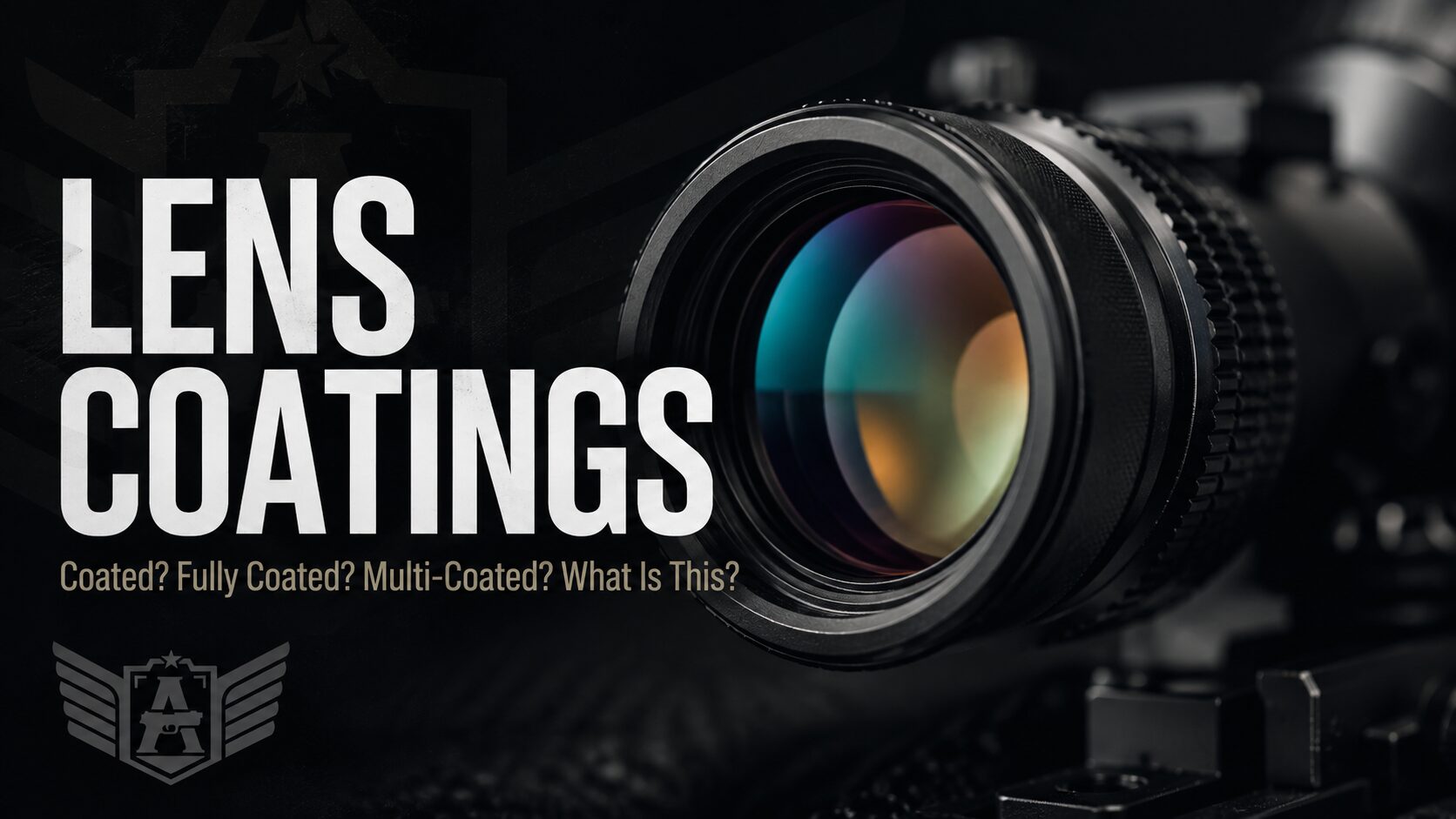
When purchasing certain types of lenses, such as telescopic sights or binoculars, you may have come across intriguing terms like “coated,” “multi-coated,” or “fully coated.” What on earth do these mean, and why is it crucial to understand the difference between these terms? Let’s find out!
Optical coatings serve to diminish internal light loss and glare, ensuring uniform light transmission that culminates in enhanced image sharpness and contrast. The application of coatings on optics results in a subdued, often dark appearance when peering into the barrel or tube, with a potential tint of greenish, bluish, or brownish hues attributed to the magnesium fluoride or calcium fluoride composition.
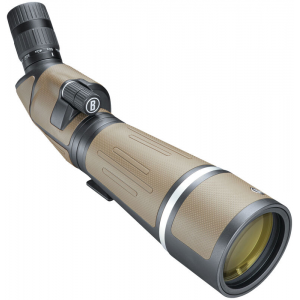
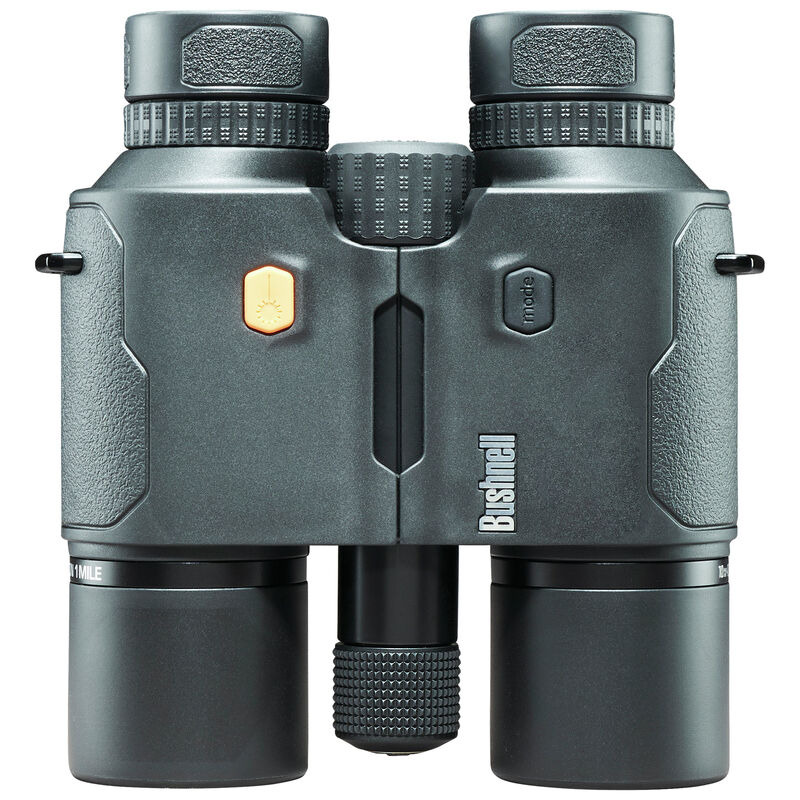
Glass surfaces can undergo various coatings for multiple purposes. Take, for example, your car windows. It’s highly probable that they are coated to repel water, minimize glare, and decrease the transmission of light and heat into the car’s interior. Similarly, lenses with AR (anti-reflective) coatings are frequently found on optics like rifle scopes, laser rangefinders, binoculars, and spotting scopes. Irrespective of the optical device they are applied to, lens coatings serve identical purposes and are maintained using the same eyeglass cleaners.
“Anti-reflection coatings usually consist of a number of very thin transparent film layers, each having a distinct index of refraction to alter the lens performance with different wavelengths and at different angles of incidence. Sometimes, you can see these coatings by looking for blue, red, or green reflections as you look into the front of an optic’s objective lens at different angles.” (2)
These coatings employ a destructive interference mechanism, selectively eliminating certain colors or wavelengths of light and thereby reducing reflection. Consequently, a greater amount of light permeates the optics, facilitating its passage to the observer’s eyes.
“Lens coatings can also be specifically formulated to repel moisture. These coatings provide the benefits of reducing water spots and preventing rain and snow from sticking to the lens. However, more importantly, these coatings can eliminate fogging.
The fogging of lenses occurs when the temperature of the lens is lower than the dew temperature of the air. Fogging can be inevitable in warm, humid air because the dew point is close to the ambient air temperature. Under these conditions, the lenses may fog even if they are only a few degrees colder than the air temperature.
Fogging can also occur in cold conditions in which the lenses become quite cold, and moisture from your respiration or perspiration can condense on the cold lenses. Under these conditions, condensation can even freeze and form frost on the lenses.
Lens coatings repel moisture by providing a surface that is so slick that the moisture rolls off the lens rather than sticking. For example, our EXO Barrier™ technology bonds to the lens on a molecular level and fills in the pores in the lens so that beads of water have nothing to stick to.” (3)
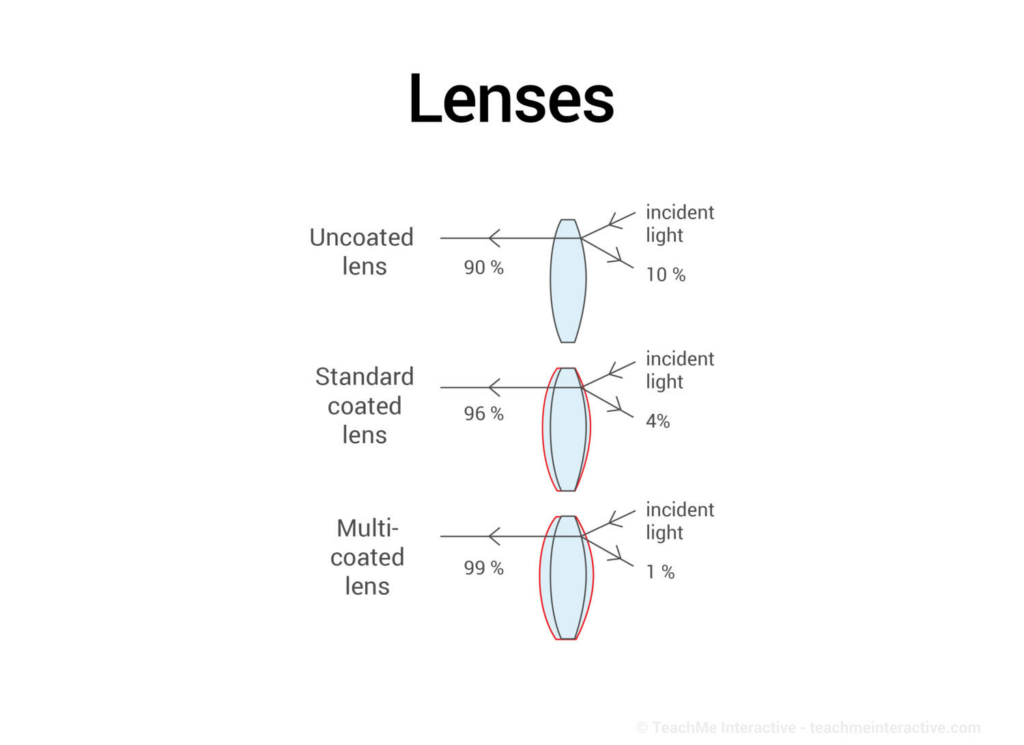
In the realm of modern consumer optics, nearly all instruments incorporate some form of coating elements, albeit varying in levels and qualities. Celestron, as an example, offers distinct levels of coatings for optical tubes, binoculars, and spotting scopes, each denoting the extent of coverage on the optical surfaces. These levels include:
- Coated: At least one major optical element features a coating on one surface.
- Fully Coated: All lenses and glass surfaces are coated, encompassing the long side of the prism for binoculars.
- Multi-Coated: At least one major optical element in a fully-coated binocular has multiple coatings of anti-reflective compounds on one surface.
- Fully Broadband Multi-Coated: Primarily found in certain binoculars and spotting scopes, this coating reduces surface reflectivity, enhancing optical throughput across the entire visible light spectrum.
- Fully Multi-Coated: All glass surfaces boast multiple coatings, resulting in optimal light transmission (90-95%) for vivid, sharp, and high-contrast images.

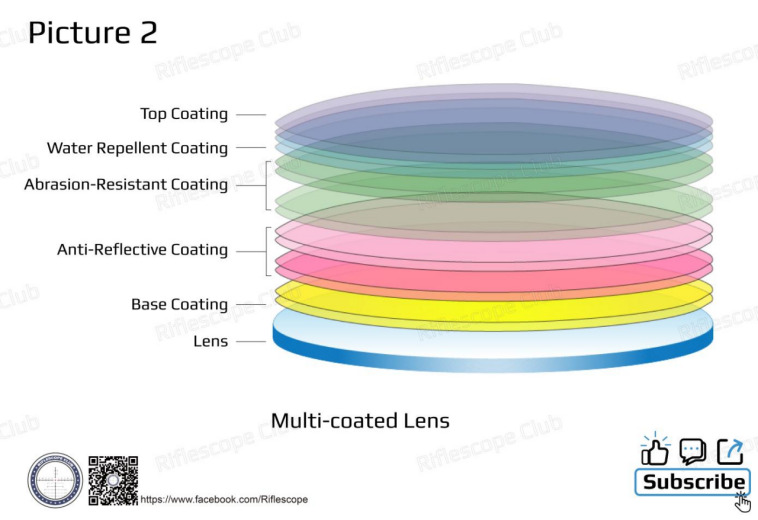
Understanding lens coatings is essential for anyone who relies on firearm optics, binoculars, or spotting scopes in demanding field conditions. These coatings are not decorative details; they are engineered optical treatments designed to control reflection, increase light transmission, reduce glare, and preserve image clarity. In a rifle scope, that can mean a brighter sight picture, better contrast at dawn or dusk, and less visual interference when light strikes the lens at difficult angles. In binoculars or observation optics, it can mean sharper detail, more accurate color rendition, and reduced eye fatigue during prolonged use.
The quality and extent of the coating system matter. A basic coated lens may offer some improvement over untreated glass, while fully multi-coated optics generally provide superior light transmission and image fidelity. This is one reason two scopes with similar magnification and objective lens diameter can perform very differently in low-light or high-glare environments. The difference is often not the number printed on the tube, but the quality of the glass, the coating system, and the precision of the optical assembly.
Proper maintenance is also part of optical performance. Coated lenses should be cleaned with appropriate lens-safe products, microfiber cloths, and careful technique. Abrasive materials, aggressive chemicals, or careless wiping can damage coatings and permanently degrade optical quality. The next time you look through a rifle scope or binocular, remember that the coating is not just a technical specification. It is one of the key factors that determines what you can see, how clearly you can see it, and how confidently you can use that information in the field.
References:
- Celestron – https://www.celestron.com/blogs/knowledgebase/what-are-the-differences-between-the-optical-coatings
2. Hunting Optics – http://huntingoptics.net/anti-reflection-lens-coatings/
3. Bushnell – https://www.bushnell.com/through-the-lens/bu-blog-antireflective-coated-lenses-and-their-role-on-optics.html
4. Vector Optics – https://www.vectoroptics.com/about/view/id/72.html
5. Long Range Shooting – https://www.longrangeshooting.org/articles/scope-internal-anatomy
TRAIN. MEASURE. EQUIP.
Continue learning through ABA research and training. When equipment is the next variable, go directly to the ABA Store.
GET THE EQUIPMENT →Continue from research to practice
Knowledge is useful when it changes what you do next.
Use this evidence to identify the next capability you need to build and the ABA route designed for it.
Find your ABA training path