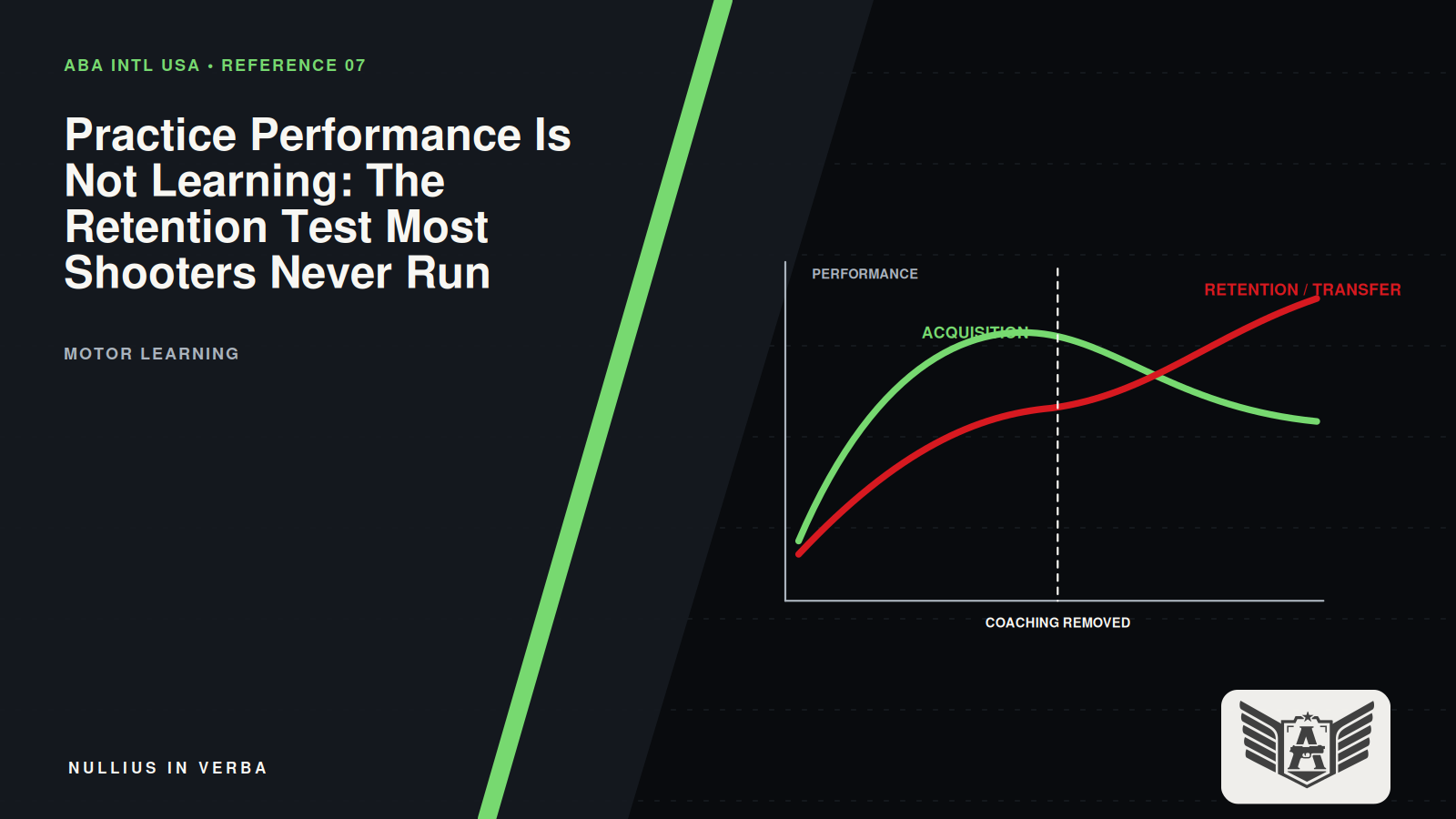
A shooter performs better near the end of a class than at the
beginning. The instructor concludes that learning occurred. That
conclusion is plausible but unproven. Performance during practice
reflects the temporary influence of warm-up, repeated task exposure,
immediate feedback, coaching, target familiarity, motivation, and
short-term strategy. Learning is a relatively persistent change in the
capacity to perform. It becomes visible after those supports are
reduced, time has passed, and the task is tested again. The distinction
is not semantic; it determines whether a training program builds durable
skill or merely produces convincing final repetitions.
Motor-learning research repeatedly demonstrates that conditions which
improve acquisition performance can fail to improve retention. Shea and
Morgan’s (1979) classic experiment showed that blocked practice produced
better performance during training, while random practice produced
superior retention and transfer. The result does not mean that random
practice is always best. It means that the smoothness of the acquisition
session can be negatively related to the processing that later supports
independent performance.
Blocked repetition is attractive because the solution remains active
in working memory. The performer repeats the same response under the
same condition, reducing the need to reconstruct the action plan. Errors
often decrease quickly, which makes the session feel effective. When the
context changes or the skill is revisited later, however, the performer
may no longer have the instructor, sequence, and recent repetitions that
supported success. What looked like automaticity may have been temporary
access to a rehearsed solution.
A retention test introduces a delay and removes avoidable support. It
uses the trained task or a closely matched version without fresh
coaching, warm-up beyond the defined protocol, or knowledge of results
after every attempt. The delay can be a day, a week, or longer depending
on the training question. A 24-hour test is common in research because
it reduces immediate practice effects, but professional programs should
also examine longer intervals that resemble actual training
schedules.
Transfer asks a harder question: can the performer apply learning
when the surface conditions change? A concealed draw practiced with one
garment should not be assumed to transfer perfectly to another. A
marksmanship skill learned on a known target does not automatically
support target discrimination. A transfer test preserves the underlying
demand while changing distance, order, presentation, equipment detail,
or response requirement. The test should be novel enough to prevent
memorized sequence from carrying the result but similar enough to sample
the intended capability.
Feedback is one reason acquisition can mislead. Continuous instructor
correction can produce excellent repetitions because the learner does
not need to detect error independently. Chiviacowsky and Wulf (2005)
found benefits from self-controlled feedback when learners requested
information in relation to their own performance. The broader
implication is that feedback should develop error estimation rather than
replace it. A shooter who performs only while the coach calls every
correction has not yet acquired an independent control system.
Reduced or faded feedback is often used to limit dependency, but
frequency should not become dogma. Aoyagi et al. (2019) found that a
fading knowledge-of-results schedule supported retention in an isometric
task, yet findings across tasks are heterogeneous. Beginners confronting
a complex movement may need more information than experts refining a
stable pattern. The training method should reduce feedback as the
performer demonstrates the ability to identify and correct error, not
according to an arbitrary percentage applied to everyone.
Task difficulty has the same double effect. A simple condition can
support initial coordination while providing too little information for
later adaptation. An excessively difficult condition can overwhelm the
learner and produce errors that are not interpretable. Guadagnoli and
Lee’s (2004) challenge-point framework proposes that useful difficulty
depends on nominal task demands and the performer’s current skill.
Learning is maximized neither by permanent comfort nor by permanent
failure, but by an information load the performer can process.
Pressure can also generate a false learning narrative. A performer
may survive a dramatic scenario once and attribute success to the
preceding drill, yet one outcome cannot establish durable adaptation.
Research by Oudejans (2008) and Nieuwenhuys and Oudejans (2011) suggests
that representative practice under pressure can improve later pressured
performance. Those studies used pre-post or retention comparisons. The
value came from measured change across conditions, not from the
emotional intensity of the practice experience.
The distinction between learning and performance changes how sessions
should end. The final exercise should not be engineered merely to give
the class a triumphant result. It can sample current acquisition, but
the instructor should label it honestly. The real evidence arrives
later, when the skill is tested without the same sequence of cues.
Programs that never conduct delayed tests cannot know whether their
strongest demonstrations are learning effects, warm-up effects, or
instructor-supported performances.
Retention data also improve diagnosis. If acquisition improves but
retention returns to baseline, the practice method may have created
guidance dependence or task-specific adaptation. If retention is stable
but transfer fails, the skill may be insufficiently variable or the
transfer test may introduce an untrained perceptual demand. If both
retention and transfer improve while the practice session looked messy,
the difficulty was productive. The delayed result protects the
instructor from judging the method by classroom appearance.
TMM places these distinctions inside a usable cycle. Technique
defines the solution. Metrics include acquisition, retention, and
transfer rather than one end-of-class score. Method manipulates practice
conditions and feedback based on the constraint. Bearare and Silveira
(2026) treat measurement as the bridge between doctrine and correction;
without a delayed test, the bridge ends before the central learning
claim is examined.
For an individual shooter, the procedure can be compact. Establish a
five-run baseline. Train one constraint for a defined period. Record
immediate post-practice performance but do not call it learning.
Reassess after at least 24 hours under the same baseline conditions,
then add a transfer condition. Preserve average, spread, and valid rate.
The resulting profile reveals whether the method produced temporary
facilitation, durable change, or flexible application.
For instructors, the cultural change is more demanding. A class may
look less polished when learners must solve problems, estimate errors,
and practice under variable conditions. Students accustomed to constant
affirmation may interpret difficulty as poor teaching. The instructor
must explain why struggle is being introduced, protect safety, and keep
difficulty within a functional range. Productive challenge is not an
excuse for confusion; it is a designed condition whose value must appear
in later testing.
Learning is what remains when the instructor stops talking, the
sequence is no longer fresh, and the environment changes just enough to
require reconstruction. If the skill disappears under those conditions,
the practice session produced performance but not yet capability. The
remedy is not simply more repetition. It is a better method, a delayed
test, and the humility to let retention—not the final applause of the
training day—judge what was learned.
References
Aoyagi, Y., Ohnishi, E., Yamamoto, Y., Kado, N., Suzuki, T., Ohnishi,
H., Hokimoto, N., & Fukaya, N. (2019). Feedback protocol of “fading
knowledge of results” is effective for prolonging motor learning
retention. Journal of Physical Therapy Science, 31(8), 687–691.
https://doi.org/10.1589/jpts.31.687
Bearare, S. C., & Silveira, L. (2026). Technique-Method-Metric
Triad in firearms training under extreme stress. RECIMA21 – Revista
Científica Multidisciplinar, 7(7), e778536.
https://doi.org/10.47820/recima21.v7i7.8536
Chiviacowsky, S., & Wulf, G. (2005). Self-controlled feedback is
effective if it is based on the learner’s performance. Research
Quarterly for Exercise and Sport, 76(1), 42–48.
https://doi.org/10.1080/02701367.2005.10599260
Guadagnoli, M. A., & Lee, T. D. (2004). Challenge point: A
framework for conceptualizing the effects of various practice conditions
in motor learning. Journal of Motor Behavior, 36(2), 212–224.
https://doi.org/10.3200/JMBR.36.2.212-224
Nieuwenhuys, A., & Oudejans, R. R. D. (2011). Training with
anxiety: Short- and long-term effects on police officers’ shooting
behavior under pressure. Cognitive Processing, 12(3), 277–288.
https://doi.org/10.1007/s10339-011-0396-x
Oudejans, R. R. D. (2008). Reality-based practice under pressure
improves handgun shooting performance of police officers.
Ergonomics, 51(3), 261–273.
https://doi.org/10.1080/00140130701577435
Shea, J. B., & Morgan, R. L. (1979). Contextual interference
effects on the acquisition, retention, and transfer of a motor skill.
Journal of Experimental Psychology: Human Learning and Memory,
5(2), 179–187. https://doi.org/10.1037/0278-7393.5.2.179

Continue from research to practice
Knowledge is useful when it changes what you do next.
Establish a baseline, locate the limiting factor and measure whether training produced a real change.
Ask about ABA | Performance