For decades, the National Institute of Justice—NIJ—ballistic classification system has served as an international reference for body armor, ballistic panels, and hard armor plates. Terms such as “Level IIIA,” “Level III,” and “Level IV” became part of the everyday vocabulary of law enforcement officers, military personnel, security professionals, and civilian consumers.
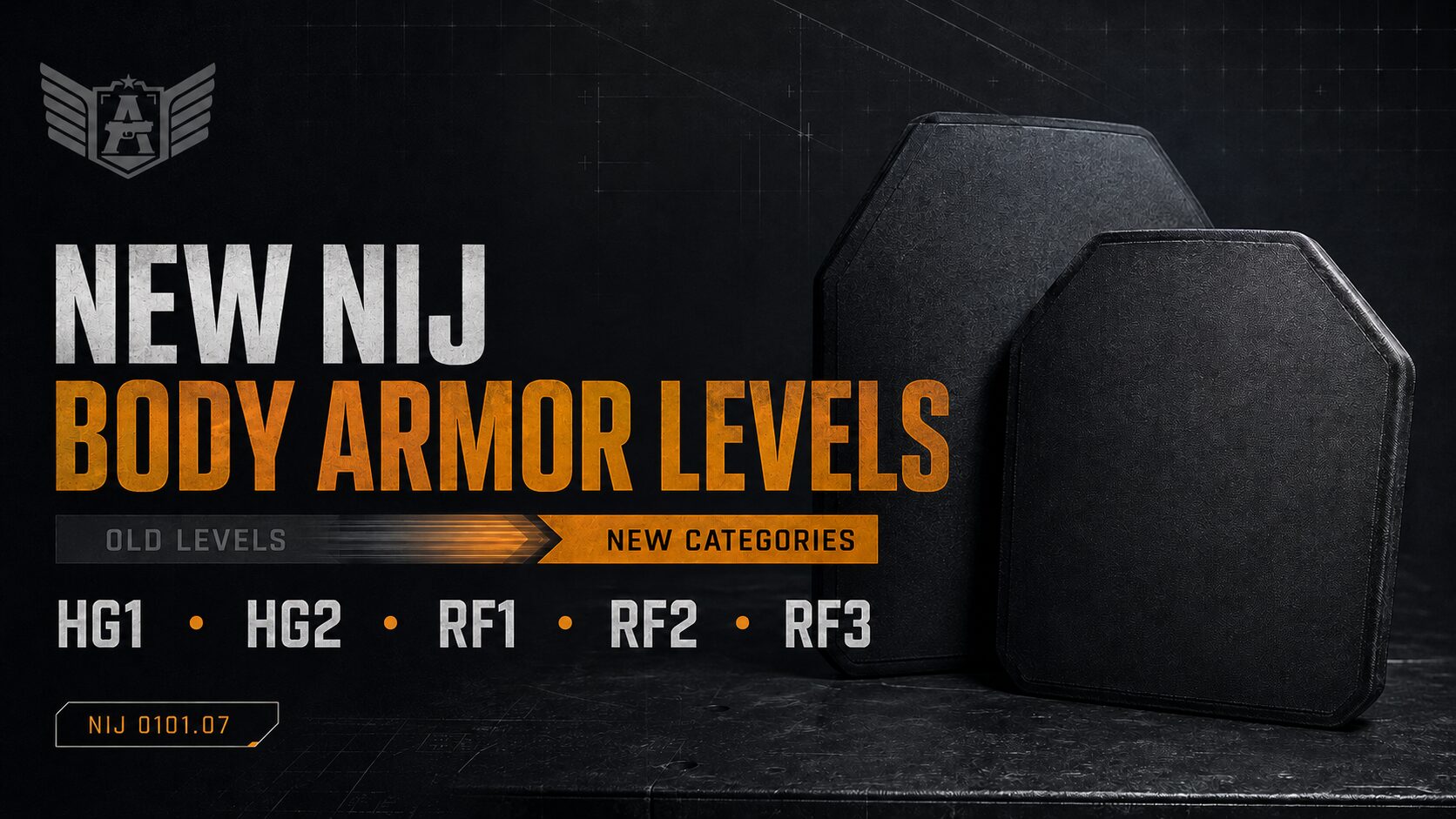
That system is now being replaced by a clearer nomenclature. With the publication of NIJ Standard 0101.07 and its companion document, NIJ Standard 0123.00, the former Roman numerals have given way to HG categories for handgun threats and RF categories for rifle threats.
The change, however, is not limited to terminology. The test threats have also been updated, particularly in the categories intended to provide protection against rifle fire.
Why Did NIJ Change the Classification System?
Under the previous standard, NIJ 0101.06, performance requirements, test methods, protection levels, and reference ammunition were consolidated in a single document.
The new structure separates those functions:
- NIJ 0101.07 establishes the performance requirements and procedures used to test and certify body armor.
- NIJ 0123.00 defines the protection levels, test ammunition, and corresponding reference velocities.
This separation allows ballistic threats to be updated without requiring the entire testing standard to be rewritten. It also creates a classification system that may later be used for other types of equipment, such as helmets and shields, provided that product-specific performance standards are developed.
According to NIJ, the new nomenclature was adopted to describe threats more clearly and reduce confusion among users of ballistic protection equipment. See the official NIJ 0123.00 specification.
How Do the Former Levels Map to the New System?
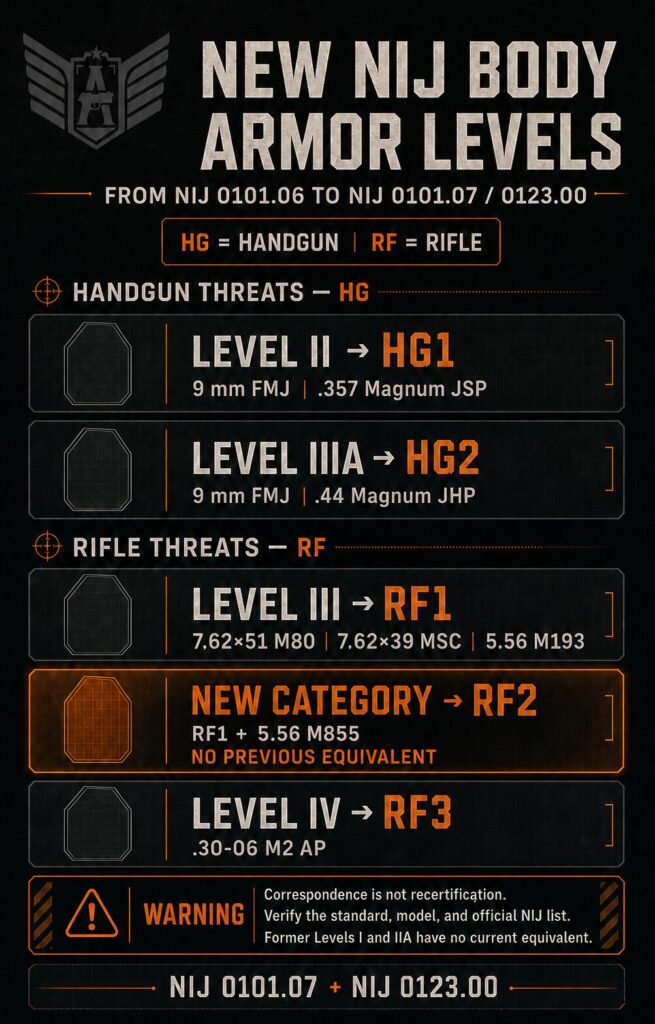
NIJ’s official correspondence is as follows:
| Former classification | New classification | Category |
|---|---|---|
| NIJ Level II | NIJ HG1 | Handguns |
| NIJ Level IIIA | NIJ HG2 | Handguns |
| NIJ Level III | NIJ RF1 | Rifles |
| No former equivalent | NIJ RF2 | Rifles—intermediate level |
| NIJ Level IV | NIJ RF3 | Rifles—armor-piercing threat |
The former Level I and Level IIA classifications do not have corresponding categories in the official transition table. Level I had already disappeared from more recent editions of the standard, while Level IIA was removed from the new structure.
It is important to note that the phrase “former Levels I, II, III, and IV” oversimplifies the previous system. NIJ 0101.06 actually used Levels IIA, II, IIIA, III, and IV.
NIJ HG1: Successor to Former Level II
The abbreviation HG stands for handgun.
The NIJ HG1 level uses the following test threats:
- 9×19 mm, 124-grain FMJ projectile, at approximately 1,306 ft/s (398 m/s);
- .357 Magnum, 158-grain JSP projectile, at approximately 1,430 ft/s (436 m/s).
This category occupies the position formerly associated with Level II and is generally related to flexible armor used in concealable or overt body armor.
NIJ HG2: Successor to Former Level IIIA
NIJ HG2 represents the highest level of protection against the handgun threats addressed by the new classification system.
The test threats are:
- 9×19 mm, 124-grain FMJ projectile, at approximately 1,470 ft/s (448 m/s);
- .44 Magnum, 240-grain JHP projectile, at approximately 1,430 ft/s (436 m/s).
HG2 nominally corresponds to former Level IIIA. This does not mean, however, that a vest certified as Level IIIA under NIJ 0101.06 may automatically be advertised as HG2. Certification under the new system requires testing in accordance with NIJ 0101.07 and inclusion of the model on the official Compliant Products List.
NIJ RF1: Far More Than a New Name for Level III
The abbreviation RF stands for rifle.
NIJ RF1 occupies the position formerly associated with Level III, but it introduces an important difference: protection is evaluated against a broader range of threats.
Testing includes:
- 7.62×51 mm M80 Ball;
- 7.62×39 mm Type 56 mild-steel-core projectile;
- 5.56×45 mm M193.
Under the previous classification, Level III was primarily associated with testing against 7.62×51 mm M80 Ball. Consequently, the designation “Level III” did not necessarily demonstrate a plate’s performance against 5.56 mm M193 or certain 7.62×39 mm projectiles.
The new RF1 category therefore provides a more comprehensive description of the expected performance against common rifle threats.
NIJ RF2: The Most Significant New Category
NIJ RF2 is an entirely new level with no direct equivalent under the former classification system.
To qualify for this category, armor must satisfy the RF1 threat requirements and also be tested against 5.56×45 mm M855, an ammunition type that incorporates a steel component in its construction.
RF2 therefore covers:
- 7.62×51 mm M80 Ball;
- 7.62×39 mm mild-steel-core projectile;
- 5.56×45 mm M193;
- 5.56×45 mm M855.
The creation of this category addresses a longstanding communication deficiency associated with Level III. Two plates previously marketed under the same classification could perform differently against 5.56 mm ammunition, depending on their materials and construction.
RF2 allows users to identify immediately that the armor has also been tested against the M855 threat, without relying solely on manufacturer claims or special testing conducted outside the basic certification protocol.
NIJ RF3: Successor to Former Level IV
NIJ RF3 occupies the highest position in the new classification system. Its test threat is the .30-06 M2 AP, an armor-piercing projectile also used to evaluate former Level IV armor.
Although Level IV corresponds to RF3 in the transition table, the terms should not be treated as interchangeable without considering the applicable edition of the standard. A plate certified as Level IV under NIJ 0101.06 remains a product certified under the previous standard; it does not automatically become an RF3 plate.
Correspondence Does Not Mean Automatic Equivalence
The table published by NIJ demonstrates how the former and new classifications relate to one another. It does not authorize manufacturers or sellers simply to replace the designation on labels of existing products.
Armor classified as NIJ 0101.06 Level III may be presented as NIJ 0101.07 RF1 only if it has undergone the new testing program and satisfied the current requirements. This distinction is particularly important because RF1 includes threats that were not part of the basic Level III test under the former standard.
Buyers should therefore verify all of the following:
- the complete standard designation;
- the protection level;
- the manufacturer and exact model designation;
- whether the product appears on the official Compliant Products List;
- the model’s status, service life, and any applicable safety notices.
A laboratory report stating that a product was “tested to NIJ parameters” is not necessarily equivalent to certification under the NIJ Compliance Testing Program.
NIJ also makes clear that its program certifies body armor designed to protect the torso. The agency does not certify backpacks, briefcases, ballistic blankets, or similar products, even when manufacturers test them using methods inspired by the standard. The official Compliant Products List can be accessed on the NIJ website.
Has Armor Certified Under the Previous Standard Become Invalid?
Not automatically.
NIJ recommends that officers and agencies continue using armor certified under the previous standard during the transition. The agency intends to maintain the NIJ 0101.06 Compliant Products List at least through the end of 2029.
This means that legitimate armor certified under the previous standard has not become inadequate simply because a new nomenclature was introduced. It continues to provide the protection level for which it was originally tested, subject to its conditions of use, care, and service life.
What must not occur is the commercial reclassification of an older product that has not undergone the new tests. NIJ’s transition guidance is available on the official NIJ 0101.07 page.
What Changes for Security Professionals?
The new nomenclature makes it easier to identify the general category of threat:
- HG indicates protection against handgun threats;
- RF indicates protection against rifle threats.
It also creates a clearer distinction among plates intended for common rifle ammunition, plates additionally evaluated against M855, and plates designed for the M2 AP armor-piercing threat.
Even so, no NIJ level should be interpreted as an absolute guarantee against every projectile of a particular caliber. Certification demonstrates that a specific model satisfied the protocol requirements against defined ammunition, velocities, and test conditions. Caliber alone does not define a threat: projectile construction, mass, velocity, distance, impact angle, number of shots, and armor design also influence performance.
Conclusion
The replacement of Levels II, IIIA, III, and IV with HG1, HG2, RF1, RF2, and RF3 represents an important evolution in the way ballistic protection is communicated.
The most significant new category is RF2, created to identify armor that has been specifically evaluated against 5.56×45 mm M855. RF1 is also more comprehensive than former Level III because it incorporates 5.56 mm M193 and 7.62×39 mm mild-steel-core threats.
More than simply memorizing a new set of abbreviations, professionals and buyers must understand which edition of the standard applies, which threats were tested, and whether the exact model appears on NIJ’s official list. In matters of ballistic protection, a commercial designation should never replace technical verification.
References
NATIONAL INSTITUTE OF JUSTICE. Ballistic Resistance of Body Armor: NIJ Standard 0101.07. Washington, DC: U.S. Department of Justice, 2023. NCJ 307346. Accessed August 1, 2026.
NATIONAL INSTITUTE OF JUSTICE. Specification for NIJ Ballistic Protection Levels and Associated Test Threats: NIJ Standard 0123.00. Washington, DC: U.S. Department of Justice, 2023. NCJ 307347. Accessed August 1, 2026.
NATIONAL INSTITUTE OF JUSTICE. Ballistic Resistance of Body Armor: NIJ Standard 0101.06. Washington, DC: U.S. Department of Justice, 2008. NCJ 223054. Accessed August 1, 2026.
NATIONAL INSTITUTE OF JUSTICE. NIJ Ballistic-Resistance Body Armor Standards Updates. Washington, DC: U.S. Department of Justice, 2023. NCJ 307847. Accessed August 1, 2026.
NATIONAL INSTITUTE OF JUSTICE. Ballistic Resistance of Body Armor, NIJ Standard 0101.07. Washington, DC: U.S. Department of Justice, 2025. Official standard page containing transition guidance and addenda. Accessed August 1, 2026.
NATIONAL INSTITUTE OF JUSTICE. Specification for NIJ Ballistic Protection Levels and Associated Test Threats, NIJ Standard 0123.00. Washington, DC: U.S. Department of Justice, 2025. Official page containing updated threat tables, reference velocities, and addenda. Accessed August 1, 2026.
NATIONAL INSTITUTE OF JUSTICE. Compliant Products List: Ballistic-Resistant Body Armor. Washington, DC: U.S. Department of Justice, n.d. Accessed August 1, 2026.