ABA Research archive

Category: Science & Physiology

← All research

Sitting duck or scaredy-cat? Effects of shot execution strategy on anxiety and police officers’ shooting performance under high threat

Law enforcement may require police officers to inhibit intuitive responses to high threat and thereby affect their emotional reaction and operational effectiveness. Upon this premise, the current study reports two experiments which compare the impact of two relevant shot execution strategies on police officers’ shooting performance under high threat, including (1) fire at an armed assailant and then step away from the assailant’s line of fire (‘fire-step’) or (2) step away from the assailant’s line of fire and then fire (‘step-fire’).

Read article

I am right-handed, but my dominant eye is the left one, and now?

There is a common practice in beginner shooting courses that involves determining the shooter's dominant eye. The goal is to decide which eye the shooter should align their firearm with, influencing many shooting habits and training in the future. However, one frequently asked question is: I am right-handed, but my dominant eye is the left one, and now? - Relax, Young Padawan. Let's explain!

Read article

An Evaluation of Light Positioning on Suspect Accuracy in Low Light Environments

In a recent study led by J. Pete Blair, M. Hunter Martaindale, and Emily D. Spivey, the intricate relationship between flashlight techniques and police accuracy in low-light environments was thoroughly investigated. Policing inherently involves unique occupational hazards, notably felonious assaults and homicides, setting it apart from other professions. The study delved into the challenges officers face in low-light conditions, where incidents are more likely to occur, and emphasized the significance of evidence-based training methods to mitigate risks.

Read article

A scientific examination of the 21-foot rule

The purpose of this study was to scientifically assess the long-standing 21- foot rule. There are several anecdotal publications looking at the 21-foot rule as a standard in policing. This study uses experimental design to examine whether this standard should continue in modern-day policing. The 21-foot rule was tested in three independent experimental design studies. The first study measured the average speed at which a person could run 21 feet. The second and third studies tested the speed at which an officer could draw and fire their weapon with no stress and under stress respectively. The final study examined methods for increasing survivability for the officer (movement). The findings show the 21-foot rule to be an inadequate standard for officers to safely draw and fire their weapons when being charged by a suspect who’s intent it to cause harm. Additionally, different strategies of moving can increase the officer’s ability to survive.

Read article

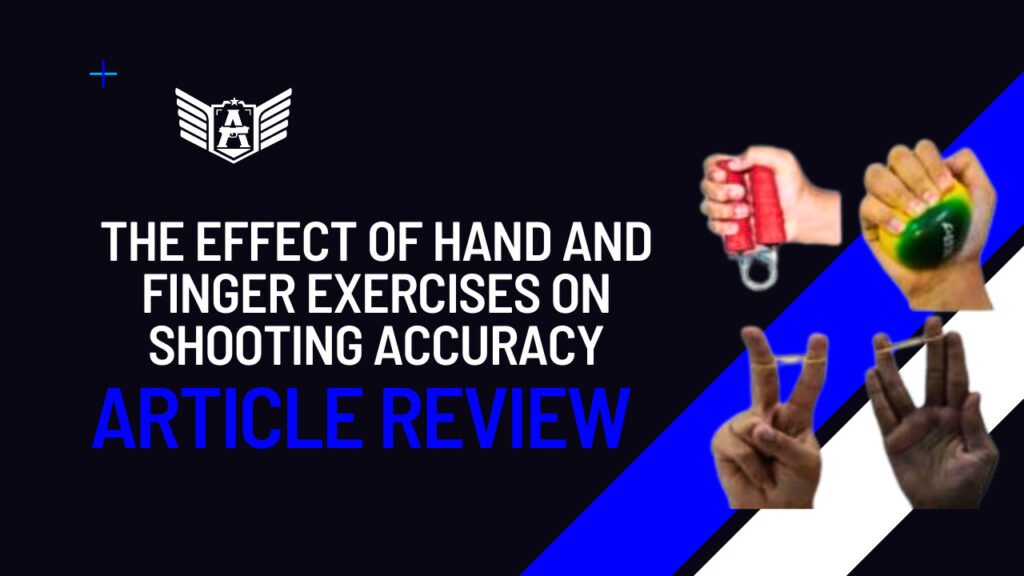
THE EFFECT OF HAND AND FINGER EXERCISES ON SHOOTING ACCURACY

This study aimed to investigate whether hand and finger exercises had an effect on shooting accuracy and if they did, determine the shot grouping of these exercises and analyze its relationship with shooting statistic data. In this study, to obtain the findings of the investigation, a model with a pretest and a posttest was implemented on an experimental and a control group. A total of forty teenage girls in the 15-18 age group having no shooting experience before participated in the study. Participants were divided into experimental and control groups. The experimental group regularly participated in hand and finger exercises for a total of 10 weeks, 3 days a week, 1 hour a day. Within the scope of the investigation, to determine the shooting accuracy of subjects, the SCATT Shooting Training System was utilized. In order to evaluate the data obtained from the sample group, a package program SPSS (Statistical Package for Social Sciences) was used. The level of significance was considered to be 0.05 in statistical analysis. The investigation showed that there was a significant variance (p<0.01) between hand and finger exercises and shooting score, diametrical dispersion, mean length of aiming trace, and stability of aiming in pretestposttest measurements of the experimental group. Outcomes of our study have indicated that hand and finger exercises have a positive effect on shooting accuracy. In this study administered on subjects with no shooting experience before, we speculate that hand and finger exercises affect performance to such an extent that they will enhance shooting performance when combined with technical and mental training, and we recommend that shooters should specifically include hand and finger exercises in their training program.

Read article

The influence of unpleasant emotional arousal on military performance: An experimental study using auditory stimuli during a shooting task

Due to the intrinsic difficulties associated with simulating extreme events, it remains unclear how unpleasant emotional arousal might affect shooting performance among well-trained high-risk operators. To address this issue, an infantry rifle squad performed two simulated shooting exercises of different complexity (low vs. high) while exposed to unpleasant emotionally charged sound clips. A control group underwent the same experimental procedure without the presence of any sound clips. To externally validate our method of emotional arousal inoculation, we collected infantrymen’s salivary cortisol and perceived arousal and valence levels over the experimental phases (i.e., baseline, shooting, and recovery). The dependent variables were their shooting performance (shot-to-hit ratio and instructor’s evaluation) and the perceived degree of task complexity. Furthermore, we explored the variations of participants’ nasal skin temperature during the shooting exercises. Salivary cortisol concentrations varied over time only for the squad exposed to emotionally charged stimuli. While emotional arousal had an effect on overall infantrymen performance (e.g., precision of movements while shooting), shooting accuracy was not affected. Emotional arousal did not influence nasal skin temperature. Overall, our results suggest that arousal inoculation based on emotionally charged sound clips could serve as a complementary (reliable and ethically appropriate) method to train high-risk operators to deal with emotional arousal. These findings may also contribute to a better understanding of the role of emotional arousal in operational effectiveness.

Read article