Have you ever been told to “aim small, miss small”? That familiar instruction suggests that a narrowly specified visual goal may reduce the spatial error of an aimed shot. Today’s paper, Target size, self-efficacy, and stress as determinants of precision in a marksmanship task, by Fabio Ibrahim, Kevin Wittig, and Philipp Yorck Herzberg, examines a closely related question: whether changing the visible area surrounding an identical aiming mark is associated with measurable differences in handgun precision, and how those differences relate to confidence and stress. Published in Frontiers in Psychology on January 6, 2026, the study offers an empirical basis for discussing a widely repeated training maxim while also showing why its interpretation requires methodological care.
Across 140 military officer cadets, the smaller target condition produced lower mean distance to the aiming point, with a reported standardized effect of d = 0.36. Greater shooting self-efficacy was associated with better performance, whereas the physiological stress measure used in the study did not significantly predict precision. These findings concern a controlled simulator task, and their value depends on preserving that context when discussing applications to firearms instruction.
What the researchers actually tested
The investigators recruited active-duty members of the German Armed Forces studying at Helmut-Schmidt-University in Hamburg. Of 153 initial participants, 140 had complete datasets for analysis, comprising 103 men and 37 women with a mean age of 23.5 years. Participants had completed the required P8 pistol qualification and additional marksmanship instruction. The experiment therefore examined trained young military personnel, a population whose experience and institutional background should remain visible when considering applications to other groups.
Each participant completed two 10-shot conditions at a simulated distance of 15 meters, approximately 16.4 yards. The apparatus was the German Armed Forces’ AGSHP simulator, using a modified Heckler & Koch P8 with infrared tracking and compressed-air recoil. It reproduced relevant weapon characteristics while operating without projectile discharge. The small target area measured 12 centimeters in diameter, approximately 4.7 inches; the larger area was described in the abstract and Figure 2 as 30 by 25 centimeters, approximately 11.8 by 9.8 inches. Both conditions used the same type of blue aiming mark. The experimental question concerned the visual target area around that mark, which makes it relevant to the perceptual assumptions behind “aim small, miss small.”
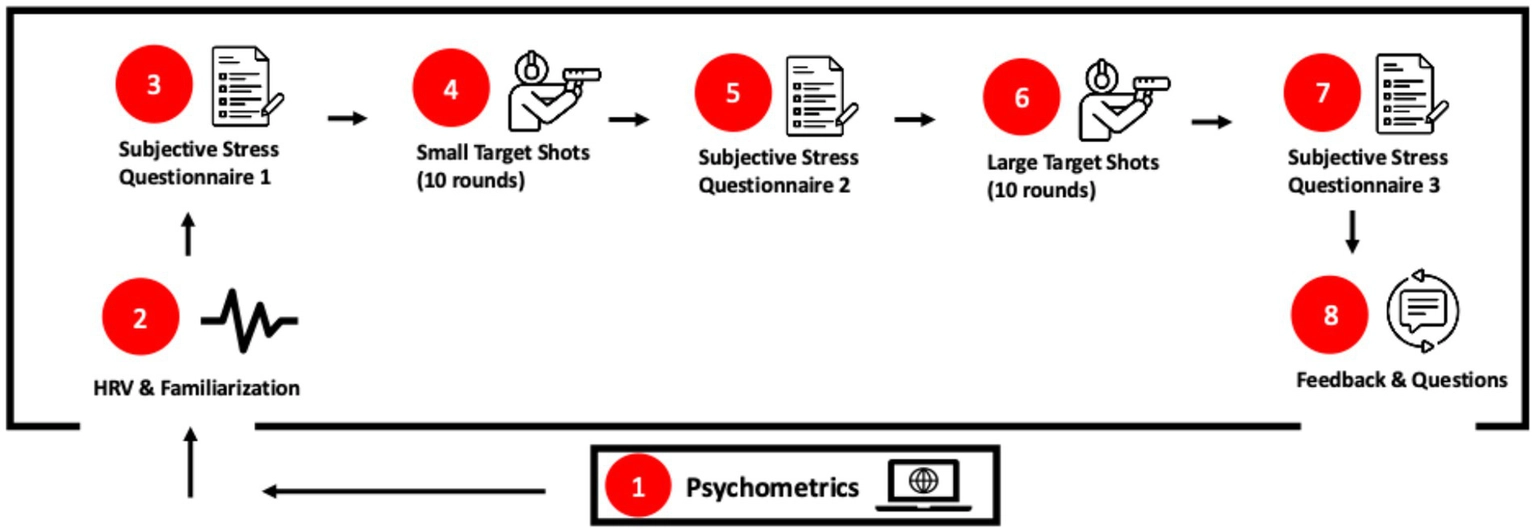
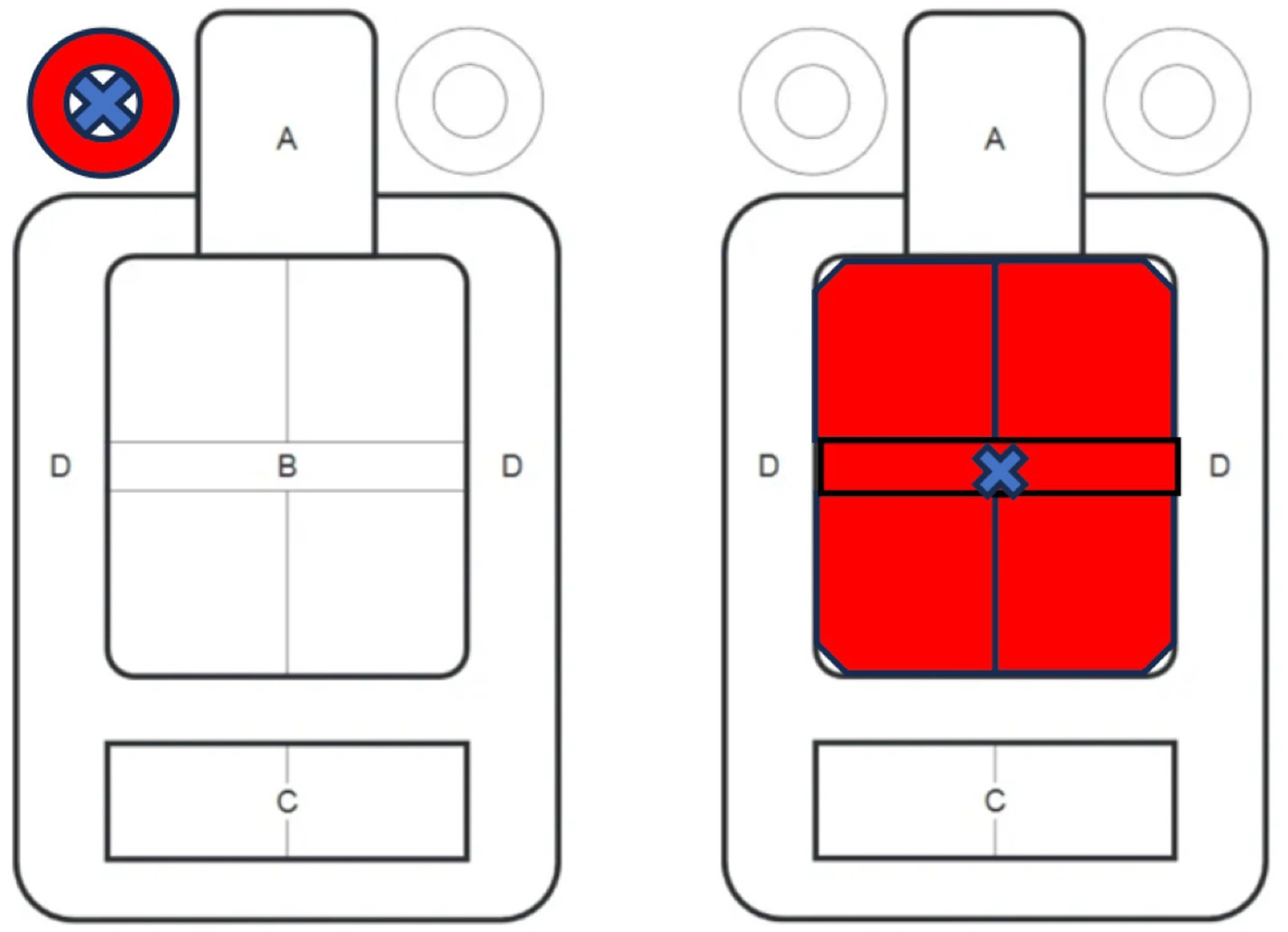
The researchers collected self-reported emotional stress, a task-specific measure of shooting self-efficacy, and heart rate variability expressed as RMSSD. Shooting performance was assessed using mean distance to center, which describes average spatial error relative to the aiming point, and shot-group radius, which describes the spatial spread of the recorded shots. Lower raw values indicate better performance. For their correlation analyses, the authors inverted the performance measures so that higher analytical scores represented better shooting; that change in coding matters when interpreting the signs of the reported correlations.
Smaller target areas were associated with lower spatial error
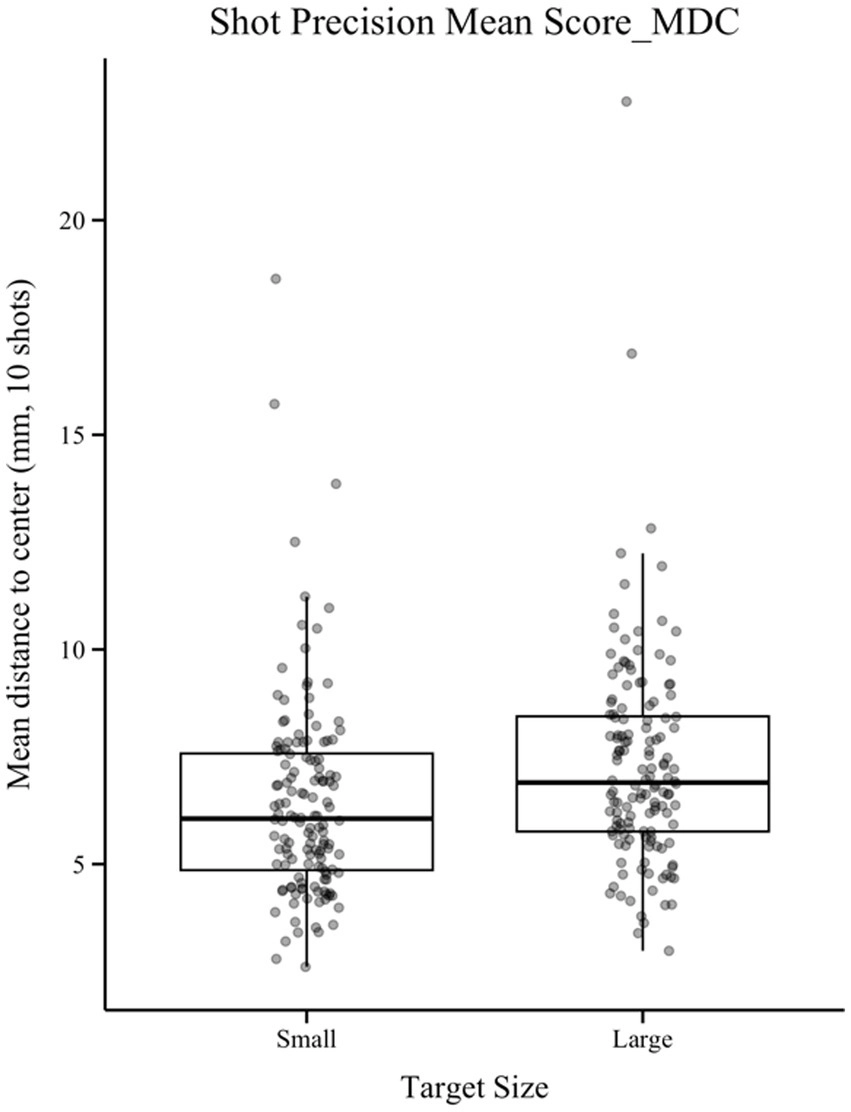
The principal comparison favored the small target condition: the paired analysis of mean distance to center yielded t(139) = 5.00, p < .001, and d = 0.36. The original boxplot below shows the distributions and their substantial overlap. The effect size is a standardized statistical quantity; it should not be interpreted as a 36 percent improvement in shooting. The result supports a measurable difference between the conditions used in this experiment, with its practical importance depending on the task, the measurement system, and the outcome being evaluated.
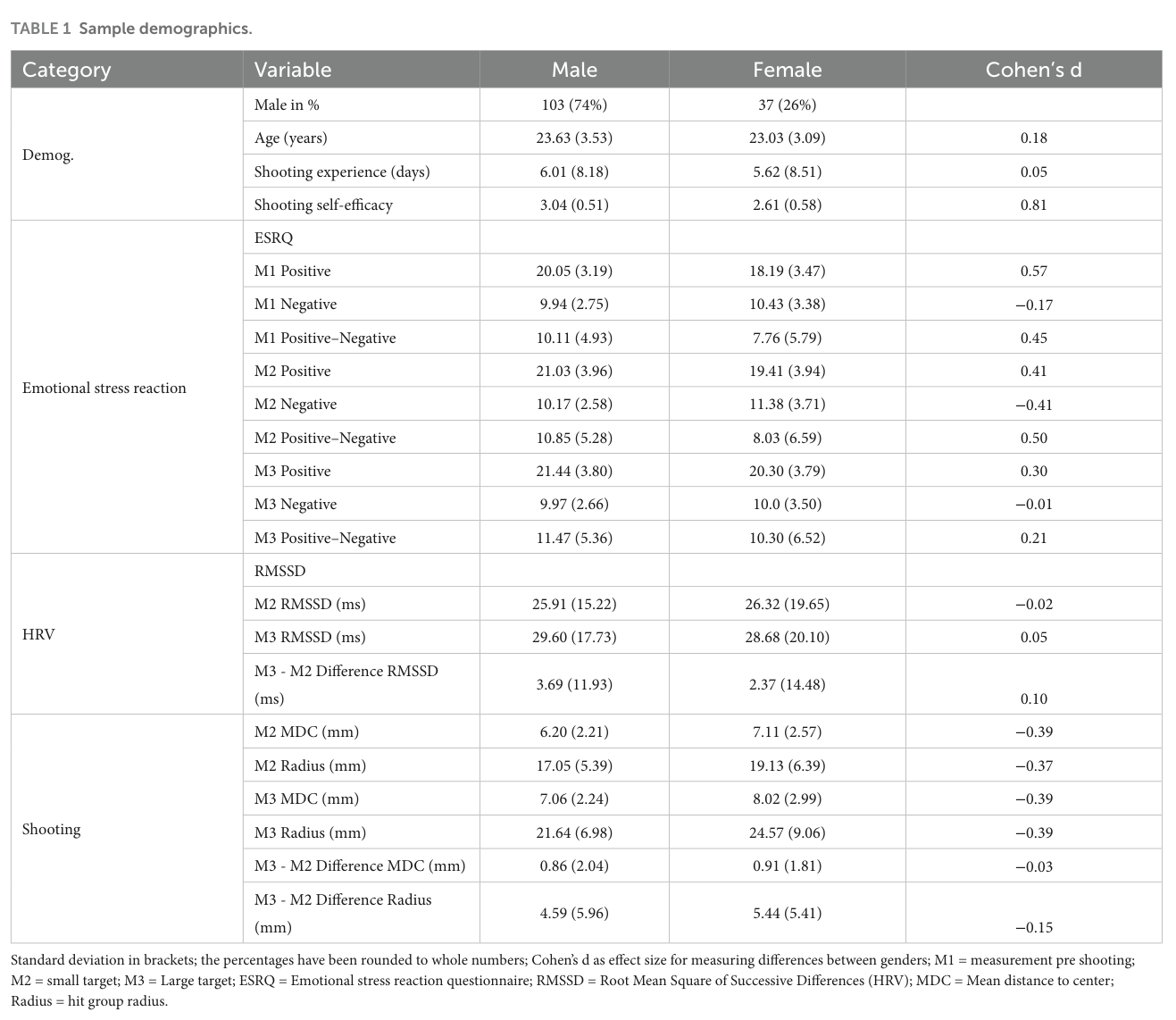
The descriptive values in the paper show the same general pattern for both men and women. Mean distance to center and shot-group radius were lower in the small target condition. The table below reproduces selected rows from the authors’ Table 1, retaining the reported values and units. These are simulator measurements under the published protocol, and comparisons with live-fire group sizes would require validation of measurement equivalence. The complete original table is available later in this article and in the downloadable paper.
| Measure reported in Table 1 | Men, mean (SD) | Women, mean (SD) |
|---|---|---|
| Participants | 103 | 37 |
| Age, years | 23.63 (3.53) | 23.03 (3.09) |
| Small target: mean distance to center, mm | 6.20 (2.21) | 7.11 (2.57) |
| Large target: mean distance to center, mm | 7.06 (2.24) | 8.02 (2.99) |
| Small target: shot-group radius, mm | 17.05 (5.39) | 19.13 (6.39) |
| Large target: shot-group radius, mm | 21.64 (6.98) | 24.57 (9.06) |
Self-efficacy, subjective stress, and shooting precision
Shooting self-efficacy refers to a person’s belief in their capacity to perform the relevant firearm tasks successfully. In this study, it was measured using an eight-item P8-specific questionnaire covering perceived competence, preparation, ease, and related beliefs. Higher self-efficacy was associated with better precision in both target conditions, with correlations of r = .39 for the small target and r = .27 for the large target. These associations describe differences among participants. Establishing whether an intervention that increases confidence would itself improve shooting would require an appropriate intervention study and control of alternative explanations, including existing skill.
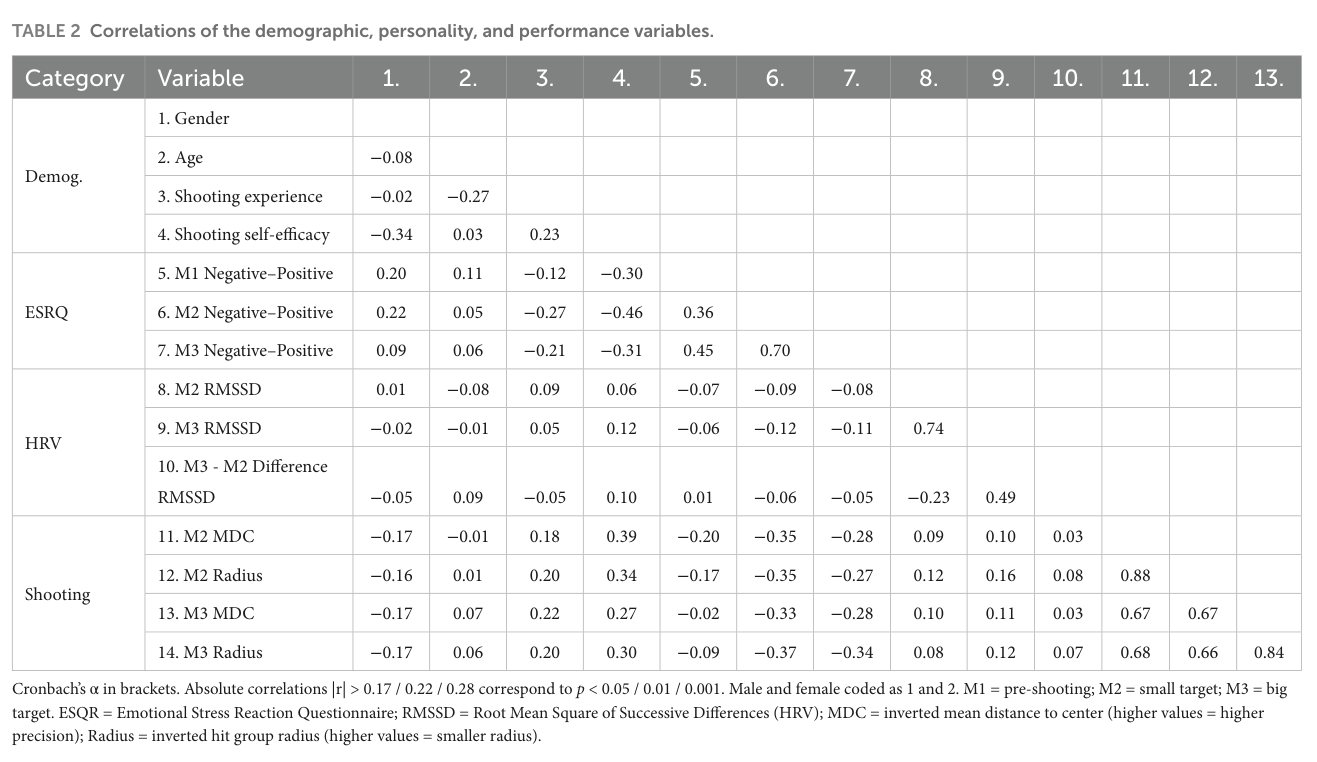
The relationship with stress also depended on how and when stress was measured. The selected correlations below come directly from Table 2, using the corresponding post-task emotional assessment for each target condition. Greater subjective stress was associated with worse shooting performance, while self-efficacy was associated with lower pre-task stress, r = −.30. This pattern is consistent with a connection among task-specific confidence, emotional appraisal, and performance, although the observational psychological measures leave the causal direction unresolved.
| Variable correlated with shooting performance | Small target, M2 | Large target, M3 |
|---|---|---|
| Shooting self-efficacy | r = .39 | r = .27 |
| Reported shooting experience | r = .18 | r = .22 |
| Subjective stress at the corresponding post-task measurement | r = −.35 | r = −.28 |
| RMSSD at the corresponding task measurement | r = .09 | r = .11 |
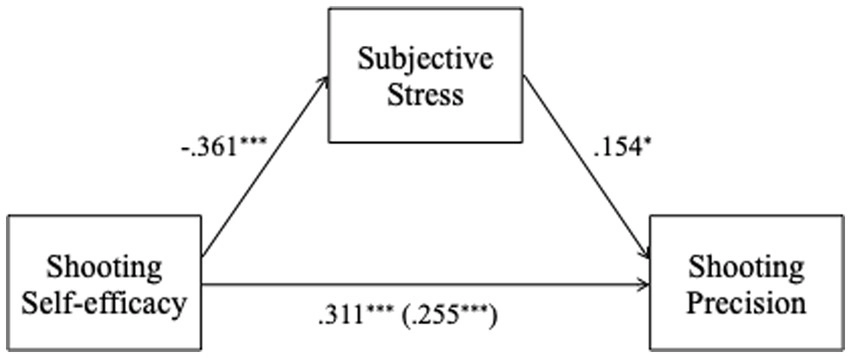
The authors also fitted a mediation model in which subjective stress accounted for 17.7 percent of the modeled association between self-efficacy and shooting precision. That percentage concerns the statistical relationship within their model; it is not a measured percentage increase in accuracy following confidence training. The original diagram is reproduced below for readers who wish to inspect the published model. Its interpretation should be considered alongside the study’s measurement coding, timing, and observational design.
RMSSD, the selected heart rate variability measure, showed no statistically significant condition-specific relationship with precision. The reported correlations were r = .09, p = .31, for the small target, and r = .11, p = .20, for the large target. This finding sets a useful boundary on interpretation: a physiological stress indicator and a participant’s subjective experience can carry different information within the same shooting task. The absence of a significant association here leaves open how other physiological measures, stronger stressors, or different operational demands might relate to performance.
A plausible perceptual explanation remains to be tested
Ibrahim and colleagues propose that a smaller visible target area could provide a more precise spatial reference during the final alignment of the weapon and target. They discuss potential contributions from visual attention, sensory feedback, and the final fixation commonly described as quiet eye. These explanations make the finding theoretically interesting, but the experiment did not directly measure gaze behavior or weapon kinematics. The proposed mechanisms therefore remain hypotheses that could be investigated with eye tracking, movement sensors, and more detailed timing measures. Their plausibility should be kept separate from the specific performance difference demonstrated by the experiment.
Limitations that matter when interpreting “aim small, miss small”
The most consequential limitation is the fixed order of presentation: every participant shot the small target first and the large target second. Target size was consequently linked to position in the testing sequence. Learning, adaptation, fatigue, or other changes over the session could have contributed to the observed difference. A design that counterbalances presentation order would allow a stronger assessment of the contribution of target size itself. The within-participant comparison reduces variability between people, but it cannot separate factors that systematically change together within the procedure.
Generalizability also requires restraint. The participants were predominantly young military officer cadets, the task occurred indoors, and the simulator discharged no projectiles. The study’s spatial outcomes provide limited information about time pressure, threat identification, use-of-force decisions, or performance during an actual confrontation. Similarly, a difference measured within a single experimental session does not establish a lasting training benefit. Applying the result to longer-term instruction would require evidence of retention and transfer, with clearly specified populations and performance outcomes.
The publication also contains reporting discrepancies worth identifying transparently. The large target is described as 30 by 25 centimeters in the abstract and Figure 2, while one passage in Methods 3.1 gives 30 by 35 centimeters. In addition, the description of the large-target pre-shooting stress correlation in Results 4.3 does not match the corresponding pre-task entry in Table 2. This review uses the dimensions in the abstract and Figure 2, and its correlation table is transcribed directly from Table 2 with measurement timing identified. The original figures and full tables are reproduced unchanged so readers can evaluate the source themselves.
Implications for evidence-based firearms instruction
For instructors, the study makes target presentation a legitimate variable for investigation. A target’s surrounding visual area may influence measured performance even when the specified aiming mark remains similar. Evaluations should therefore document target geometry, distance, sequence, apparatus, and performance criteria. Confidence ratings and stress measures can add context when they are interpreted alongside the shooting measurements and their limitations. Research that evaluates retention, transfer, and the speed–accuracy relationship would further clarify the instructional significance of the present result.
Within ABA Intl’s Technique–Metric–Method framework, our interpretation is that familiar instructional principles gain value when their proposed effects are translated into explicit, testable measurements. This paper makes a useful contribution to that process: it reports a target-condition difference, identifies psychological associations, and exposes questions that a stronger follow-up design could resolve. Readers interested in the evaluation principles behind this approach can also consult our discussions of reliability in tactical tests and validity in firearms qualification. The evidence supports continued investigation of “aim small, miss small,” with attention to exactly what was measured and how the result was obtained.
View the complete original tables
The full descriptive table and correlation matrix are provided below as excerpts rendered from the original PDF. Expand either table and select its image to inspect the full-size version. The accessible tables earlier in this review reproduce selected values with simplified labels; these source excerpts preserve the authors’ complete presentation.
Original Table 1: Sample demographics and performance statistics
Original Table 2: Full correlation matrix
Download the complete research article
The complete 13-page research article is available below as an unchanged PDF, including all methods, figures, tables, references, and author statements. The source is open access under a Creative Commons Attribution license. Readers may also read the complete article on the publisher’s website and follow the authors’ link to the study’s data repository.
Reference and reproduction credit
Ibrahim, F., Wittig, K., & Herzberg, P. Y. (2026). Target size, self-efficacy, and stress as determinants of precision in a marksmanship task. Frontiers in Psychology, 16, Article 1710147. https://doi.org/10.3389/fpsyg.2025.1710147. Although the DOI and volume carry 2025, the publication date stated by the journal is January 6, 2026.
Scientific commentary by ABA Intl. Original article, figures, and tables © 2026 Fabio Ibrahim, Kevin Wittig, and Philipp Yorck Herzberg, reproduced or adapted as identified under the Creative Commons Attribution license. The two accessible tables select and reformat published values; original figures and source-table excerpts retain their published content. The cover is an ABA Intl editorial illustration and does not depict the experimental apparatus. Interpretive statements attributed to ABA Intl represent our reading of the evidence.
TRAIN. MEASURE. EQUIP.
Continue learning through ABA research and training. When equipment is the next variable, go directly to the ABA Store.
GET THE EQUIPMENT →Continue from research to practice
Knowledge is useful when it changes what you do next.
Connect technical execution with perception, judgment and decision-making in the Cognitive Operator pathway.
Explore Cognitive Operator