Dry fire has an image problem. To some shooters, it is the boring thing instructors recommend when ammunition is expensive. To others, it is almost magical: the secret ritual that supposedly turns mediocre shooters into experts without recoil, noise, or range fees. Both views are wrong.
Dry fire is neither a substitute for live fire nor a meaningless imitation of it. Properly understood, dry fire is a constrained training environment. It removes some variables, especially recoil, blast, and ballistic confirmation, so that the shooter can isolate technical components of performance. That is precisely its value. It allows the shooter and coach to examine the parts of the shot process that live fire often hides under noise, recoil, emotion, and impact obsession.
The scientific answer to “dry fire or live fire?” is therefore not “one or the other.” The answer is: dry fire develops specific technical and perceptual-motor qualities; live fire validates whether those qualities survive recoil, timing pressure, environmental variation, and consequence. In other words, dry fire is the laboratory. Live fire is the exam.
Shooting Is a Motor Skill, Not a Vibe
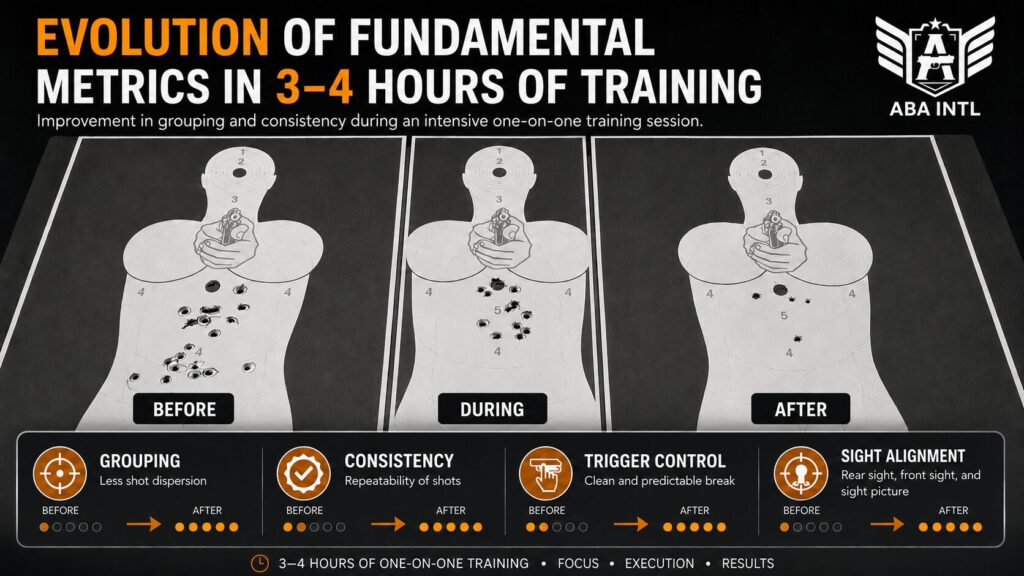
Shooting performance is often discussed with folk language: confidence, mindset, instinct, natural ability, feel. None of those terms are useless, but they are inadequate. Shooting is a perceptual-motor task that depends on stability, visual control, pressure management, timing, and repeatable movement organization. It is closer to a technical sport than to a personality trait.
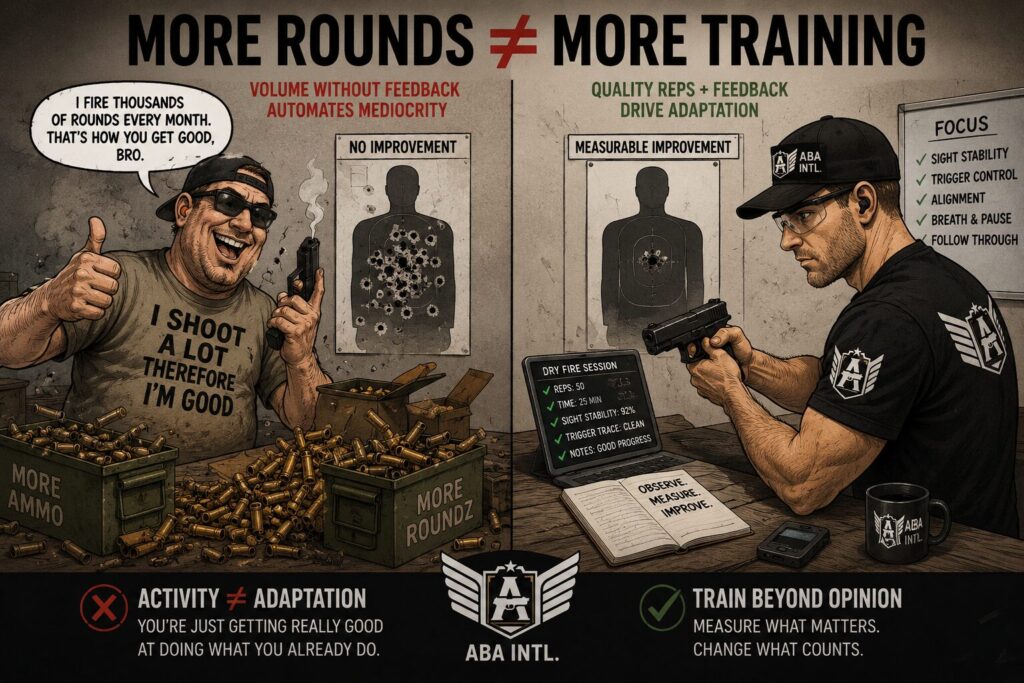
“More rounds” is not the same thing as “more training.” A shooter can fire thousands of rounds while reinforcing the same error pattern. Volume without feedback merely automates whatever is already happening. If the movement is efficient, volume helps. If the movement is defective, volume accelerates the defect.
Research on air pistol performance illustrates this clearly. Olsson and Laaksonen identified five key technical components in air pistol shooting: aiming time, stability of hold, aiming accuracy, cleanness of triggering, and timing of triggering. Four of those components, excluding aiming time, correlated significantly with shooting score, and aiming accuracy, timing of triggering, and stability of hold together explained approximately 75–78% of the variance in performance.
That finding matters far beyond Olympic-style air pistol. It reinforces a principle every serious firearms instructor should respect: performance is not a mystical outcome. It is the visible result of measurable technical variables. The target tells you what happened, but it does not always tell you why it happened. Dry fire, especially when paired with observation, video, or electronic feedback, helps expose the “why.”
What Dry Fire Actually Trains
Dry fire is valuable because it allows the shooter to work on the shot process without the disruptive effects of recoil, blast, ammunition cost, range limitations, and outcome anxiety. That does not make it complete. It makes it specific.
In dry fire, the shooter can better observe whether the sights or optic remain stable through the trigger press, whether the body is balanced, whether the gun is being driven into alignment consistently, whether the shooter is rushing the shot, and whether the trigger action disturbs the aiming structure. These are not small details. They are the mechanics behind hit probability.
The biathlon literature is especially useful here because biathlon standing shooting combines accuracy, time pressure, fatigue, posture, and rifle control. Isoaho’s 2023 thesis examined dry firing and feedback in standing biathlon shooting over eight weeks with sixteen national- and international-level biathletes. The Mantis feedback group improved more with fewer training sessions than the control group, and dry fire volume was associated with better standing shooting performance both in laboratory and range contexts, though the relationship was not simple or perfectly linear. The same study also showed something extremely important for coaches: laboratory dry fire results and range results are not automatically interchangeable. Range and laboratory scores correlated only in post-tests, and improvements in range scores did not correlate neatly with changes in laboratory technical variables.
That should immediately kill the simplistic claim that dry fire “is the same as shooting.” It is not. Dry fire develops parts of shooting. Live fire tests integration.
The Role of Feedback
The worst version of dry fire is mindless repetition. The shooter stands there, cycles the same movement pattern, sees no measurable data, receives no coaching, and assumes that repetition itself is productive. That is not training. That is rehearsal without quality control.
Skill acquisition depends heavily on feedback. Feedback tells the athlete whether the intended action and the actual action matched. In shooting, this matters because the athlete may believe he pressed the trigger cleanly, maintained alignment, or stabilized the gun, while the gun tells a different story. Dry fire can make that discrepancy visible.
In Isoaho’s biathlon study, the feedback device provided immediate augmented feedback through sound, graphs, and long-term statistics. The group using that feedback improved standing shooting performance more efficiently than the control group.
This does not mean every shooter needs a gadget. It means the training environment must provide information. Feedback can come from a coach, video, shot-tracking technology, structured scoring, timed standards, or carefully defined technical criteria. But without feedback, dry fire easily becomes self-confirmation.
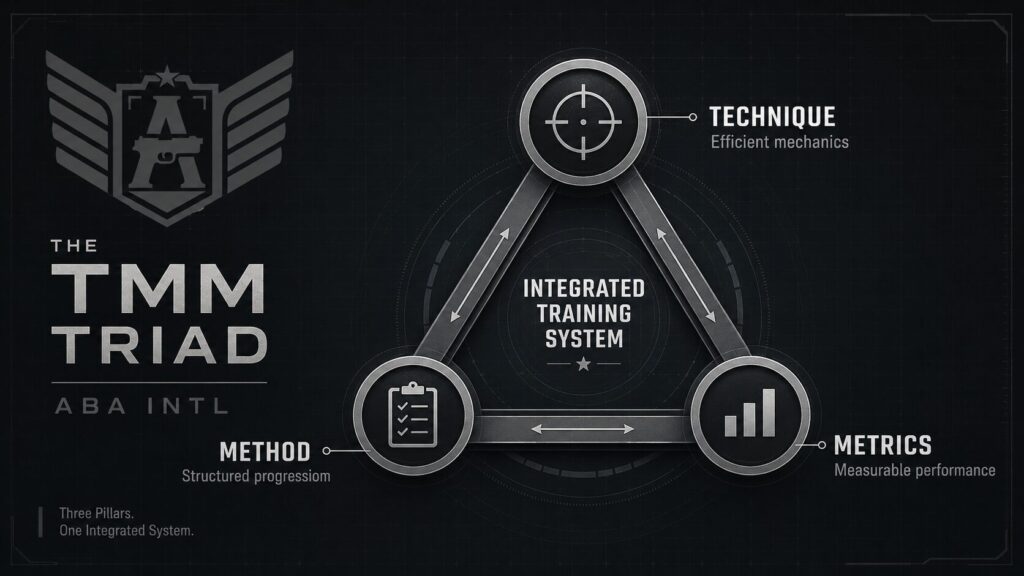
At ABA Intl, this is where the TMM Triad becomes essential: Technique, Method, Metrics. Technique defines what must happen. Method defines how it will be trained. Metrics determine whether it improved. Dry fire belongs inside that structure. Outside of it, dry fire becomes a ritual.
Dry Fire Can Improve Performance, But the Evidence Must Be Read Carefully
One study on school-going rifle shooters found that a six-week dry fire program produced significant improvement in rifle shooting performance, with the experimental group improving from a pre-test mean of 7.8 to a post-test mean of 12, and outperforming the control group in the post-test.
That is useful evidence, but it should not be overextended. The sample was narrow, the population was young, and the research design does not automatically translate to armed professionals, defensive shooters, or advanced competitors.
This is the correct scientific posture: dry fire appears useful, especially for developing technical consistency, but its effects depend on the shooter, the task, the measurement, the feedback, and the transfer environment. A beginner may improve quickly because basic coordination is still unstable. An advanced shooter may need more precise feedback because gross improvement has already occurred. A tactical shooter may need live validation because the requirements include recoil management, decision-making, movement, positional adaptation, and psychological pressure.
The lesson is not “dry fire works” in a vague motivational sense. The lesson is sharper: dry fire works when it is tied to specific performance variables and when its results are checked against live fire.
Why Live Fire Still Matters
Live fire introduces variables that dry fire cannot fully reproduce. Recoil changes the task. Noise changes the task. The emotional consequence of an actual shot changes the task. Ballistic confirmation changes the task. Outdoor conditions, lighting, target presentation, range procedures, time pressure, and the shooter’s psychological response all change the task.
The U.S. Army Research Laboratory’s comparison of live and simulated fire is relevant here. Scribner, Wiley, and Harper compared soldiers’ performance in a live-fire pop-up target scenario and a simulated version of the same task. Hit percentage, workload, and stress ratings did not significantly differ between live and simulated fire, but reaction time and radial aiming error did differ. The authors concluded that hit performance was similar, while acknowledging that the environments were different and that some performance measures were not equal.
That is exactly the nuance shooters need. Simulation can approximate certain performance elements. It can collect data, reduce cost, increase repetition, and isolate variables. But similarity in one measure does not prove equivalence in all measures. A shooter who performs well in dry fire has demonstrated something useful, but not everything necessary.
Live fire remains indispensable because it tests whether the shooter’s technical organization survives the complete shooting event. Dry fire can help build the trigger press. Live fire shows whether that trigger press survives recoil anticipation. Dry fire can help refine presentation. Live fire shows whether presentation, sight recovery, grip structure, and follow-through remain functional when the gun actually fires.
Dry Fire Should Not Be Treated as Cheap Live Fire
Treating dry fire as merely “shooting without ammunition” is a considerable mistake. That definition is technically understandable, but pedagogically weak. Dry fire is not cheap live fire. It is not a lower-quality version of the range. It is a different training environment with a different job.
Dry fire is ideal for isolating movement quality. Live fire is ideal for validating ballistic performance. Dry fire allows high attention to process. Live fire forces accountability to outcome. Dry fire reduces interference. Live fire reveals whether the skill transfers under the full task constraints.
Once that distinction is understood, the training question changes. Instead of asking, “How much dry fire should I do?” the better question is, “Which technical variable am I trying to improve, how will I measure it, and how will I verify transfer under live fire?”
That is a more serious question. It prevents the shooter from hiding behind volume. It also prevents the instructor from selling superstition as methodology.
The Problem With Round Count Worship
The shooting world often treats round count as if it were a proxy for competence. It is not. Round count measures ammunition expenditure. It does not measure learning.
A shooter can burn ammunition while making no technical progress. Another shooter can perform a smaller amount of carefully measured work and improve more. Isoaho’s biathlon data are consistent with this broader principle: greater training amount did not automatically guarantee better improvement, and the feedback group improved more efficiently than the control group.
This is why professional training must distinguish activity from adaptation. Activity is what the shooter does. Adaptation is what changes in the shooter’s performance system. The goal of training is not to be tired, entertained, or impressed. The goal is to become more capable under defined conditions.
Dry fire supports that goal when it is used to create high-quality repetitions, reduce unnecessary noise in the learning environment, and provide frequent opportunities for technical correction. It fails when it becomes a box-checking ritual.
What Serious Dry Fire Should Be Connected To
Dry fire should be connected to defined technical objectives: stability, alignment, trigger behavior, timing, presentation consistency, visual discipline, decision structure, or manipulation efficiency. It should also be connected to metrics. Those metrics do not always need to be complex, but they must be real.
A shooter can track consistency, time, visual disturbance, movement path, error direction, group behavior after live validation, or coach-assessed technical criteria. The important point is that dry fire must produce information. Without information, the shooter has no reliable way to distinguish learning from mere familiarity.
This is especially important because dry fire can make a shooter feel better without making him perform better. In a no-recoil environment, almost everything feels cleaner. The gun does not move as much. The shot does not punish anticipation. The environment is quieter. The shooter can become fluent in a simplified version of the task while remaining fragile in the complete version.
That does not make dry fire deceptive. It means dry fire must be interpreted correctly.
Dry Fire, Live Fire, and the TMM Triad
The ABA Intl approach is built around the TMM Triad: Technique, Method, Metrics. Dry fire fits perfectly into that structure, but only when all three elements are present.
Technique answers the question: what exactly are we trying to improve? Method answers: how will the training be organized to produce that improvement? Metrics answer: what evidence will show that improvement occurred?
Without technique, dry fire becomes random movement. Without method, it becomes scattered practice. Without metrics, it becomes belief.
This is also where many shooters misunderstand “fundamentals.” Fundamentals are not beginner topics. They are the technical variables that remain decisive when the task becomes harder. Grip, sight management, trigger control, stability, timing, and follow-through do not become irrelevant at higher levels. They become less negotiable.
Dry fire is one of the best environments for examining those fundamentals because it slows down the shooter’s ability to lie to himself. The target is not exploding with feedback. The gun is not masking errors with recoil. The shooter either sees the technical behavior or he does not.
The Practical Conclusion
Science does not say that dry fire is better than live fire. It also does not say that live fire makes dry fire unnecessary. The evidence points to a more mature conclusion: dry fire and live fire solve different training problems.
Dry fire is useful for isolating technical components, increasing repetition quality, developing movement consistency, and integrating feedback. Live fire is necessary for validating recoil management, ballistic accuracy, environmental adaptation, and complete performance under real shooting conditions.
A shooter who only dry fires may become technically polished in an incomplete environment. A shooter who only live fires may spend a great deal of money confirming errors he never slows down enough to correct. The serious shooter uses both.
Dry fire builds the system. Live fire audits the system.
At ABA Intl, we do not treat shooting as folklore. We treat it as human performance. That means technique must be defined, training must be organized, and progress must be measured.
Nullius in verba.
References
Adams, J. A. (1971). A closed-loop theory of motor learning. Journal of Motor Behavior, 3(2), 111–150.
Ericsson, K. A., Krampe, R. T., & Tesch-Römer, C. (1993). The role of deliberate practice in the acquisition of expert performance. Psychological Review, 100(3), 363–406.
Fitts, P. M., & Posner, M. I. (1965). Human performance. Prentice-Hall.
Isoaho, J. (2023). Benefits of dry firing and feedback in biathlon standing shooting practice [Master’s thesis, University of Jyväskylä].
Olsson, E., & Laaksonen, M. S. (2021). Key technical components for air pistol shooting performance. International Journal of Performance Analysis in Sport, 21(3), 348–360. https://doi.org/10.1080/24748668.2021.1891820
Saini, P., Reddy, T. O., & Singh, V. (2023). Influence of dry fire practice on rifle shooting performance of school going students. International Journal for Research in Applied Science & Engineering Technology, 11(IV).
Schmidt, R. A., & Lee, T. D. (2011). Motor control and learning: A behavioral emphasis (5th ed.). Human Kinetics.
Scribner, D. R., Wiley, P. H., & Harper, W. H. (2007). A comparison of live and simulated fire soldier shooting performance (ARL-TR-4234). U.S. Army Research Laboratory.