

Driving is one of the activities people perform most frequently without thinking much about it. For most individuals, it is simply a routine task: start the vehicle, follow a GPS route, and reach a destination.
However, in the world of protective operations and tactical mobility, vehicle movement is treated very differently.
In executive protection, military operations, and high-risk environments, driving is understood as a critical component of personal security. Vehicles are not merely transportation tools; they are platforms for mobility, protection, and rapid disengagement from danger.
The discipline commonly referred to as tactical driving encompasses a set of principles designed to increase situational awareness, reduce exposure to threats, and maintain control during vehicle movements.
One important concept used in protection work is the term VIP (Very Important Person). In professional environments, this usually refers to a client under protection.
In everyday life, however, the concept is much broader.
Your VIP may simply be the people you care about most: your spouse, your children, your parents, or anyone whose safety matters to you.
When you adopt the mindset that the people in your vehicle are your VIPs, driving stops being a casual activity and becomes a responsibility tied to protecting those under your care.
This mindset becomes even more relevant when we consider the statistical reality of modern mobility.
According to the U.S. National Highway Traffic Safety Administration (NHTSA), more than 42,000 people died in traffic accidents in the United States in 2022 alone, and millions more were injured. While most incidents are unintentional, they demonstrate that vehicle movement is inherently a high-risk activity.
In addition to accidents, vehicles are frequently involved in criminal activity. Data from the FBI Uniform Crime Reports and insurance industry studies show that hundreds of thousands of carjackings and vehicle theft-related confrontations occur in the United States every year.
Many of these incidents happen in predictable situations such as:
- parking lots
- residential driveways
- traffic lights
- vehicle entry or exit moments
These are precisely the types of vulnerabilities that tactical driving principles are designed to mitigate.
Below are seven tactical driving practices that anyone can adopt to significantly improve safety and awareness on the road.
1. Maintain Your Vehicle Properly
The first principle of tactical driving is straightforward:
Your vehicle must be reliable.
In protective operations, a vehicle may become the primary tool for escape, maneuver, or repositioning during a critical situation. Mechanical failure at the wrong moment can have serious consequences.
For everyday drivers, the principle is exactly the same.
Regularly check the following:
- Tire condition and pressure
- Brake system performance
- Battery health
- Fluid levels
- Suspension components
According to the National Transportation Safety Board, mechanical failures—especially tire failures and brake issues—contribute to thousands of accidents each year in the United States.
A worn tire, weak battery, or degraded braking system can transform a minor inconvenience into a serious hazard.
A fundamental rule in tactical mobility is simple:
Your vehicle must always be ready to perform when needed.
2. Move in Convoy When Possible
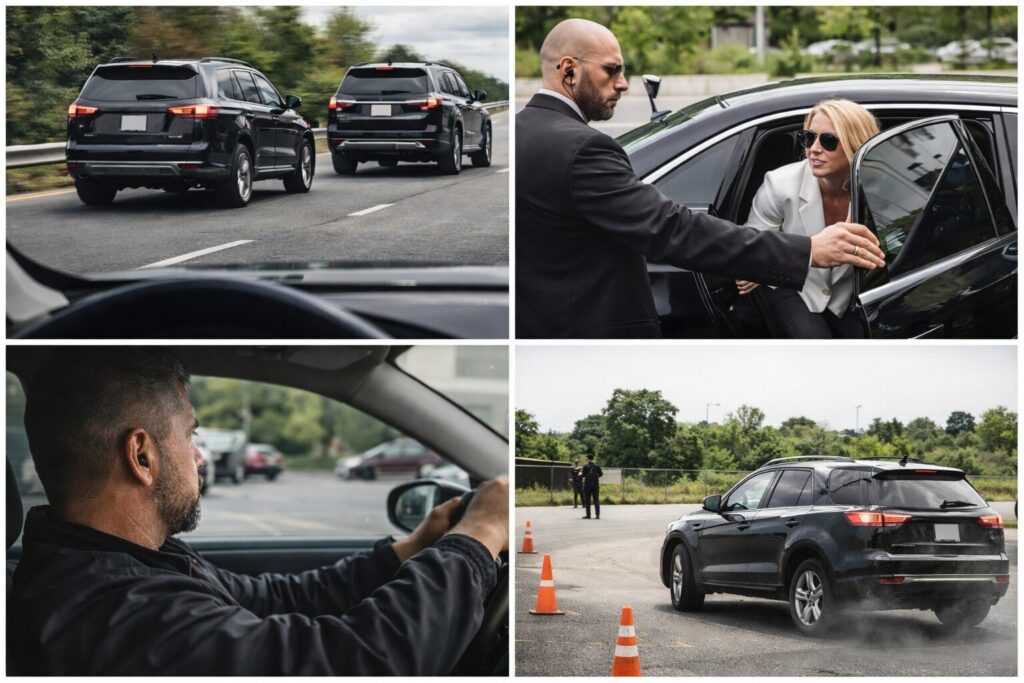
In executive protection operations, vehicles rarely travel alone when transporting a principal.
Instead, they operate in convoy formations.
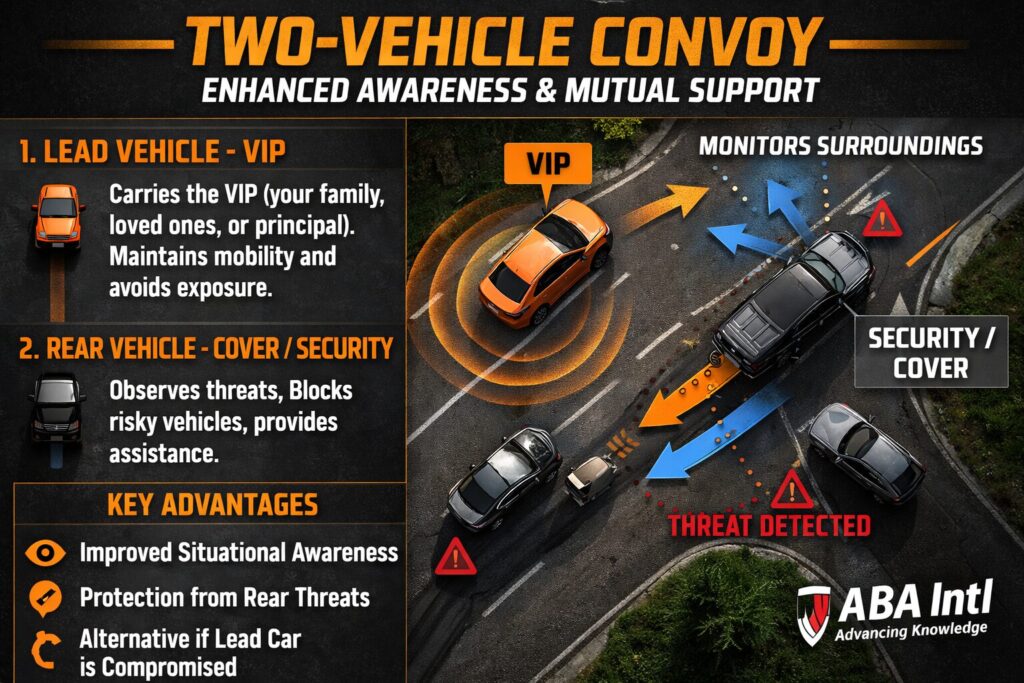
If two vehicles are traveling together—family members, colleagues, or friends—it can be beneficial to maintain visual proximity and coordination between vehicles.
Typically:
- the lead vehicle carries the VIP
- the rear vehicle acts as a support element
This second vehicle helps monitor surrounding traffic and respond to problems.
Security research on vehicle-based attacks shows that criminals prefer isolated targets. Multiple coordinated vehicles introduce uncertainty and increase perceived resistance.
Even outside professional protection environments, traveling in pairs during night travel or long-distance trips can significantly reduce vulnerability.
3. Conduct a 360-Degree Environmental Scan
One of the most common mistakes drivers make is focusing exclusively on what is directly ahead of the vehicle.
This phenomenon is often referred to as tunnel vision.
In tactical driving, tunnel vision is unacceptable.
Before stopping, parking, or allowing passengers to exit the vehicle, perform a 360-degree environmental scan.
Observe:
- vehicles approaching from behind
- pedestrians near the vehicle
- unusual behavior nearby
- blind spots and potential hiding areas
Crime prevention research consistently shows that situational awareness is one of the most effective deterrents against opportunistic crime.
Criminals typically prefer distracted victims.
A driver who scans the environment, maintains awareness, and appears attentive is statistically far less attractive as a target.
4. Control the Environment During Passenger Entry and Exit
In executive protection, the driver or protection agent usually controls the passenger door when the principal enters or exits the vehicle.
This is not simply etiquette.
It is a security procedure.
The correct sequence includes:
- scanning the environment before opening the door
- positioning the body between the VIP and potential threats
- controlling the space until the passenger is safely inside or outside the vehicle
Statistics from urban crime studies show that vehicle entry and exit moments are among the most common times for carjacking and robbery attempts.
These moments create natural vulnerability because:
- attention is divided
- movement is restricted
- occupants are transitioning between environments
By simply pausing for a moment and observing the surroundings, a driver dramatically reduces the risk of surprise.
Remember: your VIP may simply be your spouse or your children.
Protecting them begins with controlling the environment before exposing them to it.
5. Plan Your Route in Advance
Another key principle of tactical mobility is route planning.
Professional drivers rarely begin a movement without understanding:
- the primary route
- potential choke points
- alternative escape routes
- areas of elevated risk
Route planning is particularly important in unfamiliar environments.
Studies on vehicle-related crime show that offenders often operate in predictable choke points, such as:
- poorly lit parking structures
- congested intersections
- predictable commuting routes
Having alternative routes available allows for faster decisions and greater mobility if conditions change.
Drivers who rely exclusively on GPS without situational understanding often become reactive instead of proactive.
6. Avoid Unnecessary Aggressive Driving
Many people mistakenly associate tactical driving with aggressive driving.
In reality, they are very different.
Tactical driving emphasizes:
- control
- efficiency
- predictability
- discretion
Aggressive driving increases:
- accident probability
- road rage incidents
- unnecessary attention
According to the AAA Foundation for Traffic Safety, nearly 80% of drivers report experiencing significant anger, aggression, or road rage at least once per year.
Professional operators avoid escalating conflicts.
They prioritize smooth, controlled movement and reserve aggressive maneuvers only for genuine emergencies.
7. Train
The most important principle of all is training.
Skills such as:
- situational awareness
- vehicle control
- decision-making under pressure
must be developed deliberately.
Training may include:
- defensive driving courses
- tactical mobility training
- situational awareness exercises
- vehicle control drills
Research in human performance consistently shows that trained individuals react faster and make better decisions under stress.
The goal of training is not to create paranoia, but to develop competence and confidence in dynamic environments.
Final Thoughts
Tactical driving is not reserved exclusively for security professionals or military personnel.
At its core, it represents a mindset of disciplined movement, environmental awareness, and proactive planning.
When you adopt the idea that the people in your vehicle are your VIPs, your perspective changes.
Maintaining your vehicle, scanning your environment, planning routes, and driving with purpose become part of a broader responsibility: protecting the people who matter to you most.
Small habits practiced consistently can dramatically improve safety.
And in many cases, awareness and preparation are the factors that determine whether a problem is avoided—or encountered.
TRAIN. MEASURE. EQUIP.
Continue learning through ABA research and training. When equipment is the next variable, go directly to the ABA Store.
GET THE EQUIPMENT →Continue from research to practice
Knowledge is useful when it changes what you do next.
Use this evidence to identify the next capability you need to build and the ABA route designed for it.
Find your ABA training path