
Private security is often described through two competing myths. In
one, former military or police experience automatically transfers into
professional competence. In the other, private providers are inherently
unprofessional because coercive capacity is contracted. Serious doctrine
rejects both shortcuts. Professionalism is a system of lawful purpose,
selection, training, evidence, supervision, reporting, and
accountability. Experience can strengthen that system, but it cannot
replace it.
Schaub and Kelty (2016) describe private military and security
contractors as “corporate warriors” whose coercive capacities create
problems of legitimacy, effectiveness, and control. Their edited volume
examines national regulation, industry associations, contracting,
identity, and the Montreux Document across multiple contexts. The
diversity of cases demonstrates that “private security” is not one
operational category. Guarding, convoy protection, training,
intelligence support, maritime security, and direct participation
present different legal and performance risks.
The Montreux Document, adopted in 2008 through an initiative of
Switzerland and the International Committee of the Red Cross, reaffirms
relevant international legal obligations and presents good practices for
states dealing with private military and security companies in armed
conflict. It does not create a legal vacuum or a special class beyond
law; it clarifies that existing international humanitarian and
human-rights obligations remain relevant. Its primary audience is
states, but its procurement, training, vetting, oversight, and
accountability logic should shape responsible corporate doctrine.
Lawfulness is a performance dimension. A fast and accurate response
that violates the applicable rules is not operational success. Training
objectives must therefore integrate use-of-force standards, human
rights, contract scope, local law, rules for the use of force, and
client policy into the same scenario that evaluates mechanics.
Separating “legal class” from “range class” encourages performers to
master two disconnected systems and improvise the connection under
pressure.
Recruitment should evaluate more than credentials and narrative
reputation. Prior service indicates exposure, not current competence,
judgment, health, or integrity. Structured background checks, identity
verification, reference validation, role-specific testing, and exclusion
criteria are essential. Selection records should be auditable because
the organization is accountable for foreseeable risk introduced through
hiring.
Operational memoirs can illuminate the environment while remaining a
different evidence category from controlled research. Reynolds (2018)
describes the complexity, uncertainty, entrepreneurship, and lethal
consequences of private contracting in Iraq from a participant’s
perspective. Such accounts preserve details that formal datasets may
omit, but memory, selection, hindsight, and author perspective shape the
narrative. ABA doctrine uses memoir as a source of hypotheses and
context, not as proof that one person’s method generalizes.
Standard operating procedures should state purpose, conditions,
authorities, actions, prohibited actions, reporting, and review.
Excessive detail can create documents no one can use; excessive
abstraction moves every hard decision to the field. Procedures must be
trained through representative cases and revised after evidence, legal
change, or operational review. A signature acknowledging receipt is not
proof of competence.
Instructor qualification is a governance control. Technical skill
does not automatically produce pedagogical ability, and operational
history does not automatically produce scientific literacy. Instructors
need a defined curriculum, calibration, observation standards, feedback
methods, and periodic evaluation. Silveira (2023) emphasizes that
combat-shooting instruction requires scientific foundations and
deliberate application for instructors and trainees, a requirement that
becomes more important when organizations operate across languages and
jurisdictions.
Metrics must include what the contract and public interest actually
require. Qualification scores and response times are insufficient.
Programs should track decision validity, no-action performance, safety
deviations, equipment failures, complaints, near misses, injuries, force
reports, reporting timeliness, training exposure, and corrective-action
closure. Denominators are essential: ten incidents among ten thousand
exposures describe a different system from ten incidents among one
hundred.
Incident review must be protected from two corruptions. A blame-only
process encourages concealment, while a learning-only process can avoid
individual accountability. A professional review distinguishes system
conditions, foreseeable design failures, rule clarity, supervision,
individual choices, and evidence integrity. Corrective actions need an
owner, deadline, verification method, and escalation path. Lessons that
are merely “shared” are not controls.
Contract design influences behavior. Payment structures, staffing
ratios, duty hours, equipment requirements, insurance, subcontracting,
reporting, and penalties can support or undermine doctrine. A client
that purchases the lowest nominal cost while imposing impossible
schedules creates performance risk upstream. Accountability should
follow the chain from the individual operator through company leadership
and the contracting entity that structured the work.
Fatigue, health, and physical capacity are governance issues as well
as personal responsibilities. Long shifts, heat, travel, poor food
access, and inadequate recovery change decision performance.
Organizations must establish duty limits, medical support, fitness
preparation, and protected reporting. A culture that celebrates
endurance while hiding impairment creates predictable error and then
blames the last person in the chain.
TMM gives professional doctrine an empirical spine. Technique
describes what personnel are expected to do. Metrics reveal whether
performance is valid, stable, and accountable. Method defines how
selection, training, supervision, and review will change the system
(Bearare & Silveira, 2026). The triad also prevents metric gaming:
when a score improves at the cost of lawful judgment or reporting
quality, the method has optimized the wrong construct.
Nullius in verba is not institutional cynicism. It is a commitment to
make claims inspectable. A company that says its personnel are elite
should show selection validity, training exposure, decision performance,
incident rates, and corrective learning. Confidentiality and security
can limit public detail, but they do not justify internal opacity.
Evidence must reach someone with authority to act.
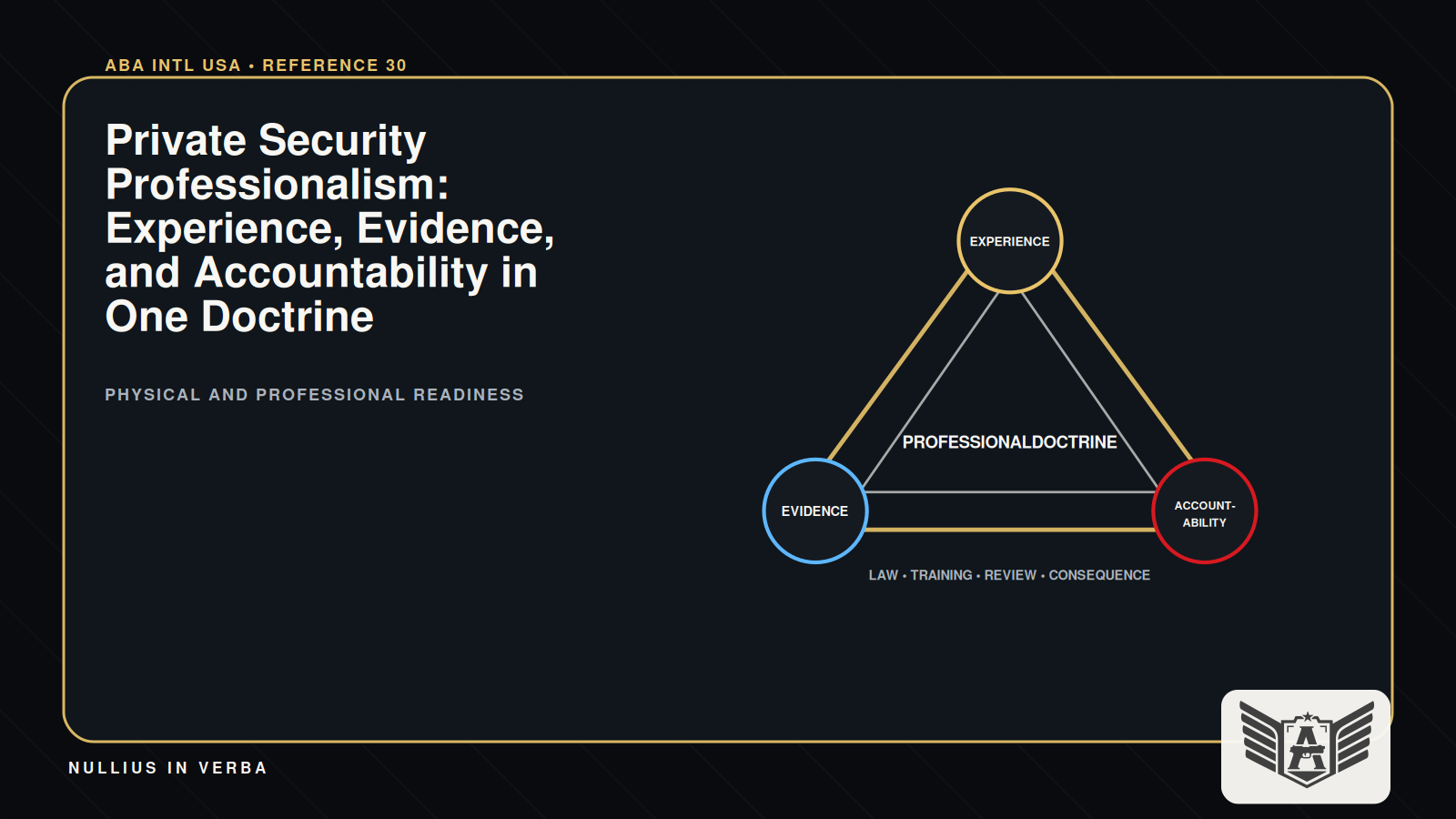
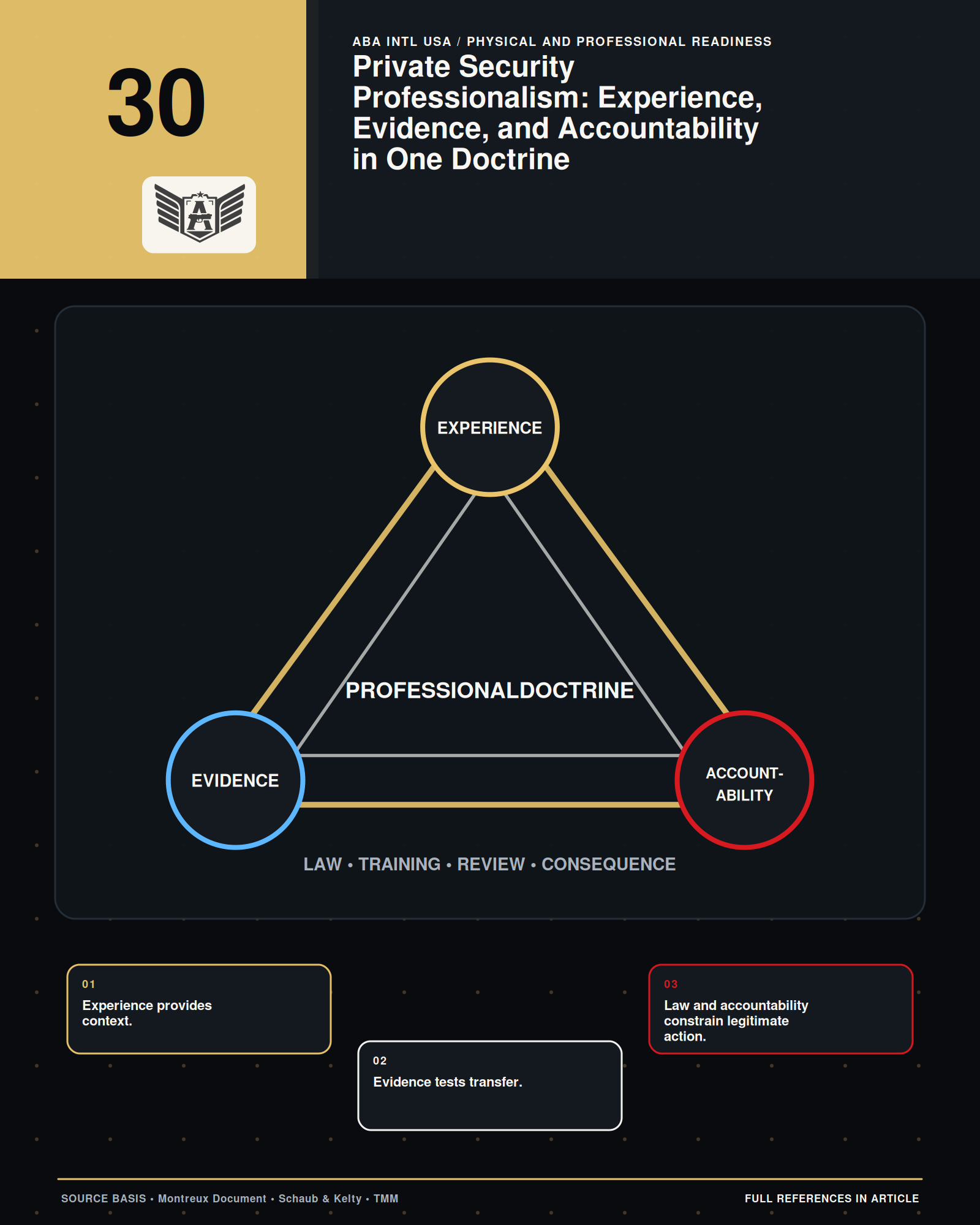
Private security professionalism exists when experience, evidence,
and accountability constrain one another. Experience identifies
realities a laboratory may miss. Evidence tests whether the proposed
response works beyond a compelling story. Law and accountability
determine whether that response should be used and who answers when it
fails. ABA doctrine can contribute by refusing generic competence claims
and building a transparent chain from training design to human
consequence.
References
Bearare, S. C., & Silveira, L. (2026). Technique-Method-Metric
Triad in firearms training under extreme stress. RECIMA21 – Revista
Científica Multidisciplinar, 7(7), e778536.
https://doi.org/10.47820/recima21.v7i7.8536
Federal Department of Foreign Affairs of Switzerland, &
International Committee of the Red Cross. (2008). The Montreux
document on pertinent international legal obligations and good practices
for states related to operations of private military and security
companies during armed conflict.
https://www.icrc.org/en/publication/0996-montreux-document-private-military-and-security-companies
Reynolds, N. (2018). Kill zone: Surviving as a private military
contractor in Iraq. Jonathan Ball Publishers.
Schaub, G., Jr., & Kelty, R. (Eds.). (2016). Private military
and security contractors: Controlling the corporate warrior. Rowman
& Littlefield.
Silveira, L. (2023). Introduction to combat shooting: Scientific
foundations, training, and application for instructors and
trainees. Editora CRV. https://doi.org/10.24824/978652514835.9
Continue from research to practice
Knowledge is useful when it changes what you do next.
Move from analysis to professional protective application through ABA | Guard.
Ask about ABA | Guard