Karlijn Kooijman, Raôul R. D. Oudejans, and R. I. Vana Hutter · Police Practice and Research · Published online March 31, 2026
A 2026 qualitative study with Dutch special-intervention personnel reframes involuntary firearm discharges as a systems and human-factors problem.
Karlijn Kooijman, Raôul R. D. Oudejans, and R. I. Vana Hutter published “‘Keep your claws off the trigger’; a focus group study on involuntary firearm discharges” online in Police Practice and Research on March 31, 2026. The study addresses involuntary firearm discharges from a perspective that differs substantially from conventional incident statistics. Instead of beginning with a database of discharge events, the researchers asked experienced special-intervention personnel to describe the conditions, behaviors, procedures, and operational pressures that they believe contribute to such incidents.
Three focus groups were conducted with members and experts associated with the Special Interventions Division of the Dutch National Police. The first two groups included operational teams of seven and six participants, while the third consisted of 13 instructors, commanders, and other subject-matter experts, producing a total sample of 26 participants. Sessions lasted approximately two hours, were audio recorded and transcribed, and were analyzed using inductive thematic analysis. The method was designed to identify recurring patterns in participants’ operational experience rather than to estimate the statistical probability of individual causes.
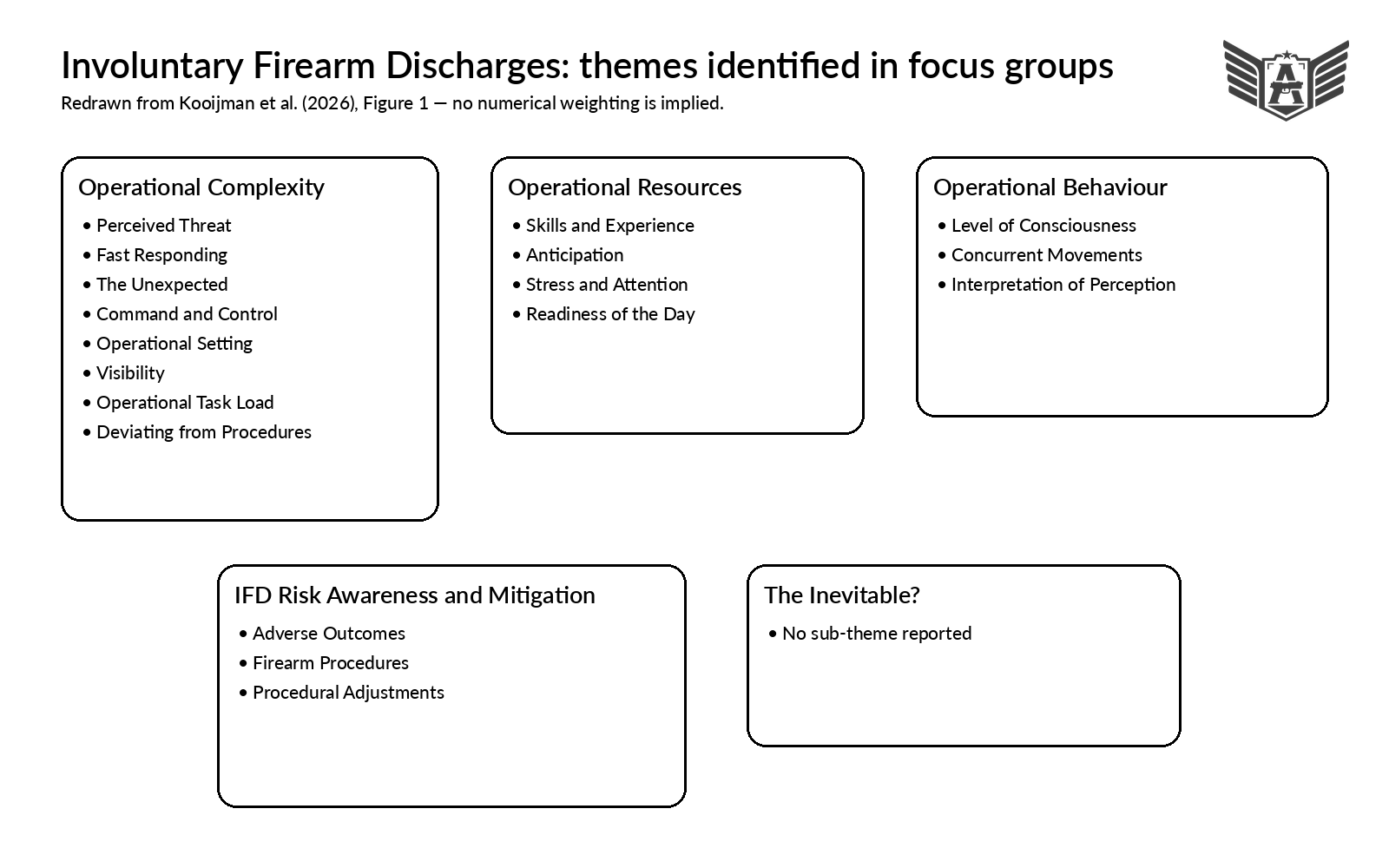
The analysis produced five overarching themes: Operational Complexity, Operational Resources, Operational Behaviour, IFD Risk Awareness and Mitigation, and “The Inevitable?”. The themes were supported by sub-themes involving perceived threat, rapid responding, unexpected events, command and control, visibility, task load, skills and experience, anticipation, stress and attention, readiness, level of consciousness, concurrent movement, interpretation of perception, firearm procedures, procedural adjustments, and other factors. The resulting structure is important because it does not reduce an involuntary discharge to a single mechanism. Instead, it presents the event as a possible endpoint of interacting personal, situational, behavioral, procedural, and motor-control influences.
This systems-oriented interpretation is directly relevant to safety training. Fundamental firearm-safety rules remain indispensable, but the existence of a simple rule does not explain every circumstance in which compliance can degrade. In a high-pressure operational environment, safe behavior occurs within a dynamic system that includes the operator, the task, other team members, equipment, movement, perceived threat, attention, fatigue, procedures, and organizational training practices. The paper therefore extends the discussion beyond individual error without eliminating individual responsibility: safety becomes stronger when training addresses both the rule itself and the conditions that can make reliable compliance more difficult.
The study is qualitative, and that limitation must remain explicit. It does not quantify the probability that any individual factor will cause an involuntary discharge, and the frequency with which a topic appeared in discussion should not be converted into a numerical risk ranking. Its contribution is mechanism identification rather than risk estimation. For evidence-based training, this distinction is useful because it suggests testable hypotheses for subsequent quantitative research while simultaneously providing a structured framework for examining procedures, task design, and training scenarios. The paper is also open access under CC BY 4.0, allowing the original thematic framework to be reproduced with appropriate attribution.
Original article visual: Open the publisher article and select Figure 1 for the original published thematic diagram. The article is CC BY 4.0.
Context and Scientific Interpretation
The purpose of this ABA Intl Science Brief is scientific communication rather than the creation of a new clinical, legal, or operational standard. Results should be interpreted within the population, measurement protocol, and statistical design used by the original investigators. Where ABA Intl has redrawn numerical results, the values are taken directly from the published article and the visualization is identified as an ABA Intl graphic rather than as an original publisher figure.
Reference
Kooijman, K., Oudejans, R. R. D., & Hutter, R. I. V. (2026). ‘Keep your claws off the trigger’; a focus group study on involuntary firearm discharges. Police Practice and Research. https://doi.org/10.1080/15614263.2026.2652259
A source-based visual summary of the study is provided below. The figure caption identifies whether it reproduces reported values, study structure, or qualitative themes.
TRAIN. MEASURE. EQUIP.
Continue learning through ABA research and training. When equipment is the next variable, go directly to the ABA Store.
GET THE EQUIPMENT →Continue from research to practice
Knowledge is useful when it changes what you do next.
Use this evidence to identify the next capability you need to build and the ABA route designed for it.
Find your ABA training path