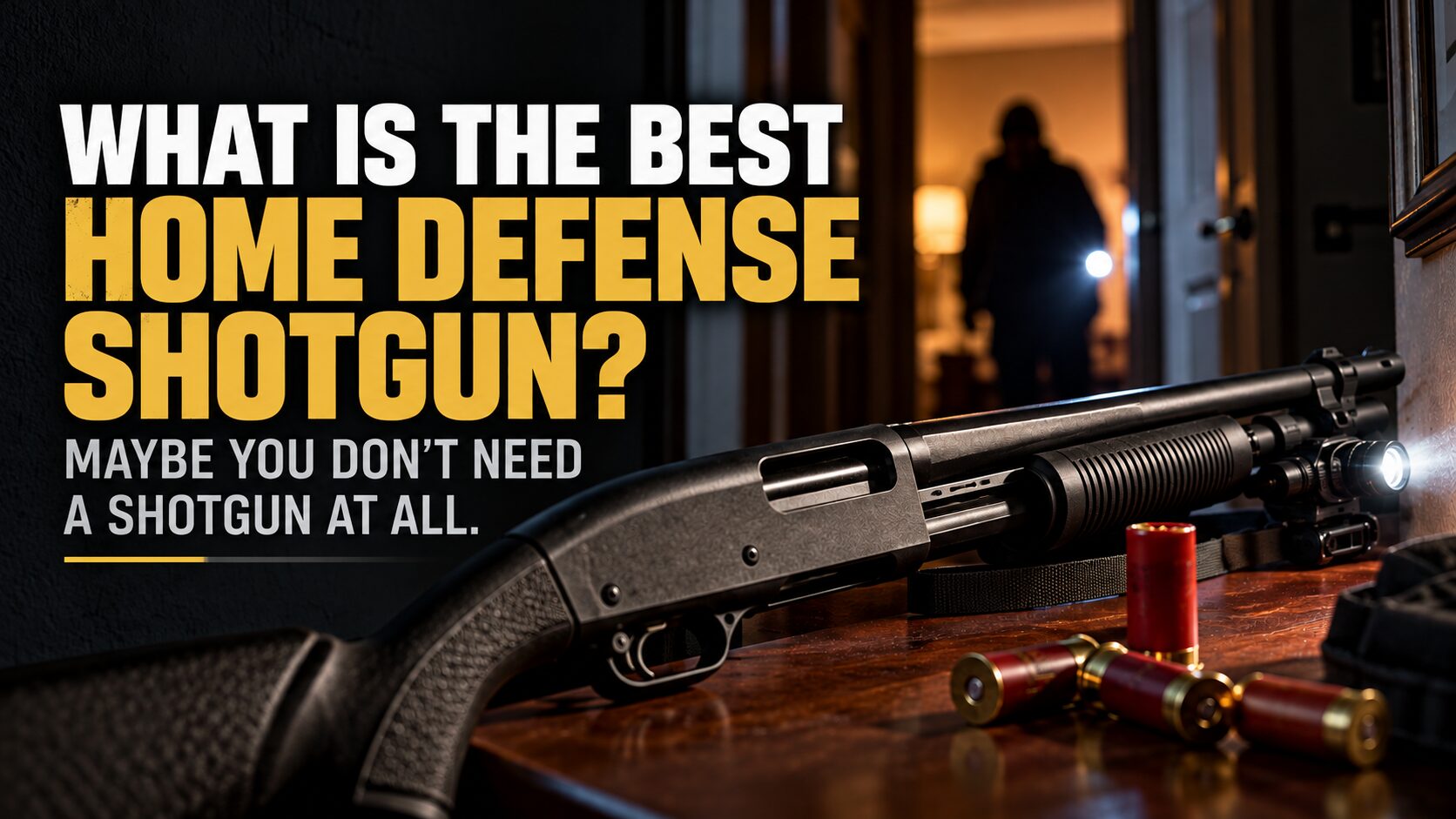
What Is the Best Home Defense Shotgun? Maybe You Don’t Need a Shotgun at All.
Around 10,000 Americans ask Google some version of this question every month. The problem is that the question already assumes a shotgun is the right answer.
That search volume tells us something important. A very large number of people are not asking whether a shotgun is appropriate for their home. They have already decided that it probably is, and they are now looking for the model someone else will call “the best.”
That assumption deserves to be challenged before we start comparing brands.
The real question is not “What is the best home-defense shotgun?” It is “What weapon best solves the home-defense problem in my environment?”
Home defense starts before the gun
We addressed this subject in 2023 in our article “10 Steps for Your Home Defense.” The basic idea has not changed: home defense is a system.
It begins with planning, physical security, lighting, locks, cameras, alarms, family communication and contingency planning. The firearm is one component of that system — not the entire system.
Read our 2023 article and build the defensive system before obsessing over the firearm.
READ: 10 STEPS FOR YOUR HOME DEFENSE →
Why does everyone assume a shotgun is ideal for home defense?
There are legitimate reasons.
Shotguns can deliver substantial terminal performance at short distance. Pump-action models can be comparatively inexpensive. A shotgun also has an extraordinary ammunition ecosystem, allowing the same basic platform to fire very different payloads.
And then there is the famous idea that a shotgun is “easier to hit with” because it fires multiple projectiles.
There is some truth in that statement — but much less than popular culture suggests.
At normal indoor distances, many defensive buckshot loads remain in a fairly compact pattern. A shotgun does not create a giant cloud of pellets that automatically covers a hallway.
You still have to aim.
You also need to know how your specific shotgun patterns with your specific ammunition.
A shotgun can simplify part of the problem
Once a shooter understands the manual of arms and can manage the recoil, a shotgun can offer a relatively direct path to useful close-range performance. Multiple projectiles can make certain shot-placement errors somewhat less punishing than with a single-projectile weapon.
That can reduce part of the precision requirement.
But it does not eliminate the training requirement.
The shooter still has to mount the gun correctly, control recoil, manipulate the action, manage the safety, understand the ammunition and know the actual pattern produced by the gun.
The problem with putting a shotgun inside a house
Now take a typical defensive shotgun with an 18- to 20-inch barrel and put it inside a bedroom, hallway, bathroom, stairwell or small apartment.
Its size suddenly matters.
A long gun is simply more physical object to manage around walls, doorframes, furniture and confined spaces than a handgun.
Then there is recoil.
A 12-gauge shotgun — particularly a light pump gun firing full-power loads — can produce substantial recoil. For smaller shooters, inexperienced shooters or people who simply dislike heavy recoil, that matters because equipment that is unpleasant to train with usually gets trained with less.
Then there is ammunition capacity.
Five, six, seven or eight shells is common in defensive shotguns. That may be entirely adequate, but it is still significantly less than the capacity available in many modern service-size pistols.
Then there is storage, weight and the fact that a long gun generally demands both hands for effective handling.
The supposedly obvious answer becomes less obvious.
For many people, a pistol is probably more useful
This is not an argument against shotguns.
It is an argument for selecting equipment based on the actual problem instead of tradition.
A handgun is compact. It is easier to maneuver through normal domestic spaces. It is easier to secure in a compact safe. It is easier to move with while opening doors, using a phone, controlling children or navigating around furniture.
Modern pistols also generally offer substantially greater ammunition capacity than tube-fed shotguns.
The tradeoff is significant: a handgun is usually harder to shoot well.
The pistol gives you portability and maneuverability while demanding greater skill from the shooter. The shotgun gives you substantial close-range performance and a more forgiving projectile system in some circumstances, but charges you in size, recoil, capacity and handling.
There is no free lunch.
For a large percentage of homeowners living in typical houses or apartments and willing to train regularly, a quality pistol may therefore be the more practical home-defense weapon.
That does not make the shotgun useless
Not every “home” is a small suburban house.
It may be a ranch, farm, rural property, estate, warehouse residence or a large house with substantial open interior spaces.
In those environments, the physical disadvantages of the shotgun become less important while its versatility can become more useful.
Few weapon platforms can match the ammunition diversity of a shotgun.
10 types of shotgun ammunition available in the American market
The American market also includes specialized products such as breaching rounds and less-lethal projectiles. Their existence demonstrates the versatility of the shotgun platform; it does not mean they belong in an ordinary civilian home-defense plan.
Pump or semi-auto?
For decades the conventional answer was simple: buy a pump shotgun.
Pump guns are comparatively inexpensive, mechanically straightforward and extremely mature designs.
Modern semi-automatic shotguns complicate that answer.
Gas-operated systems can reduce felt recoil and remove the requirement to manually cycle the action between shots. The tradeoff is usually price, mechanical complexity and sometimes greater ammunition sensitivity.
For recoil-sensitive shooters, a quality gas-operated semi-auto can therefore be a very rational choice.
What makes a good home-defense shotgun?
For the list below, the important variables are:
- Reliability — a defensive firearm needs consistent function.
- Size — shorter conventional configurations are generally easier to manage indoors.
- Capacity — useful, but not worth making the gun excessively long or heavy.
- Recoil and ergonomics — a gun you avoid practicing with is a poor choice.
- Price — additional cost should buy a meaningful performance or durability benefit.
10 home-defense shotguns worth considering
Mossberg Maverick 88 Security

It is difficult to argue with the Maverick 88 on pure cost-benefit. It uses the basic Mossberg pump architecture without the price of the more premium models.
Mossberg 590A1
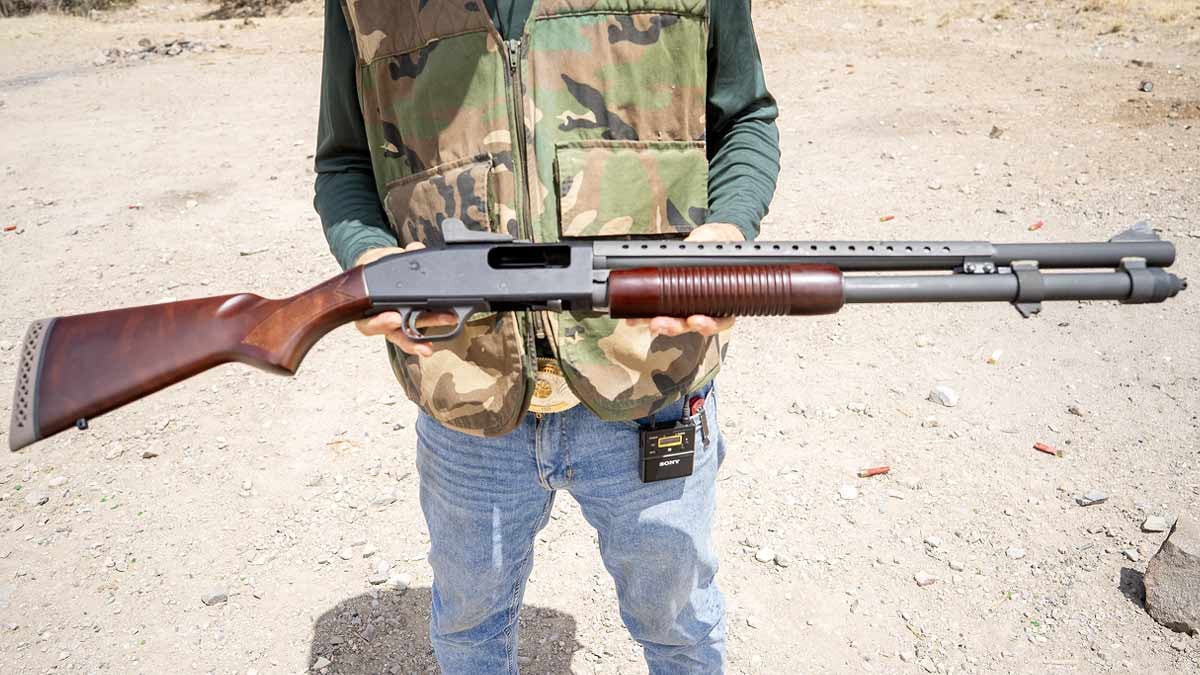
The 590A1 has earned a reputation for exceptionally robust construction. Compared with lighter sporting pumps, it is unapologetically built around durability.
Remington 870 Police / Defensive Configuration

Few shotgun designs have a longer résumé. The 870 platform remains relevant because of decades of widespread sporting, police and defensive use and a massive ecosystem of parts and configurations.
Benelli Nova Tactical

The Nova Tactical is short, durable and mechanically straightforward. Its polymer-over-steel construction is unusual but exceptionally resistant to hard use and adverse weather.
Stoeger M3000 Freedom Defense

The M3000 matters because it brings inertia-driven semi-automatic operation into a much lower price range than premium Benelli platforms.
Beretta A300 Ultima Patrol
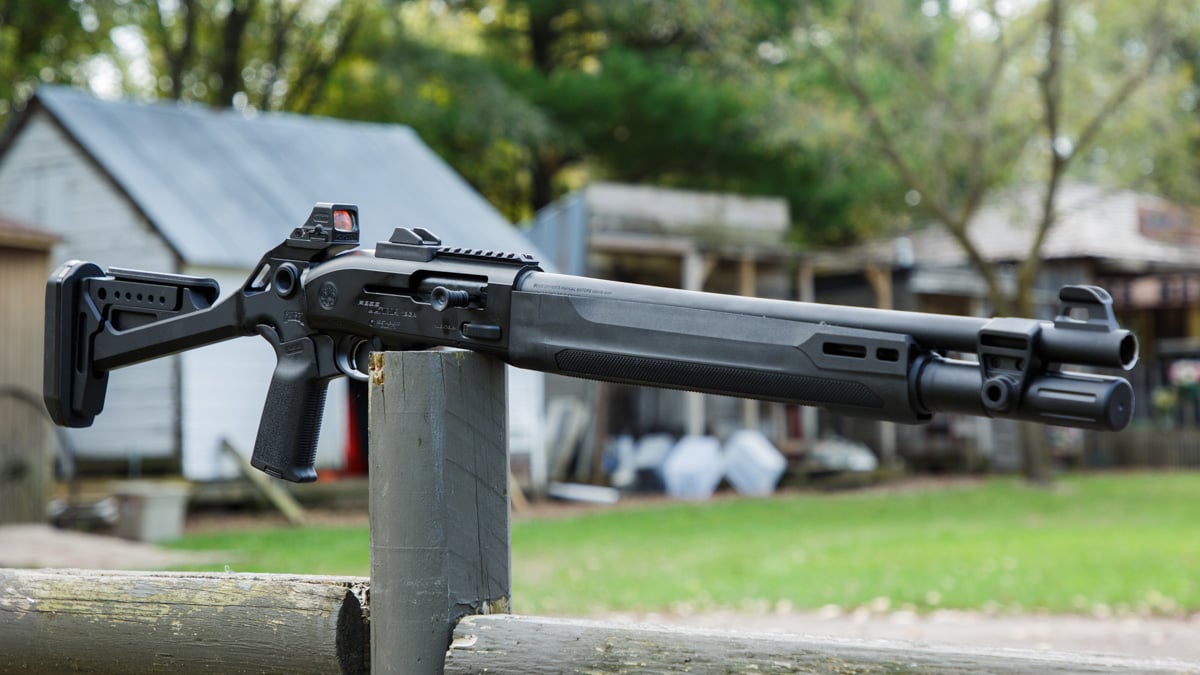
The A300 Patrol occupies an important position in the market: modern controls, good capacity and gas operation at a price well below the premium 1301 and M4 class.
Mossberg 940 Pro Tactical

The 940 Pro Tactical combines useful capacity, an 18.5-inch barrel, modern controls and a comparatively compact overall package.
Beretta 1301 Tactical Mod. 2

The 1301 is a very fast, relatively light semi-automatic platform with excellent ergonomics and a strong reputation for reliability.
Benelli M4

The M4 brings something that is difficult to replicate merely by adding features to another shotgun: a long-established reputation for hard-use reliability.
Mossberg 500
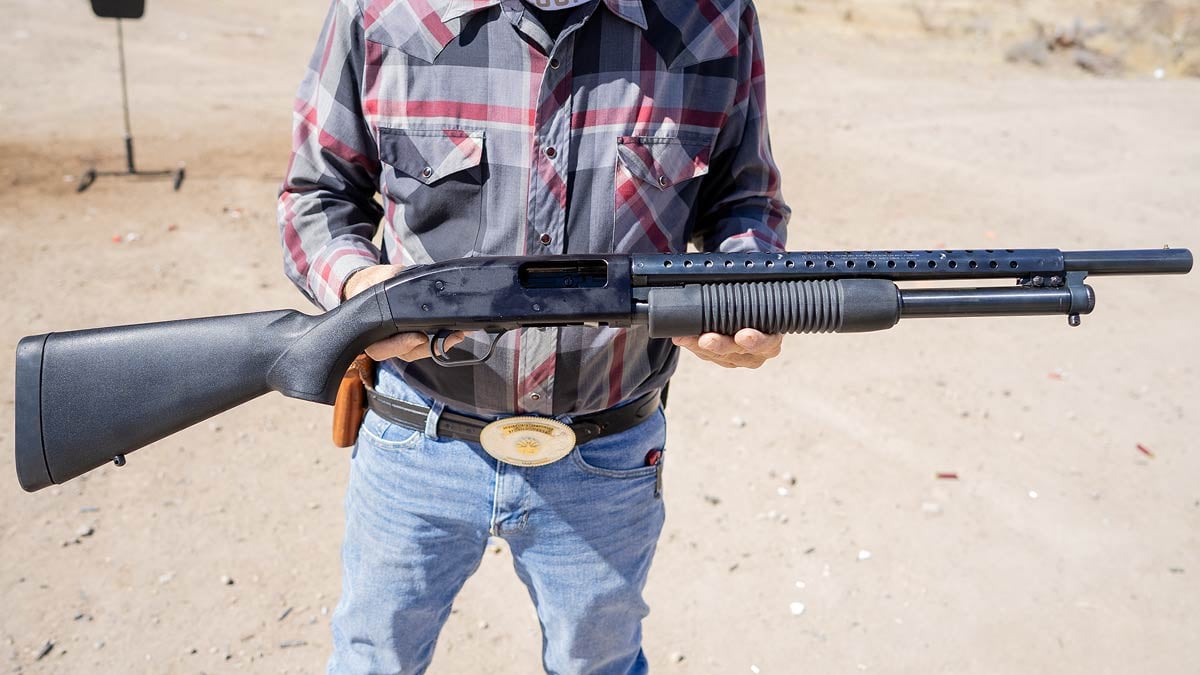
The Mossberg 500 sits exactly where many buyers need it to sit: more refined and configurable than the Maverick 88, less specialized and expensive than a 590A1, and supported by one of the largest shotgun ecosystems in America.
If we had to choose
There is no universal winner.
For sheer affordability, the Maverick 88 is difficult to beat.
For a traditional heavy-duty pump, the Mossberg 590A1 remains a benchmark.
For semi-auto cost-benefit, the Beretta A300 Ultima Patrol is exceptionally compelling.
For premium semi-auto performance, the Beretta 1301 Tactical is one of the strongest platforms in the category.
For a premium system with an extraordinary hard-use reputation, the Benelli M4 remains difficult to dismiss.
But none of those conclusions mean a shotgun is automatically the best weapon for your home.
For a large percentage of homeowners, a quality handgun combined with serious training may still be the more useful solution.
And for almost everyone, another lock, another layer of physical security, a better alarm system and a better family plan may contribute more to actual home security than replacing one perfectly functional firearm with another.
The best home-defense weapon is the one that fits inside a good home-defense system — not the one that wins a list on the internet.
Technique. Metric. Method.
ABA Intl
Product photographs are credited to Guns.com and are used here as editorial illustrations of the models discussed. Some photographs show specific variants or accessory configurations, as identified in their captions. Prices, configurations and availability change over time.
TRAIN. MEASURE. EQUIP.
Continue learning through ABA research and training. When equipment is the next variable, go directly to the ABA Store.
GET THE EQUIPMENT →Continue from research to practice
Knowledge is useful when it changes what you do next.
Establish a baseline, locate the limiting factor and measure whether training produced a real change.
Ask about ABA | Performance