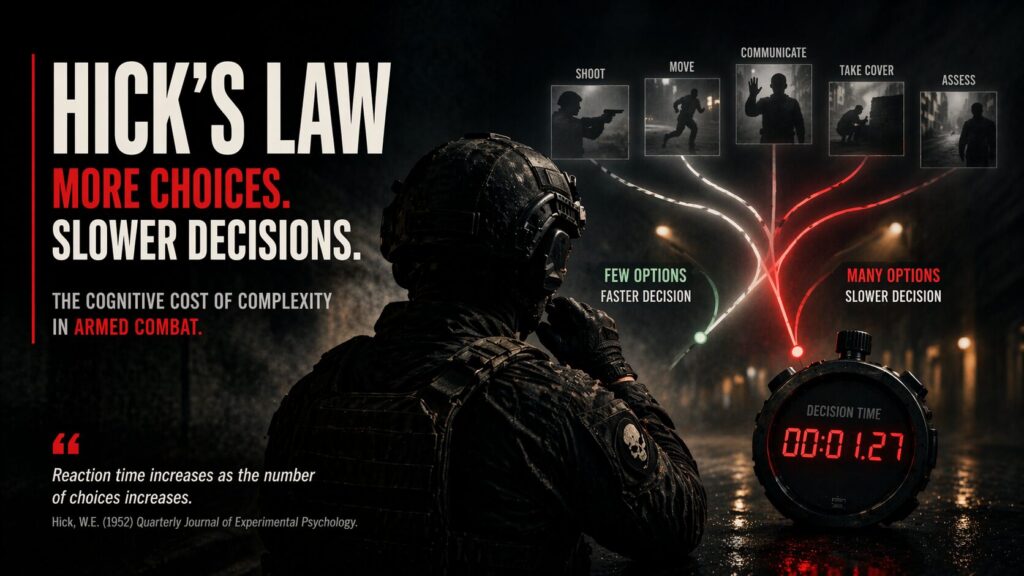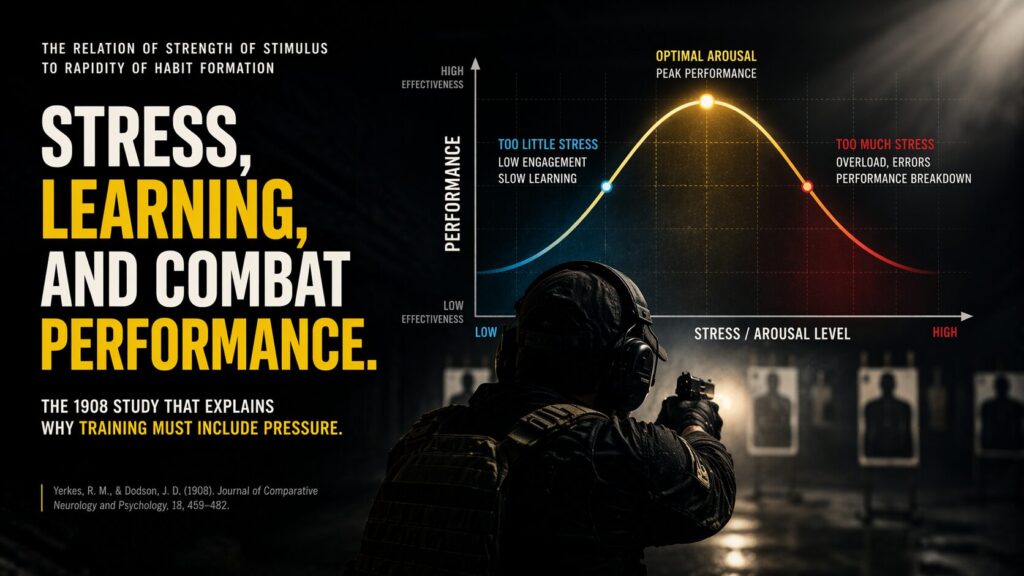
In high-risk professions such as policing, firefighting, military operations, and rescue work, self-protection is both the highest priority and the hardest skill to master. Threats appear suddenly, the environment is chaotic, and decisions must be made in fractions of a second. Under these conditions, performance depends less on physical strength and more on cognitive control—your ability to stay focused, process information, and act (or refrain from acting) under extreme pressure.
A new systematic review by Christiane B. Spiegel and Christine Sutter (2025) presents one of the most comprehensive examinations ever conducted on the trainability of executive functions (EFs) for police and military applications. These functions—shifting, updating, and inhibition—are the brain’s command system for rapid decision-making.
What the review reveals has significant implications for tactical training, decision accuracy, and the prevention of tragic errors like unnecessary shootings or friendly fire.
Why Executive Functions Matter in Tactical Work
Police and military personnel must constantly scan for threats, control their gaze, maintain situational awareness, and manage high stress. Under danger, cognitive load skyrockets, making it harder to:
- process visual information
- detect weapons or suspicious movement
- decide whether to use force
- inhibit automatic reactions
- avoid tunnel vision
Stress hormones (epinephrine, norepinephrine, cortisol) surge during life-threatening moments, boosting alertness but also risking cognitive overload, impaired decision-making, and motor errors.
Therefore, improving executive control under stress is not optional—it is a survival skill.
What the Review Investigated
Using PRISMA guidelines, the authors examined studies from psychology, policing, and the military to answer two major questions:
- Are executive functions trainable?
- Do these gains transfer to real-world police and military tasks?
After screening over 12,000 publications, only six studies met the strict criteria of EF training and transfer relevant to policing.
These studies ranged from laboratory cognitive research to live-fire police training scenarios.
The Three Executive Functions That Matter Most
1. Shifting
The ability to switch rapidly between tasks, mental sets, or rules.
Measured using:
- plus–minus tasks
- letter–number tasks
Shifting supports risk perception consistency, allowing officers to adapt quickly when situations change unpredictably.
2. Updating
Working memory ability to integrate new information and discard irrelevant data.
Measured using:
- n-back tasks
- letter-memory tasks
Updating helps maintain situational awareness in dynamic environments.
3. Inhibition
The most critical and most studied.
It is the ability to suppress automatic or inappropriate responses, such as firing too early.
Measured using:
- go/no-go tasks
- stop-signal tasks
- Stroop tasks
Weak inhibition is directly associated with friendly fire, premature shots, unintended casualties, and choking under pressure.
Major Findings of the Review
1. Executive functions can be trained—but unevenly
Among the EF components:
- Shifting showed strong training gains
- Inhibition showed very strong gains
- Updating showed moderate, reliable gains
The most effective tasks for improvement were:
- number-letter task (shifting)
- Stroop task (inhibition)
- stop-signal task (inhibition)
These produced the largest performance increases.
2. Transfer to real-world tasks depends on similarity
The closer the training task matches the target skill, the better the transfer.
This is the classic near-transfer vs. far-transfer principle.
Examples:
- Minear & Shah (2008):
Training improved task switching, but transfer occurred only when the structure of the new task was very similar.
Hofmann & Förster (2019):
Despite strong training gains, their five-week program did not transfer well to new dissimilar tasks.
This means:
pure brain-training apps won’t improve police performance unless they are highly specific to tactical decision contexts.
3. Inhibition is the most transferable—and the most crucial
Across studies, inhibition consistently predicted better decisions, especially:
- distinguishing threat vs. non-threat
- reducing false positives (shooting unarmed people)
- reducing civilian casualties
- maintaining control under stress
Biggs & Pettijohn (2022):
Lower stopping ability increased the likelihood of unintended casualties in simulations.
Hamilton et al. (2019):
Officers trained in inhibition improved shoot/don’t-shoot accuracy from 64% to 83%, while the control group showed no meaningful change.
Heusler & Sutter (2022):
In a realistic live-fire scenario, cadets who trained gaze control and inhibition increased shoot/don’t-shoot accuracy from 67% to 96%.
This confirms what many tactical instructors already believe:
Impulse control is the backbone of correct use-of-force decisions.
4. Cognitive training is most effective when combined with tactical skills
The authors conclude that no executive function should be trained in isolation.
The best approach is integrated training where EF development is built into:
- tactical gaze control
- threat recognition drills
- shoot/don’t-shoot scenarios
- stress exposure
- decision-making under time pressure
This integrates brain plasticity with real operational behavior.
Practical Takeaways for Tactical Training
1. Train inhibition deliberately
Use structured go/no-go and stop-signal tasks, then transition to dynamic tactical scenarios.
2. Train gaze control
Visual search and attention management dramatically improve threat detection and decision accuracy.
3. Use realistic scenarios
Training must simulate stress, threat ambiguity, and time pressure to produce meaningful transfer.
4. Combine EF training with physical/tactical training
The review shows that mixed programs produce the strongest improvements.
5. Avoid oversimplified “brain games”
Lab gains don’t transfer unless the tasks resemble real operational demands.
Final Conclusion
This review provides a clear roadmap for improving police and military performance:
- Executive functions are trainable.
- Inhibition is the single most important predictor of correct use-of-force decisions.
- Transfer to real-world policing only occurs when training resembles tactical reality.
- The most effective programs combine cognitive, perceptual, and live-fire components.
In a world where officers face unpredictable threats, improving the brain’s ability to process information, control impulses, and make rapid decisions is just as important as firearms proficiency.
This research reinforces a powerful truth:
Better cognitive control leads to fewer errors, better survival, and safer communities.
Spiegel, C. B., & Sutter, C. (2025).
Training and transfer of executive functions for police- and military-related tasks.
Journal of Police and Criminal Psychology. Advance online publication.
https://doi.org/10.1007/s11896-025-09789-9
Continue from research to practice
Knowledge is useful when it changes what you do next.
Move from analysis to professional protective application through ABA | Guard.
Ask about ABA | Guard