
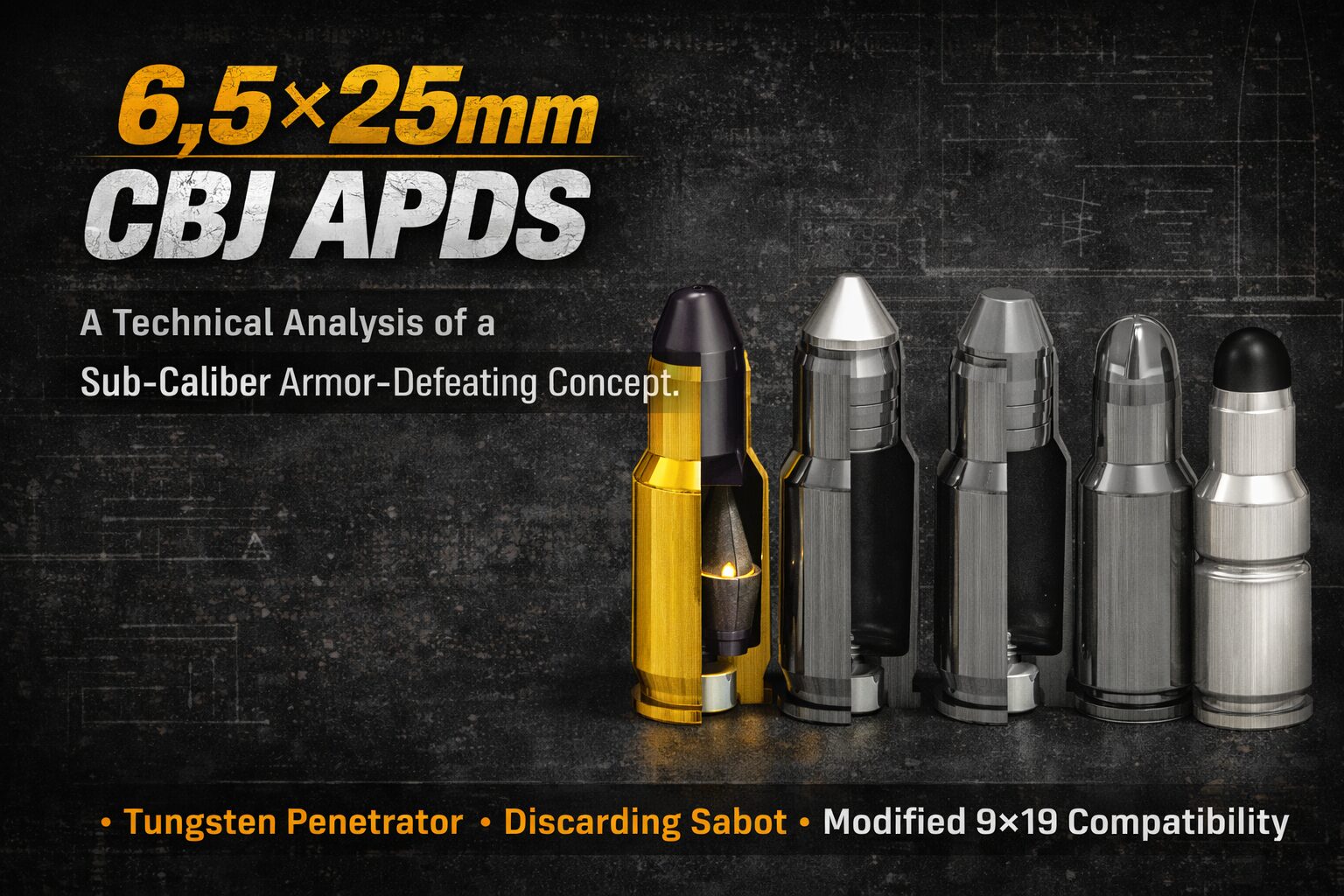
The 6.5×25mm CBJ APDS represents a technically ambitious attempt to solve a modern ballistic problem: how to increase armor penetration from compact weapon platforms without transitioning to full rifle systems.
Developed by the Swedish firm CBJ Tech AB, the cartridge applies a principle more commonly seen in large-caliber munitions—Armor-Piercing Discarding Sabot (APDS)—to small arms.
Design Architecture
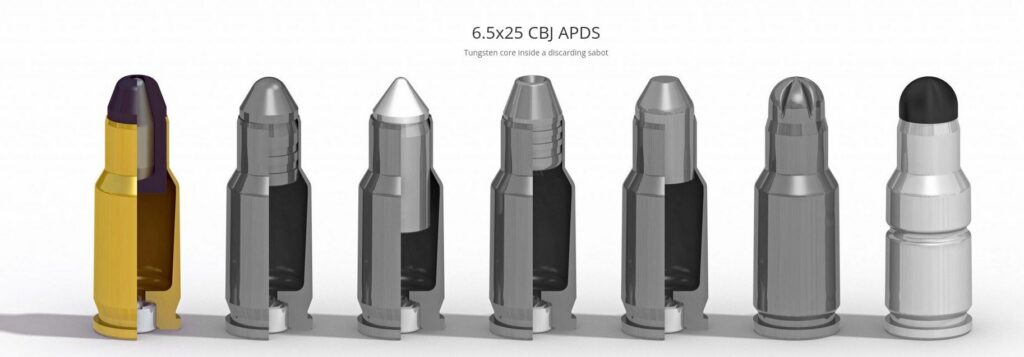
The 6.5×25mm CBJ utilizes a modified 9×19mm case to launch a sub-caliber 6.5mm tungsten penetrator. The projectile is encased in a lightweight polymer sabot that separates immediately upon exiting the muzzle. Once the sabot discards, the high-density penetrator continues toward the target at significantly elevated velocity.
This approach achieves several ballistic objectives:
- Extremely high muzzle velocity (approximately 800 m/s depending on barrel length)
- Reduced frontal area
- Increased sectional density
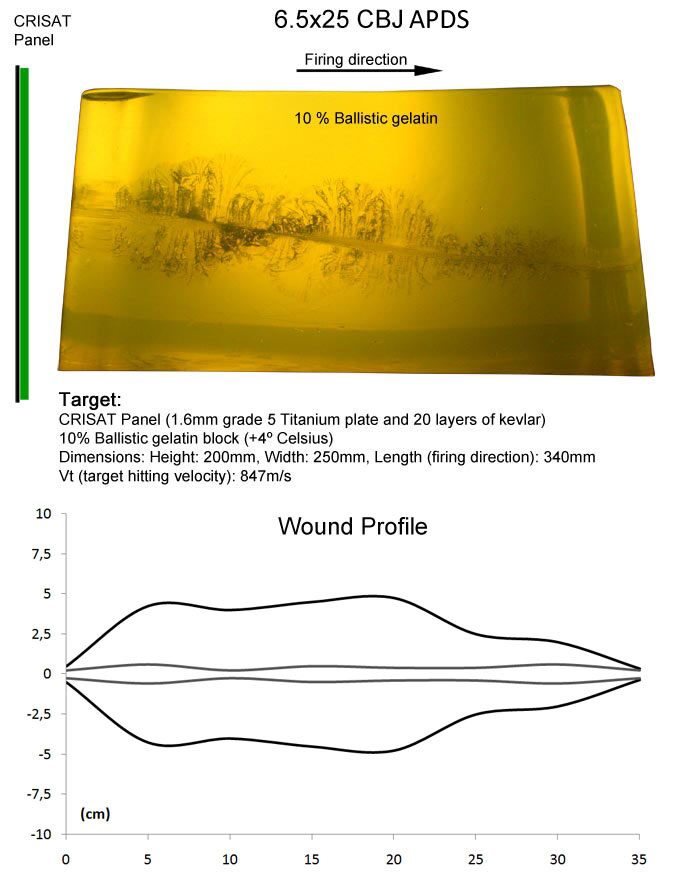
- Enhanced soft armor penetration capability
The cartridge was specifically engineered to defeat NIJ Level IIIA soft body armor under appropriate conditions, placing it conceptually alongside other Personal Defense Weapon (PDW) cartridges such as the FN 5.7×28mm and the HK 4.6×30mm.
Platform Compatibility
One of the CBJ system’s primary design philosophies was logistical practicality. Rather than introducing an entirely new weapon platform, the cartridge was developed to function in converted 9mm systems with a barrel replacement.
Key implications:
- Retention of standard 9mm magazine geometry
- Minimal training transition for operators
- Reduced acquisition cost compared to adopting entirely new PDW platforms
This approach sought to provide agencies and military units with an incremental capability upgrade rather than a wholesale platform replacement.
Tactical Relevance
The emergence of widespread soft body armor use in both military and law enforcement contexts created a performance gap for traditional handgun calibers. While rifle calibers easily defeat such protection, they introduce increased recoil, weapon size, and logistical complexity.
The 6.5×25mm CBJ attempts to bridge that gap by delivering:
- Compact weapon controllability
- Flat trajectory at extended handgun/SMG distances
- Enhanced barrier and armor performance
However, despite its technical merits, adoption has remained limited. Factors such as cost (tungsten core), specialized logistics, and the entrenchment of competing PDW systems have constrained widespread implementation.
Final Assessment
From a purely engineering standpoint, the 6.5×25mm CBJ APDS is an elegant ballistic solution. It demonstrates how projectile physics—velocity, density, sectional area—can be leveraged to produce performance gains without scaling up caliber.
While it has not achieved mainstream institutional adoption, it remains an instructive case study in applied small-arms innovation and armor-defeat doctrine.
At ABA Intl USA, we analyze developments like this not for marketing appeal, but for what they teach us about design philosophy, ballistic efficiency, and real-world application.
Understanding the technology is understanding the doctrine behind it.
Souce: https://cbjtech.com/ammunition/6-5×25-cbj/6-5×25-cbj-apds/