
Most training failures are not caused by a total absence of effort.
They are caused by broken links between observation and action. A
shooter performs a task, an instructor notices something, a drill is
prescribed, and improvement is assumed because the session felt
demanding. The chain contains activity but not control. The TMM
Triad—Technique, Metrics, Method—was developed to close that loop by
requiring every intervention to answer three linked questions: what
solution is being executed, how will its performance be observed, and
why is this training method appropriate for the diagnosed
limitation?
Technique is the organized solution used to accomplish a task. It
includes posture, access, grip, movement path, visual behavior, timing,
equipment interaction, and the coordination among them. Technique is not
a sacred sequence of externally visible positions. It is a functional
arrangement constrained by the performer, equipment, environment, and
objective. Introduction to Combat Shooting places biomechanical
analysis inside the larger problem of training and application, which
prevents technique from becoming choreography detached from consequences
(Silveira, 2023).
Metrics are observations translated into defensible records. Time,
accuracy, spread, valid rate, decision error, consistency, and technical
ratings are all possible metrics, but none is automatically meaningful.
A metric must correspond to the task and retain the failure modes that
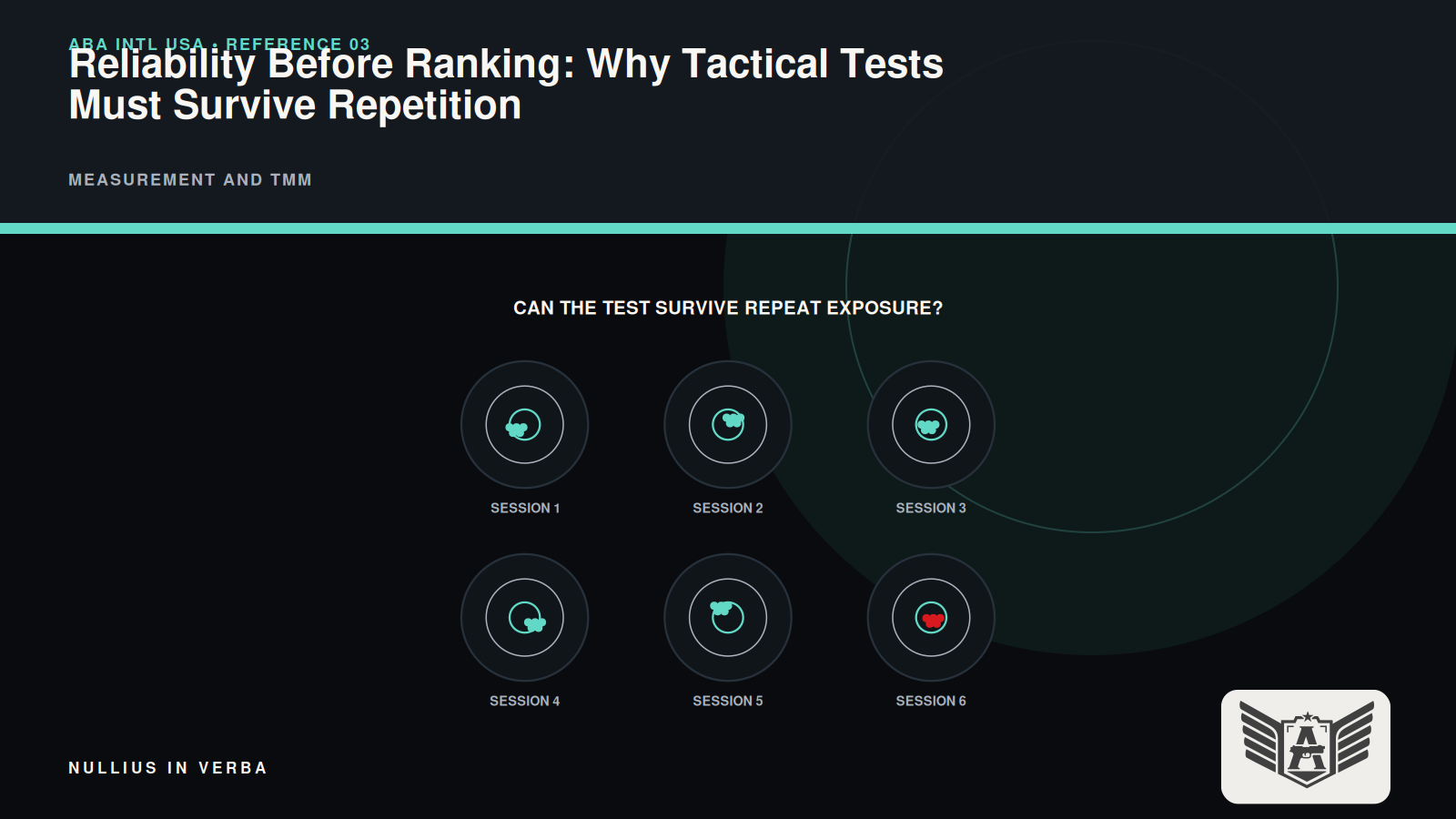
matter. Morrow et al. (2011/2014) show why reliability and validity are
separate requirements: a score can repeat consistently while measuring
the wrong construct, or it can target a relevant construct so unreliably
that change cannot be detected.
Method is the organized intervention selected to alter performance.
It includes practice structure, feedback schedule, task difficulty,
repetition distribution, pressure exposure, and retest timing. A drill
is not a method merely because it has a name. The method exists in the
rationale connecting the drill to the constraint. If two shooters have
the same average time but one is limited by garment access and the other
by target confirmation, giving both the same “speed drill” ignores the
diagnosis and converts coaching into ritual.
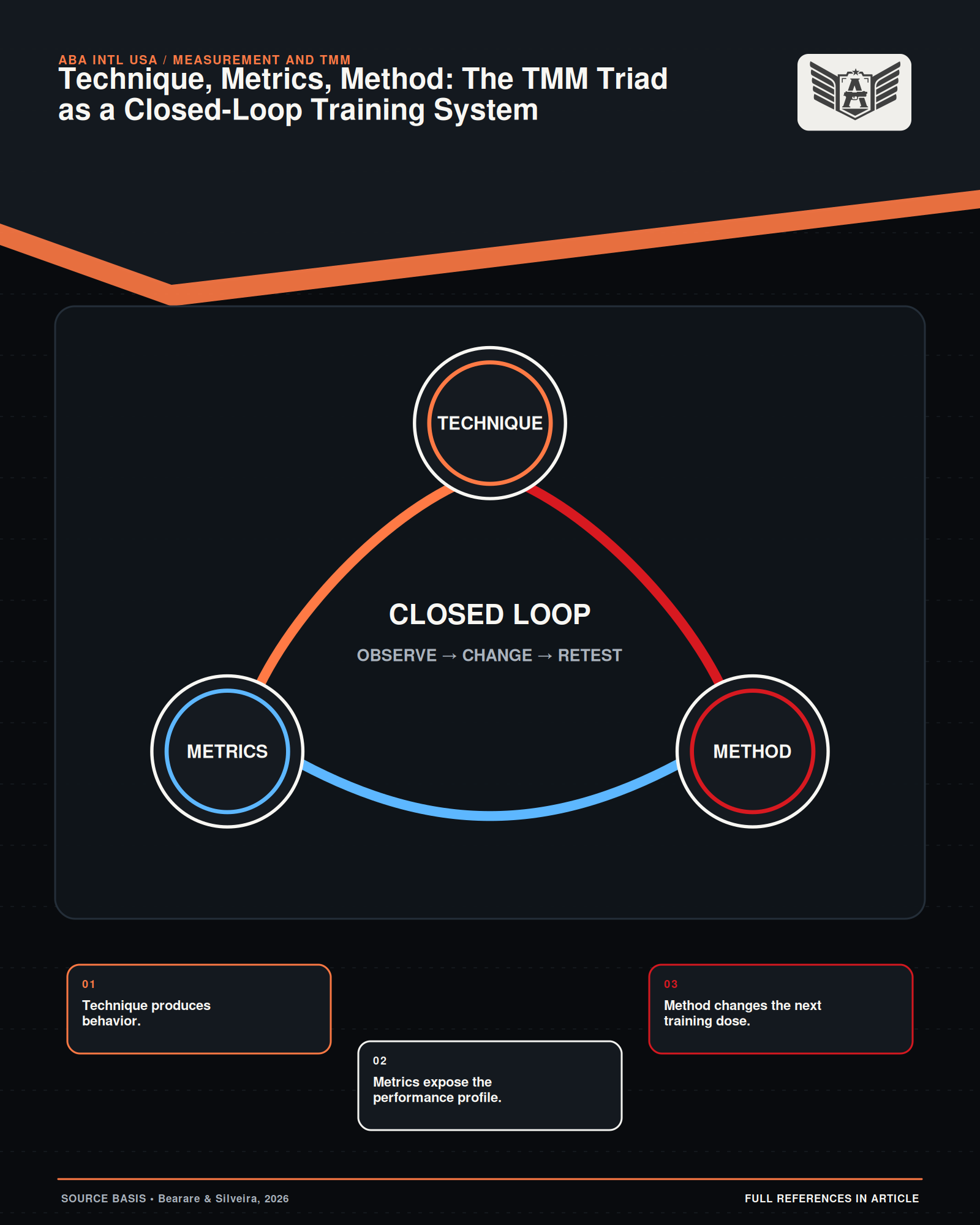
The order Technique–Metrics–Method is conceptual, but the system is
circular. The task defines the technical demand. Measurement describes
how the current solution behaves. Diagnosis selects a method. Training
changes the solution. Retesting returns data to the system. The result
may confirm the hypothesis, reveal a secondary constraint, or show that
the method failed. Bearare and Silveira (2026) present TMM as a bridge
between motor learning, stress science, deliberate practice, and field
pedagogy; its strength lies in making revision an expected part of
training rather than an admission of instructor weakness.
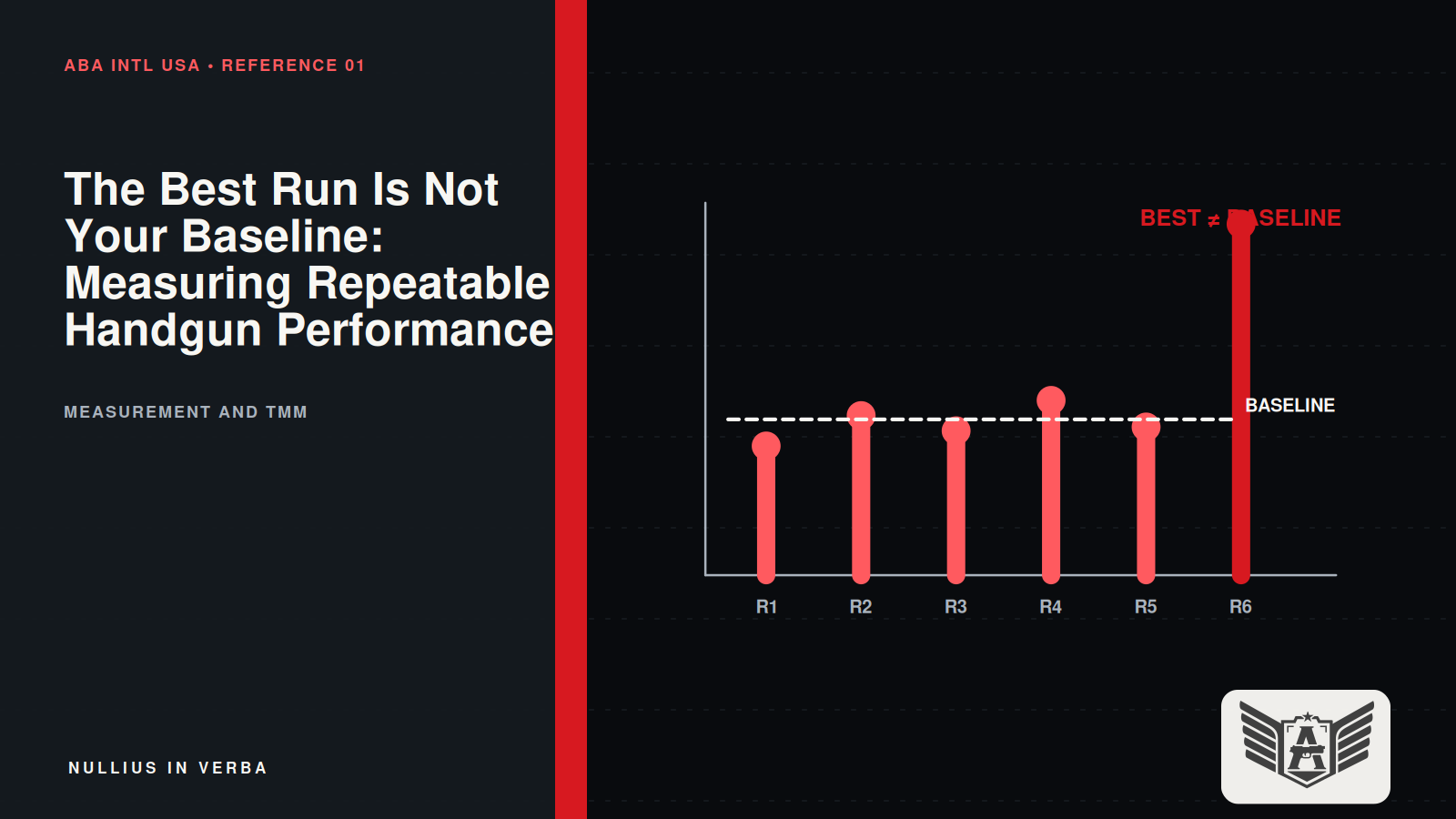
A closed loop requires a stable reference. Without a baseline, the
instructor cannot distinguish change from impression. The baseline does
not need to be elaborate, but it must preserve the variables relevant to
the claim. For a draw, that may include raw times, validity, spread,
equipment, and task conditions. For a decision scenario, it may include
response selection, latency, accuracy, and observable information use.
The baseline limits memory’s tendency to convert a good final repetition
into a story of general improvement.
Diagnosis is the intellectual center of TMM. The same visible outcome
can have different causes, and the same technical feature can produce
different consequences across performers. A late shot may reflect
access, presentation, visual processing, target difficulty, or decision
uncertainty. Video can reveal movement sequence but not automatically
identify the governing constraint. Metrics narrow the hypothesis;
instructor observation, learner report, and task manipulation test it.
The diagnosis should state its confidence and the evidence that could
disconfirm it.
The method should manipulate the suspected constraint while
minimizing unrelated noise. If grip acquisition is inconsistent, the
practice task should expose and stabilize access without overwhelming
the performer with unnecessary decision branches. If transfer under
pressure is the limitation, isolated repetitions may no longer provide
the needed information. Guadagnoli and Lee’s (2004) challenge-point
framework is useful because it treats task difficulty as relative to
performer skill. More chaos does not mean more learning; the optimal
information load changes as capability changes.
Feedback must be part of the method rather than continuous instructor
narration. Constant correction can improve the visible acquisition
session while creating dependence. Chiviacowsky and Wulf (2005) found
that self-controlled feedback can support learning when connected to the
learner’s performance and error estimation. TMM therefore asks not only
what feedback is given but when, how often, and for what purpose. A
method should eventually return control of detection and correction to
the performer.
Pressure exposure follows the same logic. Nieuwenhuys and Oudejans
(2011) reported that training with anxiety improved later police
shooting behavior under pressure, while Oudejans (2008) found benefits
from reality-based practice. These results do not justify indiscriminate
stress. They support representative, progressive exposure in which the
source of pressure, targeted skill, safety controls, and performance
measures are explicit. O Cérebro Sob Fogo uses the science of
extreme stress to challenge simplistic ideas about mindset; arousal is a
variable to manage, not a badge of authenticity (Silveira & Bearare,
2026).
Retesting must be capable of proving the method wrong. If the
post-test changes conditions, scoring, or exclusion rules, the loop
becomes self-protective. The most favorable outcome is not always a
faster average. A narrower spread, higher valid rate, improved decision
accuracy, or reduced degradation under pressure may be the intended
adaptation. The expected direction of change should be written before
the method begins, along with a time horizon and a rule for modification
if the result fails to appear.
TMM also distinguishes training from testing. Testing samples
capability and produces information; training uses information to create
adaptation. Repeating the same maximum-effort test every session can
generate scores without building the limiting capacity. Conversely,
training without periodic tests can feel productive while drifting away
from the objective. A mature program alternates the two deliberately:
test enough to steer, train enough to adapt, and retest only when the
intervention has had a plausible opportunity to work.
The system scales from one shooter to an organization. At the
individual level, TMM structures a short correction cycle. At the
instructor level, it creates a documented reason for drill selection. At
the program level, aggregated metrics reveal common bottlenecks, ceiling
effects, injury patterns, and gaps between qualification and transfer.
The same loop can evaluate curriculum: define the intended competence,
measure it appropriately, examine where learners fail, change the
instructional method, and test again.
Ethics are built into the architecture. Armed instruction carries
consequences beyond entertainment and personal identity. A method that
increases speed while lowering hit validity or decision accuracy has not
simply produced a tradeoff; it may have increased risk. A test that
flatters students by hiding invalid attempts may improve customer
satisfaction while damaging calibration. TMM makes the instructor
accountable to the complete performance profile rather than to the
emotional success of the class.
The triad is therefore incompatible with drill collecting. A library
of exercises can be useful, but exercises become methods only when
selected for a reason. The same drill may stabilize a novice, challenge
an intermediate performer, or waste an expert’s time. Ericsson et
al. (1993) described deliberate practice as effort directed at specific
weaknesses with feedback and repetition, not as accumulated hours alone.
TMM operationalizes that principle in armed training by placing
diagnosis before volume.
The practical implementation can remain simple. Define the task and
validity rule. Record a baseline. Identify the primary constraint and
the evidence supporting that hypothesis. Select one method that
manipulates the constraint. Specify dose, feedback, and safety controls.
Retest under comparable conditions. Compare the complete profile. Keep,
modify, or abandon the method. The written record need not be
bureaucratic; it needs to be precise enough that another instructor can
understand why the decision was made.
TMM’s deepest claim is epistemic. Instructors are not valuable
because they never err. They are valuable because they can build
procedures that detect error and convert it into better training.
Technique without metrics becomes aesthetic authority. Metrics without
method become scorekeeping. Method without technique becomes random
activity. Connected in a closed loop, the three create a doctrine that
can learn. That is the operational meaning of Nullius in Verba:
do not reject experience, but require experience to enter a system where
claims can be measured, challenged, and revised.
References
Bearare, S. C., & Silveira, L. (2026). Technique-Method-Metric
Triad in firearms training under extreme stress. RECIMA21 – Revista
Científica Multidisciplinar, 7(7), e778536.
https://doi.org/10.47820/recima21.v7i7.8536
Chiviacowsky, S., & Wulf, G. (2005). Self-controlled feedback is
effective if it is based on the learner’s performance. Research
Quarterly for Exercise and Sport, 76(1), 42–48.
https://doi.org/10.1080/02701367.2005.10599260
Ericsson, K. A., Krampe, R. T., & Tesch-Römer, C. (1993). The
role of deliberate practice in the acquisition of expert performance.
Psychological Review, 100(3), 363–406.
https://doi.org/10.1037/0033-295X.100.3.363
Guadagnoli, M. A., & Lee, T. D. (2004). Challenge point: A
framework for conceptualizing the effects of various practice conditions
in motor learning. Journal of Motor Behavior, 36(2), 212–224.
https://doi.org/10.3200/JMBR.36.2.212-224
Morrow, J. R., Jr., Jackson, A. W., Disch, J. G., & Mood, D. P.
(2011). Measurement and evaluation in human performance (4th
ed.). Human Kinetics. [Portuguese edition: Artmed, 2014.]
Nieuwenhuys, A., & Oudejans, R. R. D. (2011). Training with
anxiety: Short- and long-term effects on police officers’ shooting
behavior under pressure. Cognitive Processing, 12(3), 277–288.
https://doi.org/10.1007/s10339-011-0396-x
Oudejans, R. R. D. (2008). Reality-based practice under pressure
improves handgun shooting performance of police officers.
Ergonomics, 51(3), 261–273.
https://doi.org/10.1080/00140130701577435
Silveira, L. M. da. (2023). Introduction to combat shooting:
Scientific foundations, training, and application for instructors and
trainees. Editora CRV. https://doi.org/10.24824/978652514835.9
Silveira, L. M. da, & Bearare, S. C. (2026). O cérebro sob
fogo: O que o estresse extremo faz com a mente e o corpo do
atirador. Editora Ludus.
TRAIN. MEASURE. EQUIP.
Continue learning through ABA research and training. When equipment is the next variable, go directly to the ABA Store.
GET THE EQUIPMENT →Continue from research to practice
Knowledge is useful when it changes what you do next.
Establish a baseline, locate the limiting factor and measure whether training produced a real change.
Ask about ABA | Performance